The Bohr Model
of Atomic Structure
Explore how quantized energy levels explain atomic spectra, electron transitions, and the foundations of modern quantum mechanics.
Why Do We Need the Bohr Model?
By the early 1900s, classical physics predicted that orbiting electrons should continuously radiate energy and spiral into the nucleus. Atoms should be unstable, yet matter clearly exists. Niels Bohr resolved this crisis in 1913 by proposing that electrons occupy discrete, stable orbits with quantized energy.
Key Terms in Atomic Structure
Visualizing the Hydrogen Atom
Bohr's Three Postulates
The Energy Level Equation
The negative sign means the electron is bound to the nucleus. Energy must be added (positive) to move it to a higher level or free it entirely.
Energy Level Diagram
Three source conditions at one spectrometer
 A dense thermal source produces a continuum, an excited dilute gas produces emission lines, and cooler gas in front of a continuum can produce absorption lines. Photon energies match allowed atomic energy differences.
Hydrogen energy-level transitions
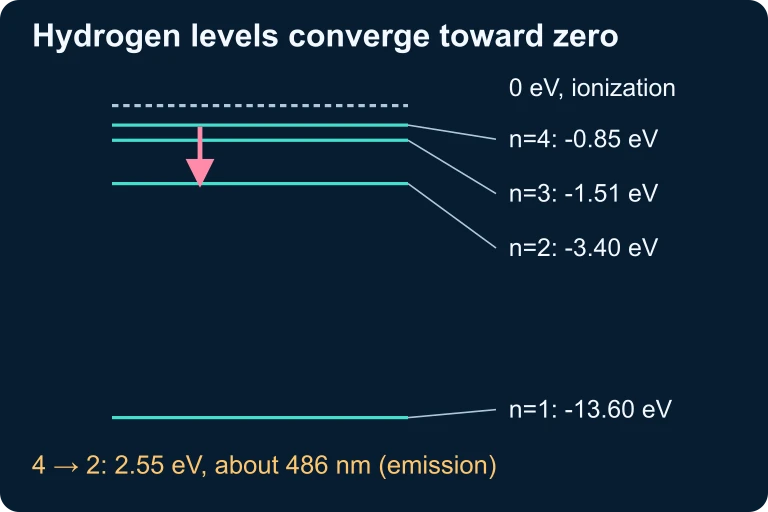 Hydrogen levels follow Eₙ = −13.6/n² eV and approach the ionization threshold at zero. The n = 4 to n = 2 transition emits a photon of 2.55 eV, corresponding to about 486 nm.
Photon Energy and Wavelength
This is exactly the Rydberg formula rewritten in terms of energy. The Bohr model predicts it from first principles.
Orbit Radius Formula
Orbits grow rapidly with \( n \): the spacing between levels increases as \( n^2 \), meaning higher orbits are much farther from the nucleus.
Bohr vs. Classical Model
| Bohr Model | Classical Model | |
|---|---|---|
| Electron orbits | Only quantized orbits allowed | Any orbit radius is possible |
| Energy | Discrete energy levels | Continuous energy values |
| Radiation | Only during transitions | Continuous radiation (spiral inward) |
| Stability | Stable ground state | Unstable: electron collapses into nucleus |
| Spectra | Predicts line spectra | Predicts continuous spectra |
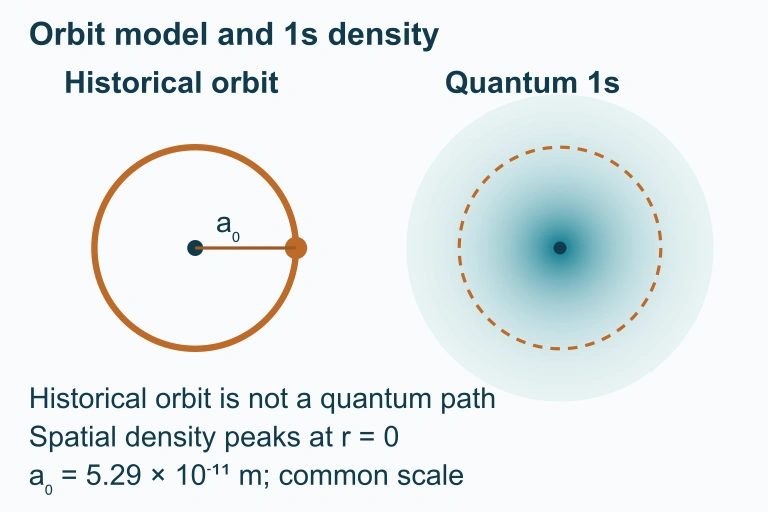
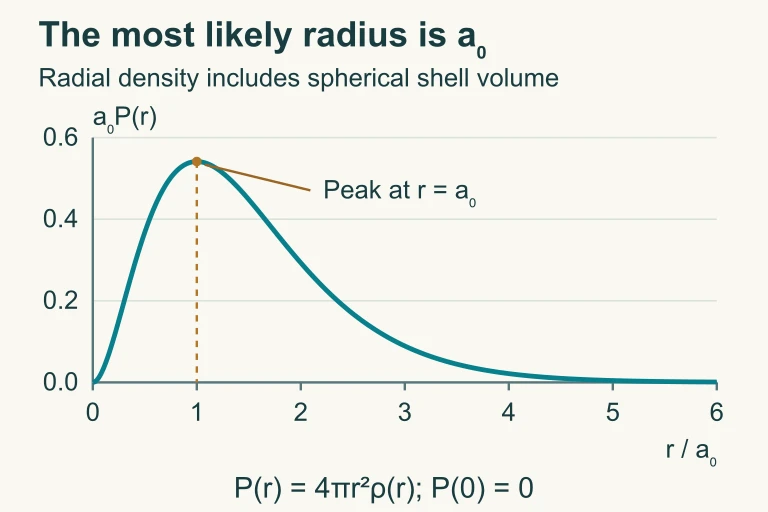
Orbit model and quantum probability
The historical orbit is not a quantum trajectory. The 1s spatial density peaks at the nucleus, while radial probability includes shell volume and peaks at the Bohr radius.
Hydrogen Spectral Series
How to Solve Bohr Model Problems
Example 1: Photon Emission
An electron in a hydrogen atom drops from \( n = 3 \) to \( n = 1 \). Find the energy and wavelength of the emitted photon.
Example 2: Balmer Series Transition
Find the wavelength of the first line of the Balmer series: the transition from \( n = 3 \) to \( n = 2 \).
Example 3: Ionization Energy
How much energy is needed to ionize a hydrogen atom from the ground state?
Common Mistakes to Avoid
Question 1 of 5
What is the energy of an electron in the \( n = 4 \) level of hydrogen?
Question 2 of 5
An electron transitions from \( n = 4 \) to \( n = 2 \). What is the energy of the emitted photon?
Question 3 of 5
Which spectral series of hydrogen produces visible light?
Question 4 of 5
The radius of the \( n = 3 \) orbit in hydrogen is approximately:
Question 5 of 5
A photon with energy 12.09 eV strikes a hydrogen atom in the ground state. What happens?