Specific Heat &
Thermal Conductivity
Understand how materials store and transfer thermal energy: the two fundamental thermal properties that govern temperature change and heat flow.
What is Thermal Energy?
Thermal energy is the total kinetic energy of all molecules within a substance. When you heat something, you increase the random motion of its particles. Two key questions arise:
Defining Specific Heat \(c\)
Specific heat capacity \(c\) is the amount of energy required to raise the temperature of one kilogram of a substance by one kelvin (or one degree Celsius).
Separate equal-heat comparison
Neglecting heat losses and vessel heat capacity, each 0.10 kg sample receives 100 J. Equal masses do not imply equal volumes.
Compare the temperature rises of copper and water for c = 385 and 4186 J/(kg·K), respectively.
Show answer and explanation
Using ΔT = Q/(mc), copper rises about 2.597 K and water about 0.239 K. This compares specific heat, not thermal conductivity.
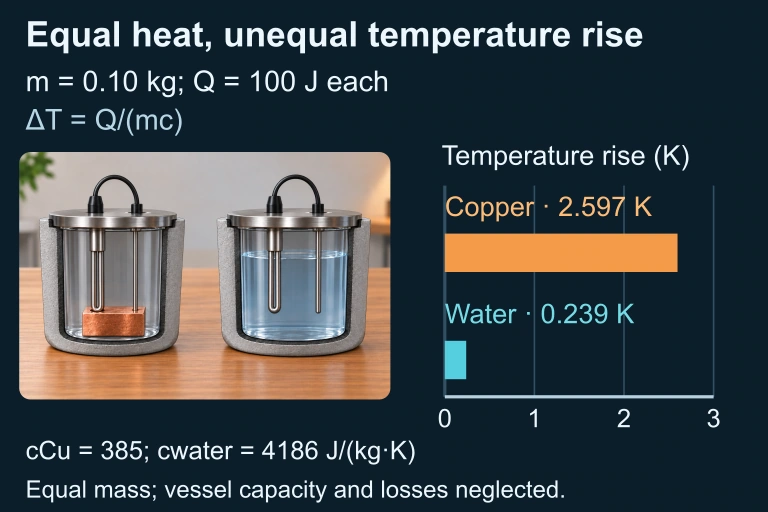
Why Water Heats Slowly
Different materials require vastly different amounts of energy for the same temperature change. Water's high specific heat (\(c = 4186\) \(\text{J}/(\text{kg}\cdot\text{K})\)) makes it an excellent thermal buffer.
Defining Thermal Conductivity \(k\)
Thermal conductivity \(k\) describes how efficiently a material conducts heat. It appears in Fourier's Law of Heat Conduction:
Steady-State Conduction
For a slab of material with uniform cross-section, in steady state (temperatures not changing with time), the heat flow rate simplifies to:
Specific Heat vs Thermal Conductivity
| Property | Specific Heat \(c\) | Thermal Conductivity \(k\) |
|---|---|---|
| Measures | Energy storage | Energy transfer rate |
| Units | \(\text{J} / (\text{kg}\cdot\text{K})\) | \(\text{W} / (\text{m}\cdot\text{K})\) |
| Key Equation | \(Q = mc\Delta T\) | \(\frac{Q}{t} = \frac{kA\Delta T}{L}\) |
| High value means | Hard to change temp | Heat flows easily |
| Water | 4186 (very high) | 0.6 (low) |
| Copper | 385 (low) | 401 (very high) |
Thermal Resistance and R-Value
Thermal resistance \(R\) is the inverse measure of how easily heat passes through a material. For a slab of thickness \(L\):
A winter window cutaway with a visible thermal bottleneck
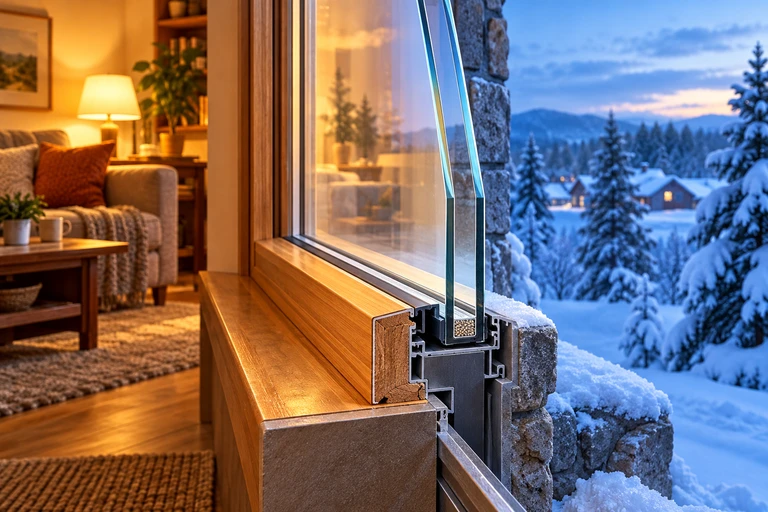 Thermal resistances add in series across the two glass panes and the air gap. Under steady conduction, every layer carries the same heat-transfer rate and the largest resistance has the largest temperature drop.
Most of the temperature drop is in air
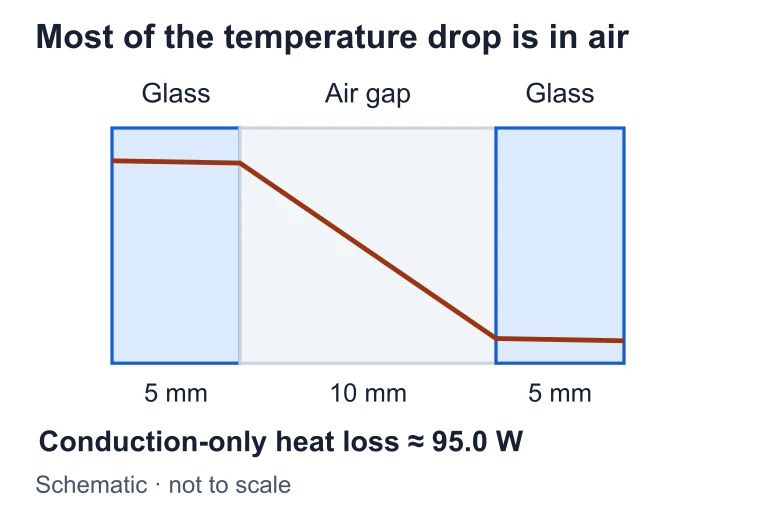 Thermal resistances add in series across the two glass panes and the air gap. Under steady conduction, every layer carries the same heat-transfer rate and the largest resistance has the largest temperature drop.
How to Solve Thermal Problems
Example 1: Heating Water
How much energy is needed to heat 2.0 kg of water from \(20^{\circ}\text{C}\) to \(80^{\circ}\text{C}\)? Use \(c_{\text{water}} = 4186 \text{ J}/(\text{kg}\cdot\text{K})\).
Example 2: Heat Through a Wall
A concrete wall is \(0.20\text{ m}\) thick with area \(12\text{ m}^2\). The inside is at \(22^{\circ}\text{C}\), outside at \(-5^{\circ}\text{C}\). Find the rate of heat loss. (\(k_{\text{concrete}} = 1.7 \text{ W}/(\text{m}\cdot\text{K})\))
Example 3: Thermal Equilibrium
A \(0.50\text{ kg}\) iron block at \(200^{\circ}\text{C}\) is dropped into \(2.0\text{ kg}\) of water at \(25^{\circ}\text{C}\). Find the final equilibrium temperature. (\(c_{\text{iron}} = 449\), \(c_{\text{water}} = 4186 \text{ J}/(\text{kg}\cdot\text{K})\))
Factors Affecting Conductivity
What determines whether a material conducts heat well or poorly? The answer lies in its microscopic structure.
Real-World Applications
Common Mistakes
Summary of Key Equations
| Concept | Equation | Units |
|---|---|---|
| Heat absorbed/released | \(Q = mc\Delta T\) | J |
| Heat flow rate | \(\frac{Q}{t} = \frac{kA\Delta T}{L}\) | W |
| Thermal resistance | \(R = \frac{L}{k}\) | \(\text{m}^2\cdot\text{K}/\text{W}\) |
| Thermal equilibrium | \(Q_{\text{lost}} + Q_{\text{gained}} = 0\) | J |
| Fourier's Law (general) | \(\frac{dQ}{dt} = -kA\frac{dT}{dx}\) | W |
Question 1 of 5
How much heat is required to raise the temperature of \(0.50\text{ kg}\) of aluminum (\(c = 897 \text{ J}/(\text{kg}\cdot\text{K})\)) from \(25^{\circ}\text{C}\) to \(75^{\circ}\text{C}\)?
Question 2 of 5
A metal rod has thermal conductivity \(k = 200 \text{ W}/(\text{m}\cdot\text{K})\), cross-sectional area \(A = 0.01\text{ m}^2\), and length \(L = 0.5\text{ m}\). If one end is at \(100^{\circ}\text{C}\) and the other at \(20^{\circ}\text{C}\), what is the steady-state heat flow rate?
Question 3 of 5
Two blocks of equal mass are heated with the same amount of energy. Block A reaches a higher final temperature. Which statement is correct?
Question 4 of 5
A wall consists of two layers: Layer 1 (\(k_1 = 0.8 \text{ W}/(\text{m}\cdot\text{K})\), \(L_1 = 0.10\text{ m}\)) and Layer 2 (\(k_2 = 0.04 \text{ W}/(\text{m}\cdot\text{K})\), \(L_2 = 0.05\text{ m}\)). Which layer provides more thermal resistance?
Question 5 of 5
A \(100\text{ g}\) copper block (\(c = 385 \text{ J}/(\text{kg}\cdot\text{K})\)) at \(90^{\circ}\text{C}\) is placed in \(200\text{ g}\) of water (\(c = 4186 \text{ J}/(\text{kg}\cdot\text{K})\)) at \(20^{\circ}\text{C}\). What is the approximate equilibrium temperature?