01 / 21

Simple
Circuits

Master the fundamentals of voltage, current, and resistance in series and parallel configurations using Ohm's Law and Kirchhoff's Rules.

AP Physics 2

What Is a Circuit?

A circuit is a closed loop that provides a continuous path for electric charge to flow. Every simple circuit requires three essential components: a source of EMF (like a battery), conducting wires, and a load (like a resistor or lightbulb).

EMF \(R\) \(I\) (current) + −

Three Key Quantities

Voltage \( V \)
The electric potential difference that drives charge through the circuit. Measured in volts (V).
Current \( I \)
The rate of charge flow: \( I = \frac{\Delta Q}{\Delta t} \). Measured in amperes (A).
Resistance \( R \)
Opposition to current flow by a material. Measured in ohms (\( \Omega \)).

Why Circuits Matter

Every electronic device: from your phone to a spacecraft, relies on circuits. Understanding simple circuits gives you the foundation for analyzing any electrical system.

1
Energy transfer: Circuits convert electrical energy into light, heat, motion, and sound.
2
Safety: Circuit analysis helps engineers design safe wiring that prevents overloads and fires.
3
AP Physics 2: Circuit problems appear on nearly every exam, combining Ohm's Law with Kirchhoff's Rules.

Ohm's Law: The Core Rule

$$ V = IR $$

\( V \)
Voltage across the element (V)
\( I \)
Current through the element (A)
\( R \)
Resistance of the element (\(\Omega\))

Kirchhoff's Two Rules

Junction Rule
The total current entering a junction equals the total current leaving: $$ \sum I_{\text{in}} = \sum I_{\text{out}} $$ Conservation of charge.
Loop Rule
The sum of all voltage gains and drops around any closed loop equals zero: $$ \sum \Delta V = 0 $$ Conservation of energy.

Series vs. Parallel

Series \(R_1\) \(R_2\) Same \(I\) Parallel \(R_1\) \(R_2\) Same \(V\)

Series Circuit Rules

1
Current is the same through every element: \( I_1 = I_2 = \ldots = I \)
2
Voltages add up: \( V_{\text{total}} = V_1 + V_2 + \ldots \)
3
Resistances add: \( R_{\text{eq}} = R_1 + R_2 + \ldots \)

A real battery bench with an internal-loss cutaway
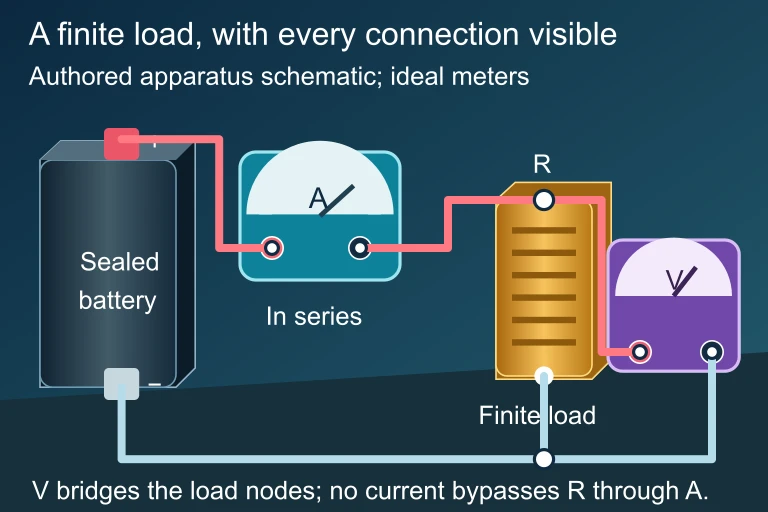
An independently authored battery bench with a sealed battery, finite load, series ammeter and parallel voltmeter, with explicitly joined leads.During discharge, internal resistance makes terminal voltage smaller than the emf. The source power divides between useful load power and internal heating.

A loaded battery has distinct current and voltage paths
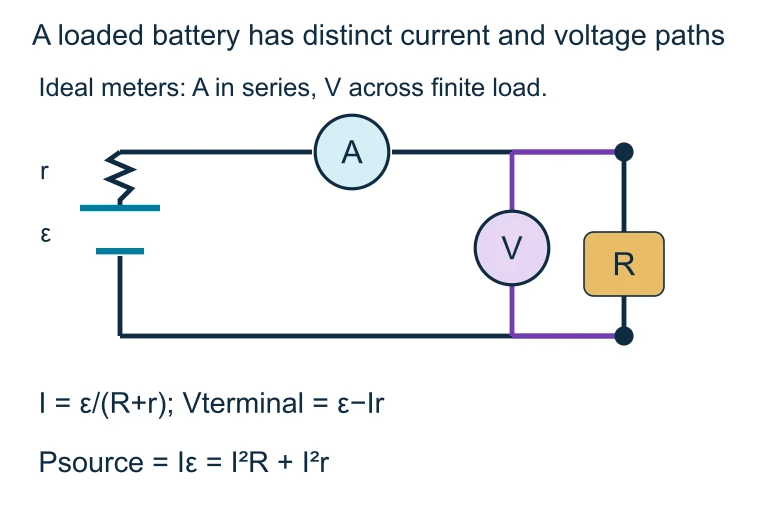
A loaded battery has distinct current and voltage paths. During discharge, internal resistance makes terminal voltage smaller than the emf. The source power divides between useful load power and internal heating.During discharge, internal resistance makes terminal voltage smaller than the emf. The source power divides between useful load power and internal heating.

Parallel Circuit Rules

1
Voltage is the same across every branch: \( V_1 = V_2 = \ldots = V \)
2
Currents add up: \( I_{\text{total}} = I_1 + I_2 + \ldots \)
3
Reciprocal resistances add: \( \frac{1}{R_{\text{eq}}} = \frac{1}{R_1} + \frac{1}{R_2} + \ldots \)

Series vs. Parallel Summary

Property Series Parallel
Current Same through all Splits among branches
Voltage Splits among elements Same across all
\( R_{\text{eq}} \) \( R_1 + R_2 + \ldots \) \( \left(\frac{1}{R_1} + \frac{1}{R_2} + \ldots\right)^{-1} \)
Adding \( R \) \( R_{\text{eq}} \) increases \( R_{\text{eq}} \) decreases
If one breaks Entire circuit stops Other branches keep going

How to Solve Circuit Problems

1
Identify series and parallel groups. Trace the current path. If current has only one path through elements, they are in series. If it splits, they are in parallel.
2
Simplify to \( R_{\text{eq}} \). Combine innermost groups first, working outward until you have one equivalent resistance.
3
Find total current. Apply Ohm's Law: \( I = \frac{V_{\text{source}}}{R_{\text{eq}}} \).
4
Work backward. Use Ohm's Law on each sub-group to find individual currents and voltage drops.
5
Check with Kirchhoff's Rules. Verify that voltages around each loop sum to zero and currents at each junction balance.

Example 1: Series Circuit

\(12\,\text{V}\) \(4\,\Omega\) \(R_1\) \(6\,\Omega\) \(R_2\) \(2\,\Omega\) \(R_3\)

Example 2: Parallel Circuit

\(24\,\text{V}\) \(6\,\Omega\) \(R_1\) \(12\,\Omega\) \(R_2\)

Example 3: Combination Circuit

\(18\,\text{V}\) \(3\,\Omega\) \(R_1\) \(6\,\Omega\) \(R_2\) \(6\,\Omega\) \(R_3\)

A separate compound-circuit illustration

These values differ from the existing worked example.

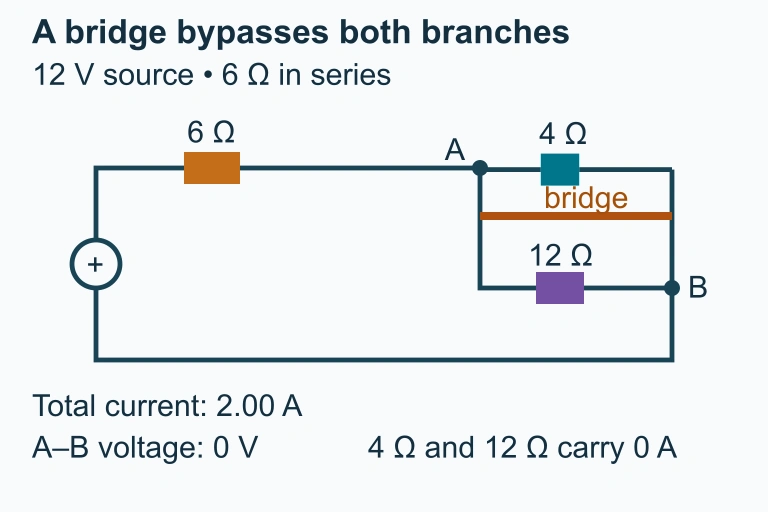
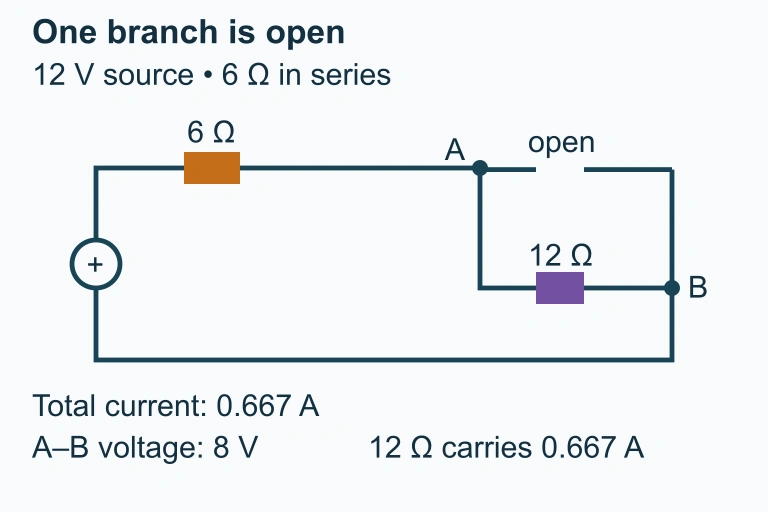
A 12 V ideal battery connects to a 6 Ω series resistor and a parallel pair of 4 Ω and 12 Ω resistors. Find the equivalent resistance and branch currents. What changes when one branch opens or a wire bridges the parallel pair?

Show answer and explanation

The parallel pair has resistance 3 Ω; the total is 9 Ω and the initial current is 4/3 A. The 4 Ω and 12 Ω branches carry 1 A and 1/3 A. Opening the 4 Ω branch leaves total current 2/3 A; a bridge across the pair leaves 2 A through the series resistor and zero current through the parallel resistors.
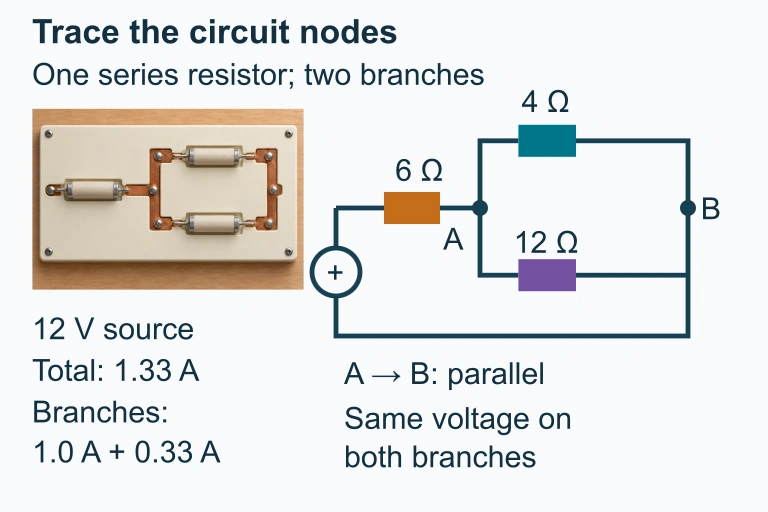
Simple-circuit preset: 12 V, series 6 Ω, parallel 4/12 Ω; Req=9 Ω, total 4/3 A, branches 1 and 1/3 A.
Separate simple-circuit preset: 6 Ω in series with 4 Ω and 12 Ω branches.
Opening the 4 Ω branch leaves 6 Ω and 12 Ω in series: 2/3 A, branch voltage 8 V.
Opening the 4 Ω branch leaves the 12 Ω branch carrying current. A bridge between A and B bypasses both parallel resistors while the 6 Ω series resistor remains.
Bridging the parallel section sets VAB=0; only 6 Ω limits 12 V, giving total 2 A and zero resistor-branch currents.
A bridge across nodes A and B bypasses both parallel resistors.

Power in Circuits

The rate at which electrical energy is dissipated or delivered is power. Three equivalent forms:

\( P = IV \)
Current times voltage: most general form.
\( P = I^2 R \)
Useful when you know current and resistance.
\( P = \frac{V^2}{R} \)
Useful when you know voltage and resistance.

Common Mistakes

✕ Adding Parallel \( R \) Directly
Parallel resistors do not add: \( R_{\text{eq}} \neq R_1 + R_2 \). You must use the reciprocal formula.
✕ Same \( V \) in Series
In series, voltage splits across elements. The total voltage equals the source only, not each resistor.
✕ Forgetting to Invert
After computing \( \frac{1}{R_{\text{eq}}} \), you must take the reciprocal to find \( R_{\text{eq}} \). Many students report the sum of reciprocals as the answer.

Question 1 of 5

Three resistors of \( 2\,\Omega \), \( 3\,\Omega \), and \( 5\,\Omega \) are connected in series with a \( 20\,\text{V} \) battery. What is the current through the circuit?

Question 2 of 5

Two \( 8\,\Omega \) resistors are connected in parallel. What is the equivalent resistance?

Question 3 of 5

A \( 12\,\text{V} \) battery drives \( 3\,\text{A} \) through a resistor. How much power does the resistor dissipate?

Question 4 of 5

In a parallel circuit with two branches, the total current is \( 5\,\text{A} \). If branch 1 carries \( 3\,\text{A} \), what is the current in branch 2?

Question 5 of 5

A \( 3\,\Omega \) resistor is in series with a parallel combination of \( 4\,\Omega \) and \( 12\,\Omega \). A \( 12\,\text{V} \) battery powers the circuit. What is the voltage drop across the \( 3\,\Omega \) resistor?