Resistance, Resistivity
& Ohm's Law
Explore how materials oppose current, the relationship between voltage and current, and how geometry affects resistance.
What is Electric Current?
Electric current is the rate of flow of electric charge. By convention, we define current as the direction positive charges would flow. In most metals, it's actually negatively-charged electrons flowing in the opposite direction.
What is Resistance?
Resistance is a measure of how strongly a material opposes the flow of electric current. A higher resistance means less current flows for a given voltage.
Understanding Resistivity \( \rho \)
Resistivity is an intrinsic property of a material that quantifies how strongly it resists current. Unlike resistance, resistivity does not depend on the shape or size of the object.
Example: copper, silver
Example: silicon
Example: rubber, glass
The Resistance Formula
Resistance depends on three factors: the material's resistivity, the conductor's length, and its cross-sectional area:
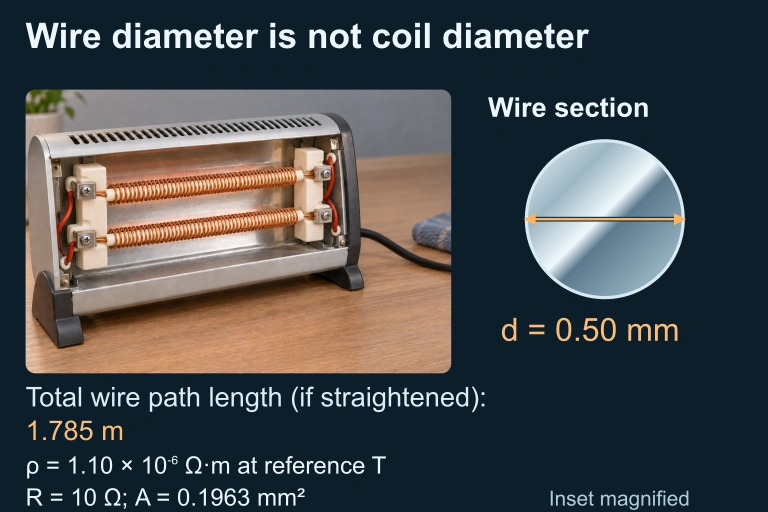
Heater wire geometry
This separate reference-temperature model treats the wire path as straightened.
A conductor has diameter 0.50 mm, total path length 1.785 m and resistivity 1.10 × 10⁻⁶ Ω·m. Find its resistance.
Show answer and explanation
The wire cross-sectional area is approximately 0.1963 mm²; R = ρL/A gives about 10 Ω. The wire diameter is not the coil or housing diameter.
Ohm's Law: The Core Relationship
Ohm's Law states that the voltage across a conductor is directly proportional to the current through it, with resistance as the constant of proportionality:
The \( V \) vs \( I \) Graph
For an ohmic material, the \( V \)-\( I \) graph is a straight line through the origin. The slope equals the resistance \( R \).
Resistance vs Resistivity
| Property | Resistance \( R \) | Resistivity \( \rho \) |
|---|---|---|
| What it describes | Opposition of a specific object | Opposition of a material |
| Depends on shape? | Yes (length, area) | No (intrinsic) |
| Units | \( \Omega \) | \( \Omega \cdot \text{m} \) |
| Temperature dependent? | Yes | Yes |
| Formula link | \( R = \rho L / A \) | |
Temperature and Resistance
For most metals, resistivity increases with temperature. Atoms vibrate more at higher temperatures, creating more collisions for drifting electrons.
How to Solve Circuit Problems
Example 1: Ohm's Law
A \( 12\;\text{V} \) battery is connected across a \( 4\;\Omega \) resistor. Find the current.
Example 2: Resistance from Geometry
A copper wire (\( \rho = 1.7 \times 10^{-8}\;\Omega\cdot\text{m} \)) is \( 2.0\;\text{m} \) long with a circular cross-section of radius \( 0.50\;\text{mm} \). Find its resistance.
Example 3: Comparing Two Wires
Wire A has length \( L \) and radius \( r \). Wire B is made of the same material but has length \( 2L \) and radius \( 2r \). How do their resistances compare?
Power Dissipated in a Resistor
When current flows through a resistor, electrical energy is converted to thermal energy. The rate of energy dissipation is the power:
Common Mistakes to Avoid
Key Equations Summary
| Equation | Formula | When to Use |
|---|---|---|
| Ohm's Law | \( V = IR \) | Relate voltage, current, resistance |
| Resistance | \( R = \rho L / A \) | Calculate \( R \) from material and geometry |
| Power (form 1) | \( P = IV \) | Both \( I \) and \( V \) known |
| Power (form 2) | \( P = I^2 R \) | \( I \) and \( R \) known |
| Power (form 3) | \( P = V^2 / R \) | \( V \) and \( R \) known |
| Temp. dependence | \( \rho = \rho_0[1 + \alpha(T-T_0)] \) | Resistance changes with temperature |
Question 1 of 5
A \( 9\;\text{V} \) battery drives a current of \( 0.5\;\text{A} \) through a resistor. What is the resistance?
Question 2 of 5
If you double the length of a wire while keeping everything else the same, the resistance:
Question 3 of 5
If you double the radius of a cylindrical wire (same material, same length), the resistance becomes:
Question 4 of 5
A \( 100\;\Omega \) resistor has \( 2\;\text{A} \) of current flowing through it. What power does it dissipate?
Question 5 of 5
Which quantity is an intrinsic property of a material, independent of the object's shape or size?