Refraction
Bending Light at Boundaries
Understand how light changes direction when passing between media, governed by Snell's Law: \( n_1 \sin\theta_1 = n_2 \sin\theta_2 \).
What Is Refraction?
Refraction is the bending of a wave as it passes from one medium to another at an angle. The change in direction occurs because light travels at different speeds in different materials.
The Index of Refraction
Every transparent material has an index of refraction \( n \), defined as the ratio of the speed of light in a vacuum to the speed of light in that medium:
Why Does Light Bend?
Imagine a marching band crossing from pavement onto mud at an angle. The side that hits mud first slows down, while the other side keeps its speed: the line of marchers pivots. Light wavefronts behave the same way.
Snell's Law: The Core Equation
At every boundary, some light also reflects. Snell's Law describes only the transmitted (refracted) portion.
A separate oblique viewing model
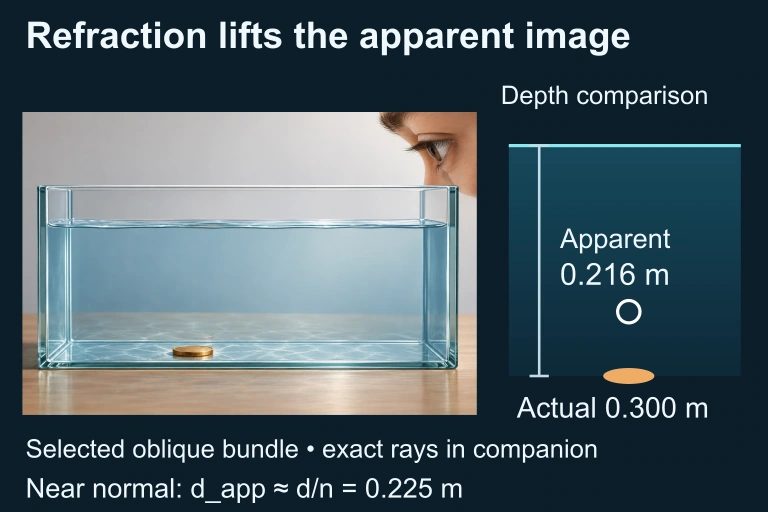
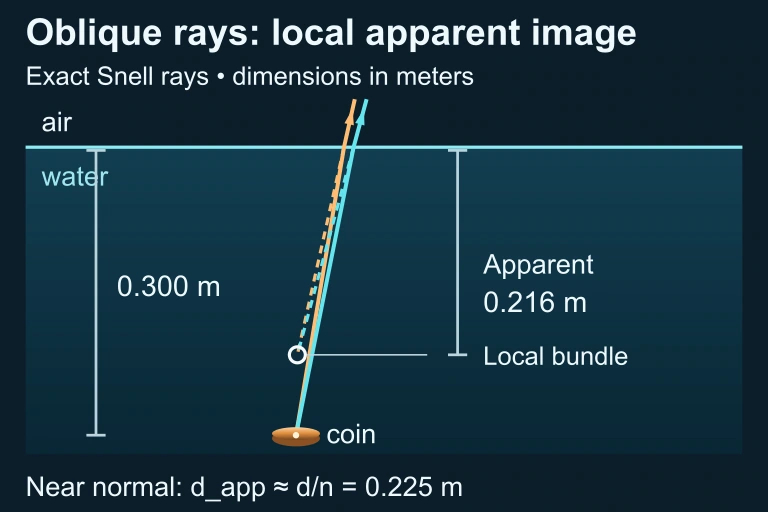
For the selected rays from a coin 0.300 m below water, backward extensions meet at 0.216 m. The near-normal approximation gives 0.225 m; apparent depth varies with viewing geometry.
Which Way Does It Bend?
Reflection vs. Refraction
| Property | Reflection | Refraction |
|---|---|---|
| Medium change? | No: light stays in same medium | Yes: light enters a new medium |
| Speed change? | No | Yes |
| Angle law | \( \theta_i = \theta_r \) | \( n_1 \sin\theta_1 = n_2 \sin\theta_2 \) |
| Direction | Bounces back | Passes through, bends |
| Occurs at | Any surface | Transparent boundaries |
Total Internal Reflection
When light travels from a denser medium to a less dense medium (\( n_1 > n_2 \)), there exists a critical angle \( \theta_c \) beyond which all light reflects back and none refracts.
A fiber connector becomes a transparent optical cutaway
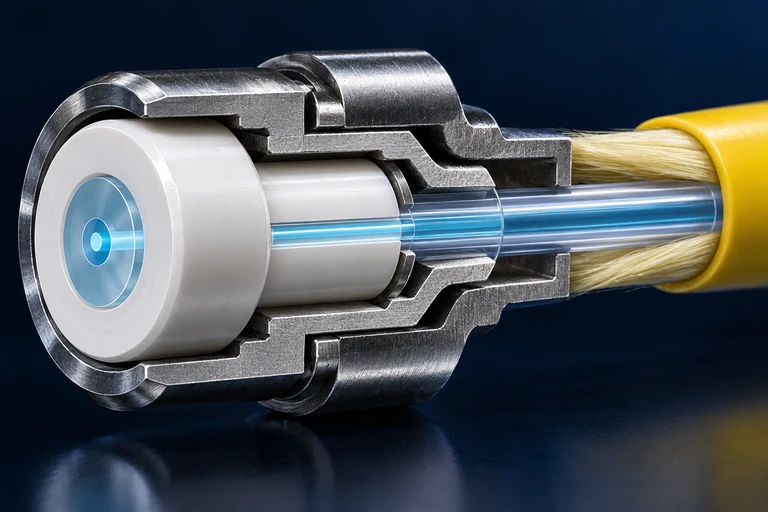 A fiber guides light by total internal reflection at its core–cladding boundary. The critical angle is measured from the sidewall normal; the entrance acceptance angle is measured from the fiber axis.
Entrance acceptance and sidewall critical angles are distinct.
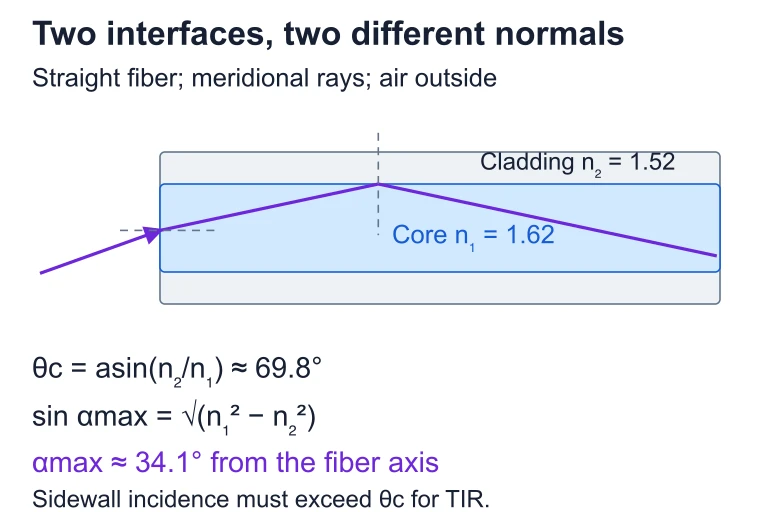 A fiber guides light by total internal reflection at its core–cladding boundary. The critical angle is measured from the sidewall normal; the entrance acceptance angle is measured from the fiber axis.
Cladding index and acceptance angle
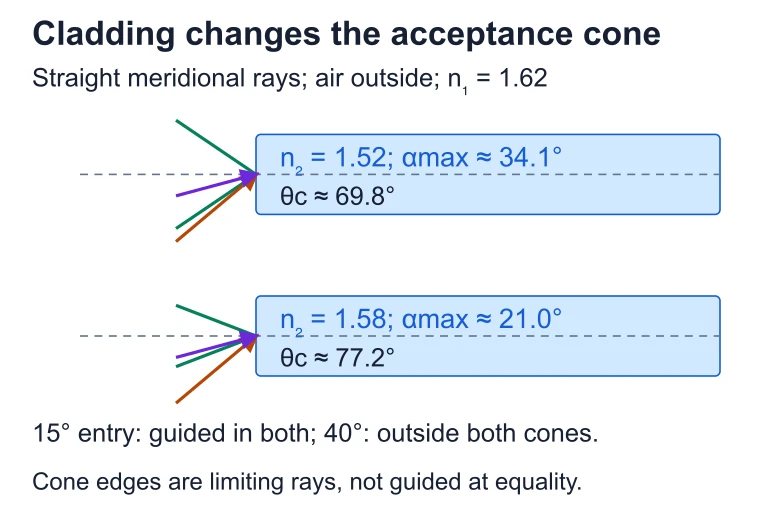 With core index 1.62 and light entering from air, raising the cladding index from 1.52 to 1.58 narrows the limiting acceptance half-angle from about 34.1° to 21.0°.
How to Apply Snell's Law
Example 1: Air to Water
A ray of light in air (\( n_1 = 1.00 \)) strikes a water surface (\( n_2 = 1.33 \)) at an angle of \( 45^\circ \) from the normal. Find \( \theta_2 \).
Example 2: Glass to Air
Light travels inside glass (\( n_1 = 1.50 \)) and strikes the glass-air boundary at \( 30^\circ \). Find \( \theta_2 \) in air (\( n_2 = 1.00 \)).
Example 3: Finding the Critical Angle
A fiber optic cable uses glass with \( n = 1.62 \). What is the critical angle for total internal reflection at the glass-air boundary?
Dispersion: Rainbows from Refraction
The index of refraction depends slightly on wavelength. Shorter wavelengths (violet) refract more than longer ones (red). This splitting is called dispersion.
Common Mistakes
Summary of Key Formulas
| Concept | Formula | Key Condition |
|---|---|---|
| Index of refraction | \( n = \frac{c}{v} \) | \( n \geq 1 \) |
| Snell's Law | \( n_1 \sin\theta_1 = n_2 \sin\theta_2 \) | Angles from normal |
| Critical angle | \( \sin\theta_c = \frac{n_2}{n_1} \) | \( n_1 > n_2 \) |
| Total internal reflection | All light reflects | \( \theta_1 > \theta_c \), denser to less dense |
Question 1 of 5
Light in air (\( n = 1.00 \)) strikes a glass surface (\( n = 1.50 \)) at \( 60^\circ \) from the normal. What is the angle of refraction?
Question 2 of 5
When light travels from water (\( n = 1.33 \)) into air (\( n = 1.00 \)), it bends:
Question 3 of 5
What is the critical angle for light going from diamond (\( n = 2.42 \)) to air (\( n = 1.00 \))?
Question 4 of 5
A material has an index of refraction \( n = 2.0 \). What is the speed of light in this material?
Question 5 of 5
Total internal reflection can occur when light travels from: