Reflection of
Light
Explore how light bounces off surfaces, the law of reflection, and applications from mirrors to fiber optics.
What Is Reflection?
When a light ray strikes a boundary between two media, part of the energy bounces back into the original medium. This phenomenon is called reflection. It occurs for all types of electromagnetic waves, not just visible light.
Key Terminology
Anatomy of Reflection
The Law of Reflection
The law of reflection is one of the oldest known principles in optics, formalized by Euclid around 300 BCE:
Additionally, the incident ray, the reflected ray, and the normal to the surface at the point of incidence all lie in the same plane.
Specular vs Diffuse Reflection
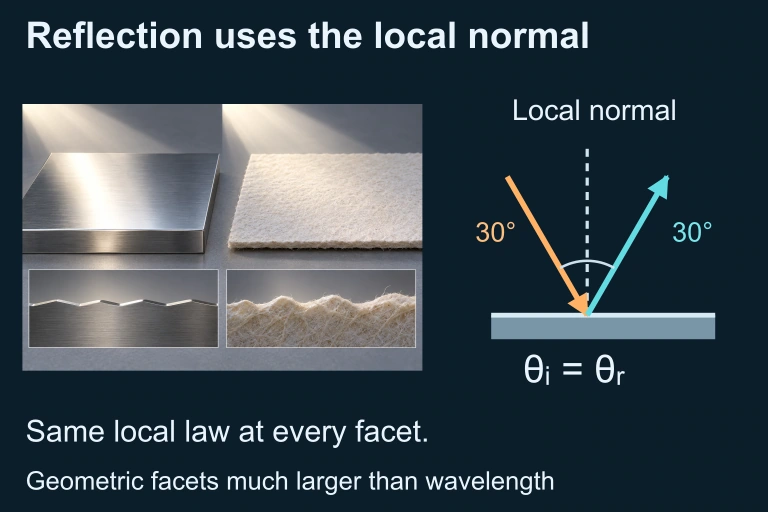
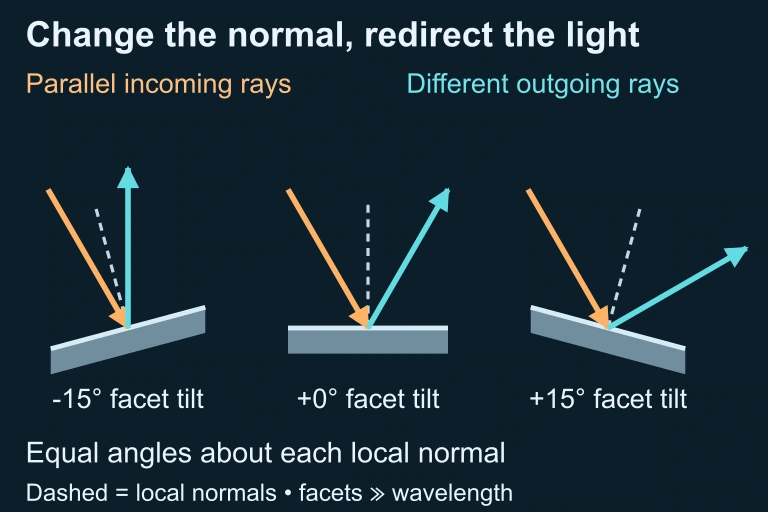
Local reflection at tilted facets
The incoming direction is fixed, but different local surface normals redirect reflected rays while each obeys equal incidence and reflection angles. This ideal geometric model assumes facets much larger than the wavelength.
Types of Mirrors
The Mirror Equation
Real vs Virtual Images
| Real Image | Virtual Image | |
|---|---|---|
| Formed by | Converging reflected rays | Diverging rays (extended back) |
| Location | In front of mirror | Behind mirror |
| Orientation | Inverted | Upright |
| Can project on screen? | Yes | No |
| Sign of \(d_i\) | Positive | Negative |
A concave mirror makes an image hang in front of it
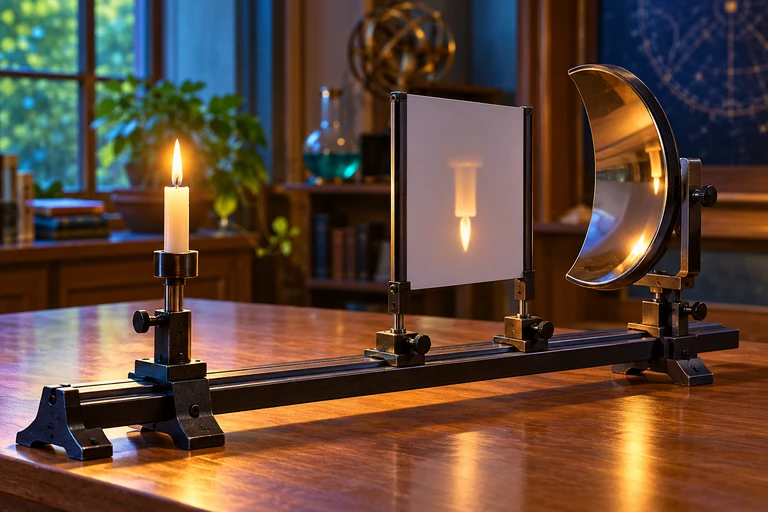 A concave mirror forms a real image where reflected rays converge. When the object is inside the focal length, the reflected rays diverge and their backward extensions locate an upright virtual image.
Concave-mirror magnification
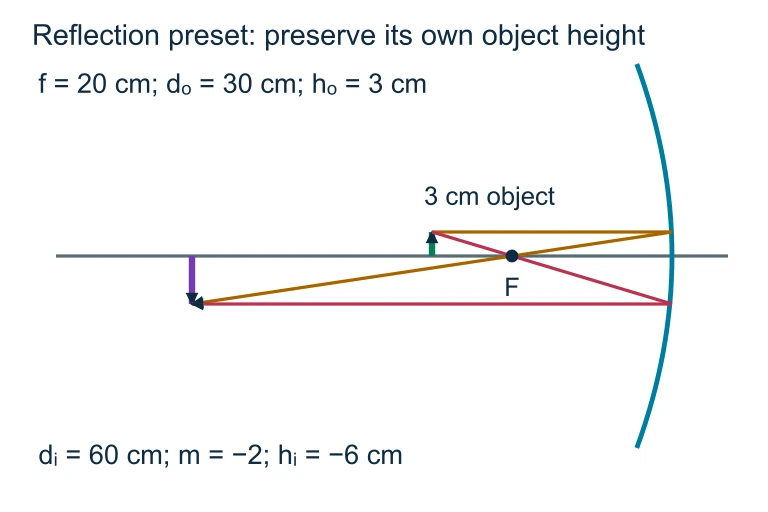 With f = 20 cm and object distance 30 cm, the image distance is 60 cm and magnification is −2. A 3 cm object therefore forms an inverted 6 cm image.
Virtual image inside the focal length
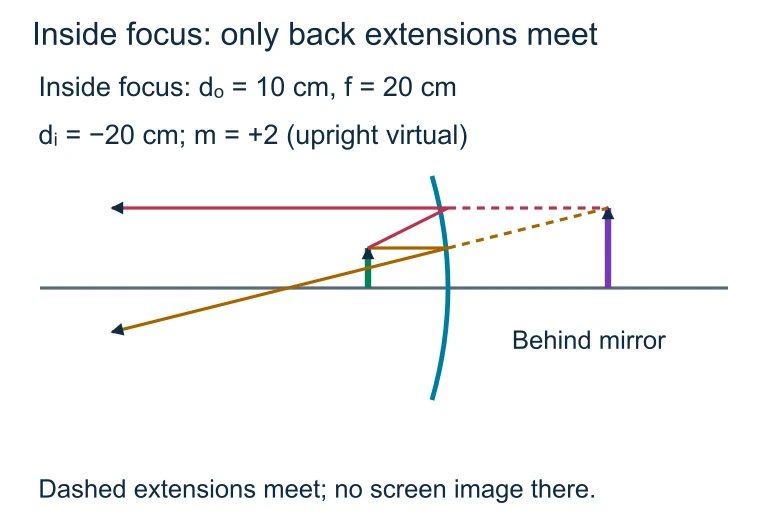 An object 10 cm in front of a concave mirror with f = 20 cm has image distance −20 cm and magnification +2. Only backward extensions meet behind the mirror.
Step-by-Step Problem Solving
Example 1: Plane Mirror
An object is placed 25 cm in front of a plane mirror. Where is the image formed?
Example 2: Concave Mirror
An object is placed 30 cm in front of a concave mirror with focal length \(f = 10\) cm. Find the image distance and magnification.
Example 3: Convex Mirror
An object is 20 cm from a convex mirror with \(f = -15\) cm. Find \(d_i\) and \(M\).
Total Internal Reflection
When light travels from a denser medium to a less dense medium (e.g., glass to air), it bends away from the normal. Beyond a certain critical angle \(\theta_c\), the light is completely reflected back into the denser medium.
Common Mistakes
Summary Comparison
| Plane | Concave | Convex | |
|---|---|---|---|
| Surface Shape | Flat | Curves inward | Curves outward |
| Focal Length | \(\infty\) | Positive | Negative |
| Image Type | Virtual only | Real or virtual | Virtual only |
| Image Orientation | Upright | Depends on \(d_o\) | Always upright |
| Image Size | Same | Enlarged or reduced | Always reduced |
| Example Use | Bathroom mirror | Telescope, headlamp | Car side mirror |
Question 1 of 5
A light ray strikes a plane mirror at an angle of 35° to the surface. What is the angle of reflection measured from the normal?
Question 2 of 5
An object is placed 20 cm in front of a concave mirror with \(f = 10\) cm. What type of image is formed?
Question 3 of 5
Which of the following is true about diffuse reflection?
Question 4 of 5
A convex mirror always produces images that are:
Question 5 of 5
Total internal reflection occurs when light travels from a medium with index \(n_1\) to one with index \(n_2\). Which condition must be satisfied?