01 / 21

Properties of
Wave Pulses and Waves

Explore how mechanical and electromagnetic waves propagate, and master the relationships between wavelength, frequency, speed, and amplitude.

AP Physics 2

What Is a Wave?

A wave is a disturbance that transfers energy from one location to another without transferring matter. The medium (if one exists) oscillates locally, but it is the pattern of disturbance that propagates through space.

Pulse vs Continuous Wave

Pulse Continuous Wave Single disturbance Repeating periodic pattern

Anatomy of a Transverse Wave

equilibrium A A λ Crest Trough
\( \lambda \) Wavelength
Distance between two consecutive identical points (crest to crest)
\( A \) Amplitude
Maximum displacement from the equilibrium position

The Wave Speed Equation

\( v = f \lambda \)

\( v \)
Wave speed (m/s): how fast the disturbance propagates
\( f \)
Frequency (Hz): number of complete cycles per second
\( \lambda \)
Wavelength (m): spatial period of the wave

A separate string-frequency model

For tension 10 N and linear density 0.010 kg/m, the wave speed is 31.62 m/s; doubling the driver from 20 Hz to 40 Hz halves the wavelength.
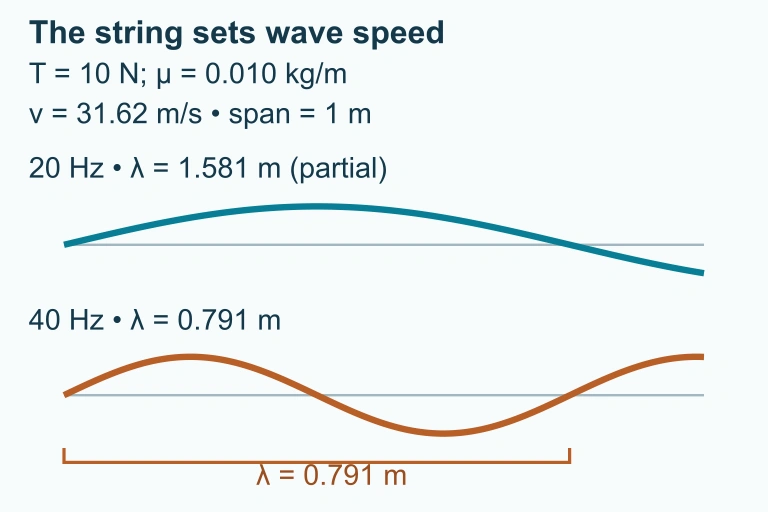
T 10 N,μ0.010 kg/m givesv 31.62 m/s;20/40 Hz givesλ1.581/0.791 m.
At fixed tension and linear density, the wave speed stays constant while a higher drive frequency shortens wavelength.

Frequency, Period, and Speed

1
Frequency \( f \) is set by the source. Changing the medium does not change the frequency.
2
Wave speed \( v \) depends on the properties of the medium (density, tension, temperature).
3
Wavelength \( \lambda \) adjusts when \( v \) changes because \( \lambda = v / f \), and \( f \) stays constant.

Transverse vs Longitudinal

Transverse propagation osc. Longitudinal C R C R C R propagation osc.
Transverse
Oscillation is perpendicular to propagation (light, string waves)
Longitudinal
Oscillation is parallel to propagation (sound, spring compressions)

Energy and Amplitude

The energy carried by a wave is proportional to the square of its amplitude. For a mechanical wave on a string:

\( E \propto A^2 \)

The Superposition Principle

When two or more waves overlap, the resulting displacement is the algebraic sum of the individual displacements at every point:

\( y_{\text{net}}(x,t) = y_1(x,t) + y_2(x,t) \)

y₁ y₂ y₁ + y₂ Individual Waves Superposition Result

Pulse reflection as superposition

The same ideal pulse reflects upright at a free end and inverted at a fixed end. The complete-overlap states illustrate the boundary constraints.
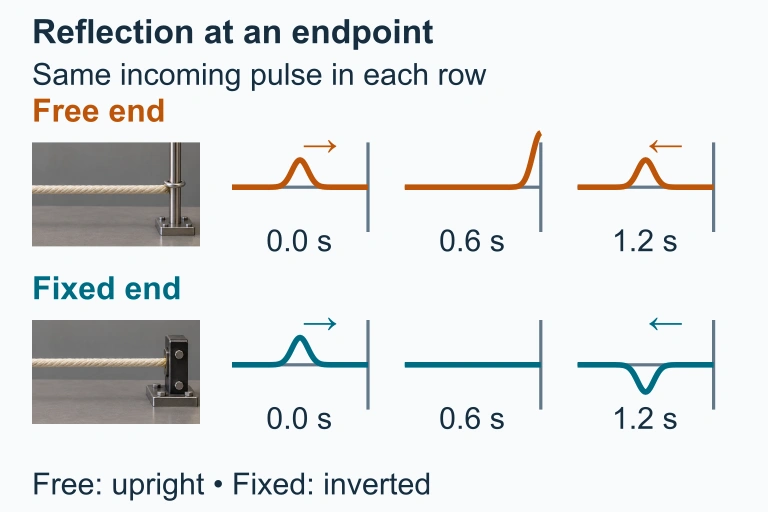
Fixed-end inversion and zero endpoint; free-end non-inversion and doubled endpoint at overlap; successive pulse snapshots.
The same ideal pulse reflects upright at a free end and inverted at a fixed end. At complete overlap, the free-end displacement doubles and the fixed end remains stationary.

Constructive vs Destructive Interference

Constructive
Waves are in phase (crests align with crests). Resulting amplitude is the sum of individual amplitudes.
Destructive
Waves are out of phase (crest aligns with trough). Resulting amplitude is the difference of individual amplitudes.

How to Apply Wave Equations

1
Identify the knowns. Which of \( v \), \( f \), \( \lambda \), and \( T \) are given?
2
Choose the equation. Use \( v = f\lambda \) or \( v = \lambda / T \) depending on what you have.
3
Convert units. Ensure frequency is in Hz, wavelength in meters, and speed in m/s.
4
Solve and check. Plug in, solve for the unknown, and verify the answer is physically reasonable.

Example 1: Finding Wavelength

A sound wave in air travels at \( v = 343 \) m/s and has a frequency of \( f = 440 \) Hz (concert A). What is the wavelength?

1
Write the equation: \( v = f\lambda \)
2
Solve for \( \lambda \): \( \lambda = \dfrac{v}{f} = \dfrac{343}{440} \)
3
Calculate: \( \lambda \approx 0.780 \) m

Example 2: Wave Crossing Media

A \( f = 500 \) Hz wave travels in air at \( v_1 = 343 \) m/s, then enters water where \( v_2 = 1480 \) m/s. Find the wavelength in each medium.

1
In air: \( \lambda_1 = \dfrac{343}{500} = 0.686 \) m
2
In water: \( \lambda_2 = \dfrac{1480}{500} = 2.96 \) m
3
Key point: Frequency stays at 500 Hz in both media. Only \( \lambda \) changes.

Example 3: Energy and Amplitude

A wave on a string has amplitude \( A_1 = 3 \) cm and carries energy \( E_1 \). If the amplitude is increased to \( A_2 = 9 \) cm, what is the new energy \( E_2 \) in terms of \( E_1 \)?

1
Relationship: \( E \propto A^2 \), so \( \dfrac{E_2}{E_1} = \dfrac{A_2^2}{A_1^2} \)
2
Substitute: \( \dfrac{E_2}{E_1} = \dfrac{9^2}{3^2} = \dfrac{81}{9} = 9 \)
3
Result: \( E_2 = 9 E_1 \). Tripling the amplitude increases the energy by a factor of 9.

Common Mistakes

✕ Confusing speed and frequency
Frequency is set by the source. Wave speed is set by the medium. Changing medium does not change \( f \).
✕ Energy proportional to \( A \)
Energy scales with \( A^2 \), not \( A \). Doubling amplitude quadruples the energy, not doubles it.
✕ Waves carry matter
Waves transfer energy, not matter. The medium oscillates locally but does not travel with the wave.

Summary Comparison

Property Transverse Longitudinal
Oscillation Perpendicular to propagation Parallel to propagation
Examples Light, string waves, water surface Sound, spring compressions
Requires medium? Not always (EM waves) Yes (mechanical)
Speed equation \( v = f\lambda \) \( v = f\lambda \)
Polarizable? Yes No

Question 1 of 5

A wave has a frequency of \( 200 \) Hz and a wavelength of \( 1.5 \) m. What is the wave speed?

Question 2 of 5

When a sound wave moves from air into water, which quantity stays the same?

Question 3 of 5

If the amplitude of a wave is tripled, by what factor does its energy change?

Question 4 of 5

Two identical wave pulses travel toward each other on a string. At the instant they completely overlap, what is the displacement of the string if each pulse has amplitude \( A \)?

Question 5 of 5

Which type of wave can be polarized?