01 / 21

Periodic Waves

Explore the physics of wavelength, frequency, amplitude, and the wave equation that connects them all.

AP Physics 2

What Is a Wave?

A wave is a disturbance that transfers energy from one place to another without transferring matter. When you toss a pebble into a pond, the ripples carry energy outward while the water molecules themselves oscillate in place.

Key Properties of a Wave

Wavelength \(\lambda\)
Distance between two consecutive identical points (crest to crest), measured in meters.
Frequency \(f\)
Number of complete cycles passing a point per second, measured in hertz (Hz).
Amplitude \(A\)
Maximum displacement from the equilibrium position, measured in meters.
Period \(T\)
Time for one complete cycle: \(T = \frac{1}{f}\), measured in seconds.

Anatomy of a Periodic Wave

The Wave Equation

$$ v = f \lambda $$

\(v\)
Wave speed (m/s): determined by the medium, not the source.
\(f\)
Frequency (Hz): set by the source that creates the wave.
\(\lambda\)
Wavelength (m): adjusts so that \(v = f\lambda\) always holds.

Frequency and wavelength on one string

This separate model fixes tension at 10 N and linear density at 0.010 kg/m. The string speed is 31.62 m/s; doubling the driver from 20 Hz to 40 Hz halves the wavelength.
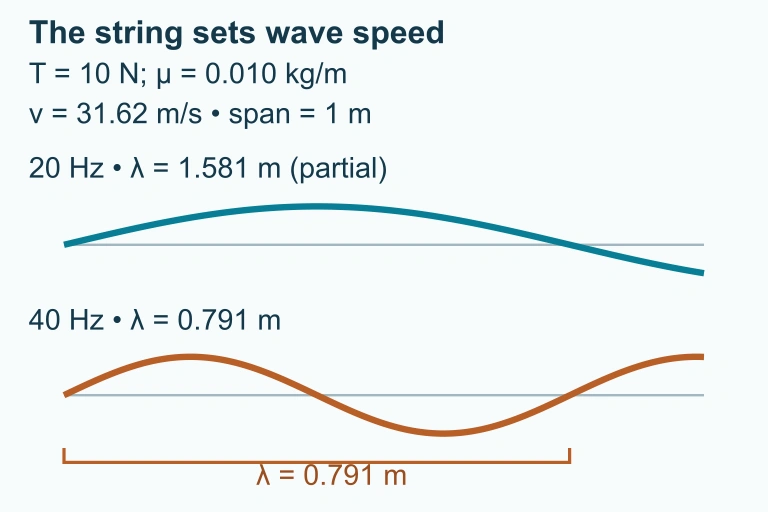
T 10 N,μ0.010 kg/m givesv 31.62 m/s;20/40 Hz givesλ1.581/0.791 m.
At fixed tension and linear density, the wave speed stays constant while a higher drive frequency shortens wavelength.

Wave Speed and the Medium

The speed of a wave is determined by the properties of the medium it travels through. When a wave passes from one medium to another, the frequency stays the same but the wavelength changes.

1
Sound in air (\(20^\circ\text{C}\)): \(v \approx 343\) m/s
2
Sound in water: \(v \approx 1480\) m/s
3
Light in vacuum: \(v = c = 3.0 \times 10^{8}\) m/s

Transverse vs Longitudinal Waves

Transverse Longitudinal
Oscillation Perpendicular to wave direction Parallel to wave direction
Example Light, string waves Sound, pressure waves
Features Crests and troughs Compressions and rarefactions
Medium Solids (and EM in vacuum) Solids, liquids, and gases

The Sinusoidal Wave Function

$$ y(x,t) = A \sin\!\left(\frac{2\pi}{\lambda}x - \frac{2\pi}{T}t\right) $$

1
\(A\): Amplitude: maximum displacement from equilibrium.
2
\(\frac{2\pi}{\lambda} = k\): Wave number: spatial frequency in radians per meter.
3
\(\frac{2\pi}{T} = \omega\): Angular frequency in radians per second.
4
Equivalent compact form: \(y = A\sin(kx - \omega t)\).

Energy and Amplitude

The energy carried by a wave is proportional to the square of its amplitude. Doubling the amplitude means four times the energy per unit length.

$$ E \propto A^2 $$

Power
Rate of energy transfer: \(P \propto A^2 f^2\). Both amplitude and frequency affect power.
Intensity
Power per unit area: \(I = P/A_{\text{area}}\). For a point source: \(I \propto 1/r^2\).

How to Solve Wave Problems

1
Identify the knowns: What values of \(v\), \(f\), \(\lambda\), or \(T\) are given?
2
Choose the right equation: Use \(v = f\lambda\) or \(v = \lambda / T\). Convert units if needed.
3
Solve algebraically first: Rearrange before substituting numbers. For example: \(\lambda = v / f\).
4
Substitute and compute: Plug in values with units. Check that the answer has the correct unit (m, Hz, m/s).
5
Sanity check: Is the wavelength reasonable? Sound wavelengths: cm to m. Light wavelengths: hundreds of nm.

Example 1: Finding Wavelength

A tuning fork produces a sound of frequency \(f = 440\) Hz. The speed of sound in air is \(v = 343\) m/s. What is the wavelength?

1
Write the equation: \(v = f\lambda\).
2
Solve for \(\lambda\): \(\lambda = \frac{v}{f}\).
3
Substitute: \(\lambda = \frac{343}{440} \approx 0.780\) m.

Example 2: Changing Medium

The same 440 Hz sound enters water, where \(v = 1480\) m/s. Find the new wavelength.

1
Key insight: Frequency stays the same when a wave changes medium.
2
Solve: \(\lambda = \frac{v}{f} = \frac{1480}{440} \approx 3.36\) m.
3
Compare: In water the wavelength is \(\frac{3.36}{0.780} \approx 4.3\times\) longer than in air.

Example 3: Wave on a String

A wave on a string has \(\lambda = 0.50\) m and \(T = 0.020\) s. Find the wave speed and frequency.

1
Frequency: \(f = \frac{1}{T} = \frac{1}{0.020} = 50\) Hz.
2
Wave speed: \(v = f\lambda = 50 \times 0.50 = 25\) m/s.
3
Alternate: \(v = \frac{\lambda}{T} = \frac{0.50}{0.020} = 25\) m/s. ✓ Same answer.

Superposition Principle

When two waves overlap, the resulting displacement is the sum of the individual displacements. This is the principle of superposition.

Constructive
Waves in phase: crests align with crests. Resulting amplitude is larger.
Destructive
Waves out of phase: crests align with troughs. Resulting amplitude is smaller (or zero).

Common Mistakes

✕ Confusing \(A\) and \(\lambda\)
Amplitude is vertical (displacement). Wavelength is horizontal (distance per cycle). They are independent.
✕ Changing \(f\) at a boundary
Frequency is set by the source and stays constant. Only wavelength and speed change when the medium changes.
✕ Energy depends on \(\lambda\)
Energy is proportional to \(A^2\), not wavelength. A taller wave carries more energy regardless of its wavelength.

Summary of Wave Quantities

Quantity Symbol Unit Depends On
Wavelength \(\lambda\) m Medium + source
Frequency \(f\) Hz Source only
Period \(T\) s Source only
Wave speed \(v\) m/s Medium only
Amplitude \(A\) m Source energy

Question 1 of 5

A wave has a frequency of 200 Hz and a wavelength of 1.5 m. What is the wave speed?

Question 2 of 5

A sound wave traveling in air enters water. Which quantity stays the same?

Question 3 of 5

If the amplitude of a wave is doubled, the energy carried by the wave is multiplied by a factor of:

Question 4 of 5

A wave on a string has a period of 0.01 s and travels at 40 m/s. What is the wavelength?

Question 5 of 5

Two identical waves meet perfectly in phase. The resulting amplitude is: