Magnetism and
Moving Charges
Explore how magnetic fields exert forces on moving charged particles, and master the right-hand rule to predict force direction.
What Is a Magnetic Field?
A magnetic field \( \vec{B} \) is a vector field that describes the magnetic influence on moving charges, electric currents, and magnetic materials. It is measured in tesla (T), where \( 1 \, \text{T} = 1 \, \frac{\text{kg}}{\text{A} \cdot \text{s}^2} \).
Field Lines of a Bar Magnet
The Magnetic Force on a Moving Charge
When a charged particle moves through a magnetic field, it experiences a force given by the Lorentz force law:
Key Properties of \( \vec{F}_B \)
The Right-Hand Rule
Circular Motion in a Uniform \( \vec{B} \)
Because \( \vec{F}_B \perp \vec{v} \) at all times, a charged particle moving perpendicular to a uniform field traces a circle. Setting magnetic force equal to centripetal force:
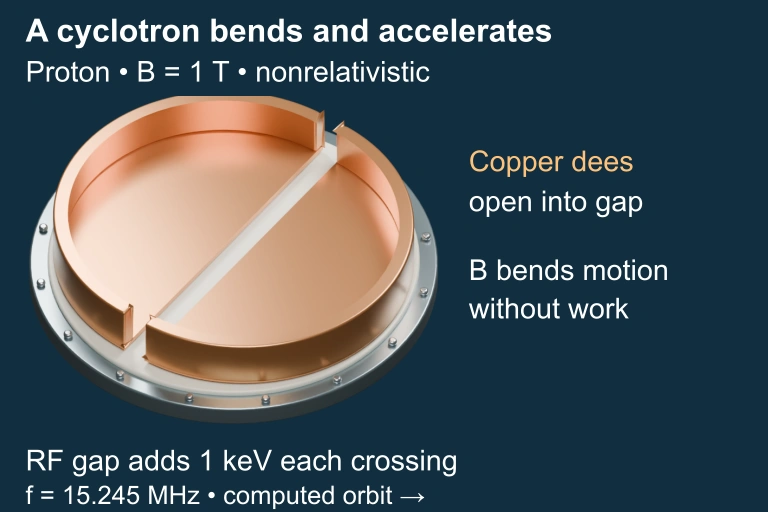
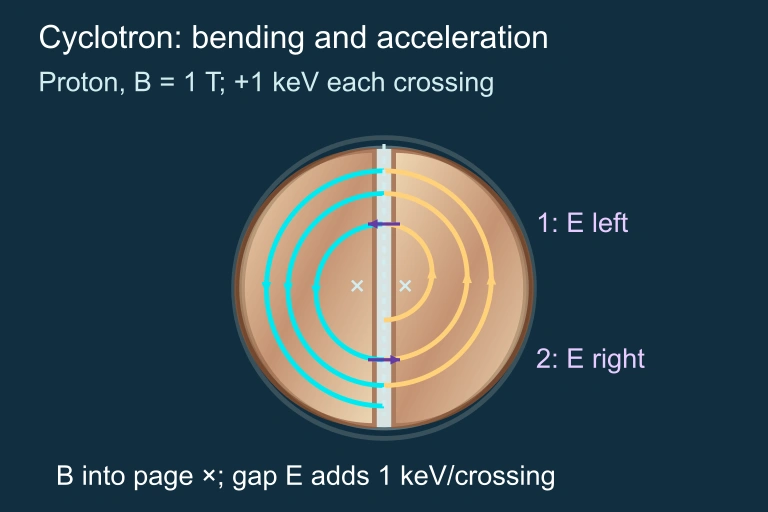
An ideal proton cyclotron
In this separate nonrelativistic B = 1 T model, the magnetic field bends the proton without doing work; alternating electric gap fields add 1 keV on each crossing.
Electric vs. Magnetic Forces
| Electric \( \vec{F}_E \) | Magnetic \( \vec{F}_B \) | |
|---|---|---|
| Source | Electric field \( \vec{E} \) | Magnetic field \( \vec{B} \) |
| Formula | \( \vec{F} = q\vec{E} \) | \( \vec{F} = q\vec{v} \times \vec{B} \) |
| Acts on | All charges (static or moving) | Only moving charges |
| Direction | Parallel to \( \vec{E} \) | Perpendicular to both \( \vec{v} \) and \( \vec{B} \) |
| Does work? | Yes | No |
| Changes speed? | Yes | No (only direction) |
Force on a Current-Carrying Wire
A wire carrying current \( I \) through a magnetic field also experiences a force, since current is just moving charges in bulk:
How to Apply \( F = |q|vB\sin\theta \)
Example 1: Proton in a Field
A proton (\( q = 1.6 \times 10^{-19} \, \text{C} \)) moves at \( v = 3.0 \times 10^6 \, \text{m/s} \) perpendicular to a uniform magnetic field of \( B = 0.50 \, \text{T} \). Find the magnetic force on the proton.
Example 2: Radius of Curvature
An electron (\( m = 9.11 \times 10^{-31} \, \text{kg} \), \( |q| = 1.6 \times 10^{-19} \, \text{C} \)) enters a \( 0.20 \, \text{T} \) field at \( v = 5.0 \times 10^6 \, \text{m/s} \) perpendicular to \( \vec{B} \). Find the radius of its circular path.
Example 3: Force on a Wire
A straight wire of length \( L = 0.30 \, \text{m} \) carries a current \( I = 4.0 \, \text{A} \) at an angle of \( 60^\circ \) to a \( 0.80 \, \text{T} \) magnetic field. Find the force on the wire.
Helical Motion: When \( \vec{v} \) Has Two Components
If a charged particle's velocity has components both parallel and perpendicular to \( \vec{B} \), it traces a helix. The parallel component is unaffected; the perpendicular component produces circular motion.
Common Mistakes
Summary of Key Formulas
| Quantity | Formula | Key Notes |
|---|---|---|
| Magnetic force (charge) | \( F = |q|vB\sin\theta \) | Perpendicular to \( \vec{v} \) and \( \vec{B} \) |
| Magnetic force (wire) | \( F = BIL\sin\theta \) | Basis of electric motors |
| Radius of curvature | \( r = \frac{mv}{|q|B} \) | When \( \vec{v} \perp \vec{B} \) |
| Period of orbit | \( T = \frac{2\pi m}{|q|B} \) | Independent of speed |
| Work done by \( \vec{F}_B \) | \( W = 0 \) | Always zero |
Question 1 of 5
A proton moves east through a magnetic field that points north. What is the direction of the magnetic force on the proton?
Question 2 of 5
A charged particle moves parallel to a uniform magnetic field. What is the magnetic force on the particle?
Question 3 of 5
An electron enters a uniform magnetic field and moves in a circle of radius \( r \). If the electron's speed is doubled, the new radius is:
Question 4 of 5
A magnetic force acts on a moving charged particle. Which of the following quantities can the magnetic force change?
Question 5 of 5
A 0.50 m wire carrying 6.0 A of current is placed perpendicular to a 0.40 T magnetic field. What is the force on the wire?
\( F = (0.40)(6.0)(0.50)(1) = 1.2 \, \text{N} \).