Magnetism and
Current-Carrying Wires
Explore how electric currents create magnetic fields, how wires experience forces in external fields, and master the right-hand rules that connect them.
What Is a Magnetic Field?
A magnetic field (\(\vec{B}\)) is a vector field that describes the magnetic influence on moving charges, electric currents, and magnetic materials. It is measured in tesla (T) in SI units.
Field Around a Straight Wire
A current \(I\) flowing through a long straight wire creates concentric circular magnetic field lines around it. The field strength decreases with distance \(r\) from the wire.
Why Does Current Create \(\vec{B}\)?
The connection between electric current and magnetism was discovered by Oersted in 1820. Two key laws quantify this relationship:
The Core Formula
Force on a Wire in a \(\vec{B}\) Field
A wire of length \(L\) carrying current \(I\) in an external magnetic field \(\vec{B}\) experiences a force. The angle \(\theta\) is between the current direction and \(\vec{B}\). Maximum force when \(\theta = 90^\circ\); zero force when parallel.
Right-Hand Rule for Force
Creating vs. Experiencing a Field
| Wire Creates \(\vec{B}\) | Wire in External \(\vec{B}\) | |
|---|---|---|
| Formula | \(B = \frac{\mu_0 I}{2\pi r}\) | \(F = BIL\sin\theta\) |
| What you find | Magnetic field magnitude | Force on the wire |
| Right-Hand Rule | Thumb = \(I\), fingers curl = \(\vec{B}\) | Fingers = \(I\), curl = \(\vec{B}\), thumb = \(\vec{F}\) |
| Depends on | \(I\) and \(r\) | \(B\), \(I\), \(L\), and \(\theta\) |
| Key insight | \(B \propto 1/r\) | Max when \(\vec{I} \perp \vec{B}\) |
Force Between Parallel Wires
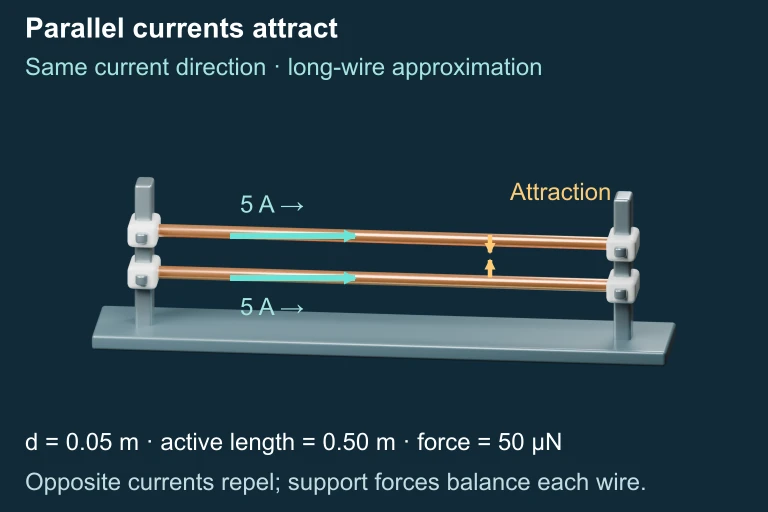
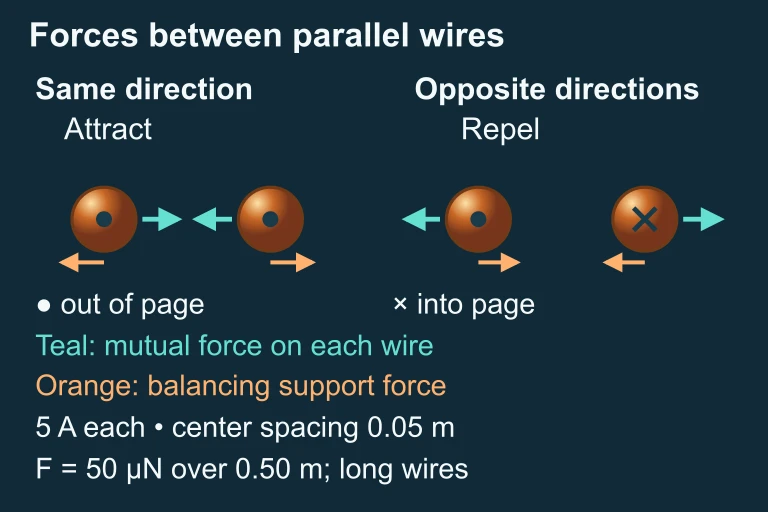
Same-direction currents attract; opposite-direction currents repel. This is the basis for defining the ampere in SI units.
Parallel-current comparison
This separate long-wire model uses 5 A in each wire, 0.05 m spacing and 0.50 m active length. Like-direction currents attract; opposite currents repel. Supports balance the mutual forces.
Inside a Solenoid
Inside a long solenoid, the field is uniform and parallel to the axis. Outside, it is approximately zero. Here \(n\) is the number of turns per unit length, \(N\) is total turns, and \(L\) is the solenoid length.
How to Solve Problems
Example 1: Field from a Wire
A long straight wire carries a current of \(I = 5\) A. Find the magnetic field at a distance \(r = 0.10\) m from the wire.
Example 2: Force on a Wire
A wire of length \(L = 0.50\) m carries \(I = 3.0\) A perpendicular to a uniform field \(B = 0.20\) T. What is the force?
Example 3: Two Parallel Wires
Two parallel wires separated by \(d = 0.05\) m carry currents \(I_1 = 4\) A and \(I_2 = 6\) A in the same direction. Find the force per unit length.
Common Mistakes
Summary of Key Formulas
| Scenario | Formula | Key Variable |
|---|---|---|
| Field from long wire | \(B = \frac{\mu_0 I}{2\pi r}\) | \(r\) = distance |
| Force on wire | \(F = BIL\sin\theta\) | \(\theta\) = angle |
| Two parallel wires | \(\frac{F}{L} = \frac{\mu_0 I_1 I_2}{2\pi d}\) | \(d\) = separation |
| Solenoid | \(B = \mu_0 n I\) | \(n\) = turns/length |
| Permeability | \(\mu_0 = 4\pi \times 10^{-7}\) | T·m/A |
Question 1 of 5
A long straight wire carries a current of 10 A. What is the magnetic field at a distance of 0.20 m from the wire?
Question 2 of 5
A wire carrying 4.0 A is placed in a uniform magnetic field of 0.50 T. The wire is 0.30 m long and oriented at 30° to the field. What is the force?
Question 3 of 5
Two parallel wires carry currents in opposite directions. The force between them is:
Question 4 of 5
A solenoid has 500 turns over a length of 0.25 m and carries a current of 2.0 A. What is the magnetic field inside?
Question 5 of 5
A current-carrying wire is placed parallel to a uniform external magnetic field. The force on the wire is: