Magnetic
Fields
Explore the invisible force fields created by moving charges and magnets: from field lines and the right-hand rule to the forces on charges and current-carrying wires.
What Is a Magnetic Field?
A magnetic field is a vector field that describes the magnetic influence on moving charges, electric currents, and magnetic materials. It is represented by the symbol \(\vec{B}\) and measured in tesla (T).
Field Lines and Their Properties
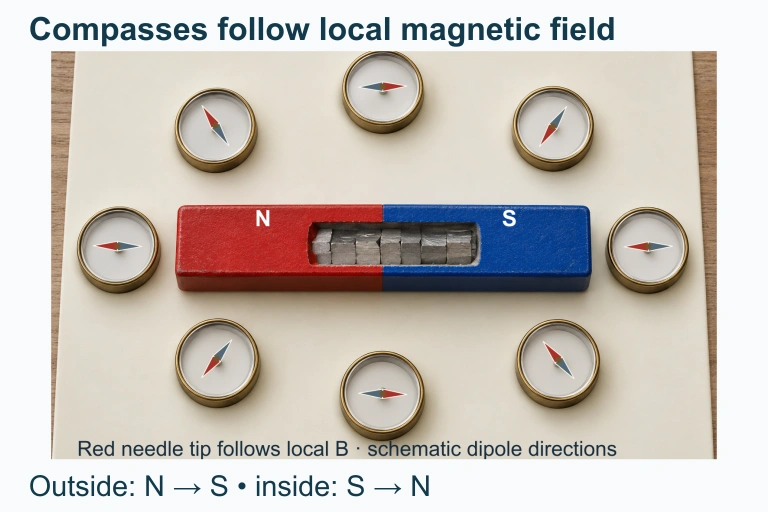
Compasses follow local field
The red north-seeking compass tips align with the local field; outside the bar magnet the field goes north to south and closes through the magnet.
Sources of Magnetic Fields
Every magnetic field ultimately originates from moving electric charges. Even permanent magnets owe their magnetism to electrons orbiting and spinning within atoms.
The Magnetic Force on a Moving Charge
The force is always perpendicular to both \(\vec{v}\) and \(\vec{B}\), so it does no work and changes only the direction of motion, not the speed.
The Right-Hand Rule
Force on a Current-Carrying Wire
The direction of \(\vec{L}\) follows the conventional current direction. Use the right-hand rule with your fingers along the current.
Electric vs Magnetic Fields
| Electric Field \(\vec{E}\) | Magnetic Field \(\vec{B}\) | |
|---|---|---|
| Source | Electric charges (stationary or moving) | Moving charges / currents only |
| Force on charge | \(\vec{F} = q\vec{E}\) | \(\vec{F} = q\vec{v}\times\vec{B}\) |
| Direction | Parallel to \(\vec{E}\) | Perpendicular to \(\vec{v}\) and \(\vec{B}\) |
| Work done | Can do work on charges | Does no work |
| Field lines | Start/end on charges | Always closed loops |
Circular Motion in a Uniform \(\vec{B}\)
Since the magnetic force is always perpendicular to velocity, a charged particle moving perpendicular to a uniform \(\vec{B}\) follows a circular path. Setting the magnetic force equal to the centripetal force:
Period and Cyclotron Frequency
The period (time for one full orbit) and cyclotron frequency depend only on the charge-to-mass ratio and the field strength: they are independent of speed.
How to Solve Magnetic Field Problems
Example 1: Force on a Proton
A proton (\(q = 1.6\times10^{-19}\,\text{C}\)) moves at \(v = 3.0\times10^{6}\,\text{m/s}\) perpendicular to a uniform field \(B = 0.50\,\text{T}\). Find the magnetic force.
Example 2: Orbital Radius
Using the same proton from Example 1 (\(m = 1.67\times10^{-27}\,\text{kg}\)), find the radius of its circular path.
Example 3: Force on a Wire
A wire of length \(L = 0.25\,\text{m}\) carries a current \(I = 4.0\,\text{A}\) at \(30^\circ\) to a \(B = 0.80\,\text{T}\) field. Find the force on the wire.
Common Mistakes
Key Formulas Summary
| Quantity | Formula | Key Insight |
|---|---|---|
| Force on charge | \(F = |q|vB\sin\theta\) | Perpendicular to \(\vec{v}\) and \(\vec{B}\) |
| Force on wire | \(F = BIL\sin\theta\) | Current replaces \(qv\) |
| Orbital radius | \(r = mv/(|q|B)\) | Proportional to momentum |
| Period | \(T = 2\pi m/(|q|B)\) | Independent of speed |
| Wire field | \(B = \mu_0 I/(2\pi r)\) | Drops off as \(1/r\) |
| Solenoid field | \(B = \mu_0 n I\) | Uniform inside |
Question 1 of 5
A proton moves due east through a magnetic field directed due north. In what direction is the magnetic force on the proton?
Question 2 of 5
A charged particle moves parallel to a uniform magnetic field. What happens to the particle?
Question 3 of 5
An electron (\(q = -1.6\times10^{-19}\,\text{C}\), \(m = 9.11\times10^{-31}\,\text{kg}\)) moves at \(2.0\times10^{7}\,\text{m/s}\) perpendicular to a \(0.10\,\text{T}\) field. What is the radius of its circular orbit?
Question 4 of 5
A 0.50 m wire carries 3.0 A of current perpendicular to a 0.20 T magnetic field. What is the force on the wire?
Question 5 of 5
If you double the speed of a charged particle in a uniform magnetic field, what happens to its orbital period?