Kirchhoff's
Loop Rule
Master the principle that the sum of voltage changes around any closed loop in a circuit equals zero: conservation of energy applied to electric circuits.
What Is a Circuit Loop?
A loop is any closed path through a circuit that starts and ends at the same point. You can trace along wires and components, returning to where you began without lifting your finger.
Conservation of Energy in Circuits
Electric potential is a property of position. When a charge travels around a complete loop and returns to its starting point, it must return to the same electric potential it started with.
Voltage Rises vs. Voltage Drops
The Loop Rule: Formal Statement
The algebraic sum of all voltage changes (rises and drops) encountered as you traverse any closed loop equals zero. This is a direct consequence of the conservation of energy.
Sign Conventions for Loop Traversal
Loop Rule vs. Junction Rule
| Loop Rule (KVL) | Junction Rule (KCL) | |
|---|---|---|
| Basis | Conservation of energy | Conservation of charge |
| Equation | \(\sum \Delta V = 0\) | \(\sum I_{\text{in}} = \sum I_{\text{out}}\) |
| Applied to | Any closed path | Any node / junction |
| What it sums | Voltage changes | Currents |
| When needed | Multi-loop circuits | Branching circuits |
How to Apply the Loop Rule
Example 1: Single Loop
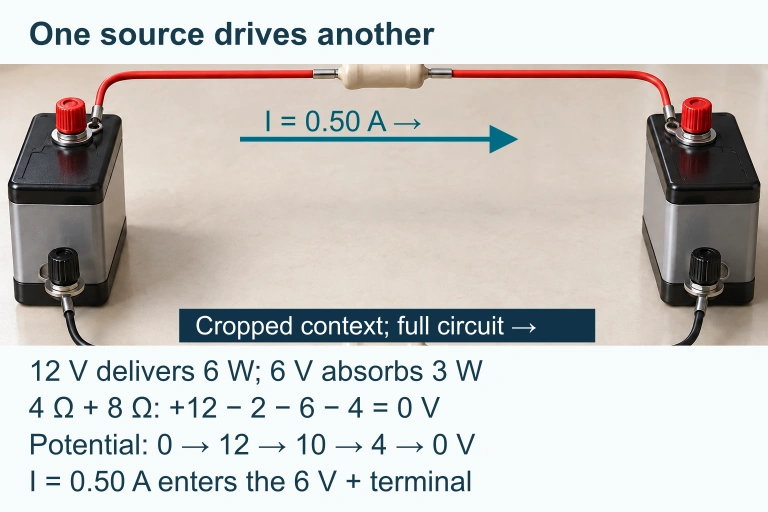
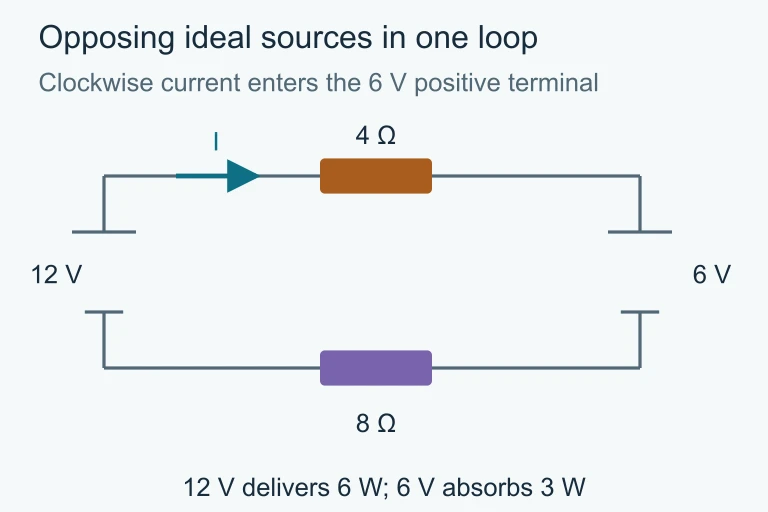
A separate opposing-source loop
This circuit has different resistor values from the existing worked example.
An ideal 12 V source opposes a 6 V source in series with 4 Ω and 8 Ω resistors. Find the loop current and the 6 V source power.
Show answer and explanation
The net 6 V across 12 Ω gives 0.50 A. Current enters the positive terminal of the 6 V source, which absorbs 3 W.
Verify Example 1
With \(I = 1\) A, check each voltage change:
Example 2: Two Batteries
Example 3: Multi-Loop Circuit
Solving the Multi-Loop System
\(4\left(\frac{5 - 2I_3}{3}\right) + 10I_3 - 20 = 0\)
\(4(5 - 2I_3) + 30I_3 - 60 = 0\)
\(20 - 8I_3 + 30I_3 - 60 = 0\)
\(22I_3 = 40 \implies I_3 = \frac{40}{22} = \frac{20}{11}\) A
\(I_2 = I_1 + I_3 = \frac{5}{11} + \frac{20}{11} = \frac{25}{11}\) A.
When Is the Loop Rule Most Useful?
Common Mistakes to Avoid
Summary: Key Concepts
| Concept | Details |
|---|---|
| Core Equation | \(\sum \Delta V = 0\) around any closed loop |
| Physical Basis | Conservation of energy |
| Battery (− to +) | \(+\varepsilon\) (voltage rise) |
| Battery (+ to −) | \(-\varepsilon\) (voltage drop) |
| Resistor (with \(I\)) | \(-IR\) (voltage drop) |
| Resistor (against \(I\)) | \(+IR\) (voltage rise) |
| Negative \(I\) result | Current flows opposite to assumed direction |
Question 1 of 5
Kirchhoff's Loop Rule is a direct consequence of the conservation of:
Question 2 of 5
A single-loop circuit has a 9 V battery and two resistors: \(R_1 = 3\;\Omega\) and \(R_2 = 6\;\Omega\) in series. What is the current in the loop?
Question 3 of 5
When you traverse a resistor in the direction of current flow, the voltage change across it is:
Question 4 of 5
A loop contains a 12 V battery and a 5 V battery (opposing), with a single \(7\;\Omega\) resistor. What is the current?
Question 5 of 5
If you solve a loop equation and find \(I = -2\) A, this means: