Kirchhoff's
Junction Rule
Master the conservation of charge at circuit nodes: understand why current in equals current out and how to solve complex circuit problems.
What Is Electric Current?
Electric current is the rate at which charge flows through a conductor. It is measured in amperes (A), where one ampere equals one coulomb of charge passing a point per second:
Current is a scalar quantity but has an assigned direction: conventional current flows from higher to lower electric potential (positive to negative).
Nodes and Junctions
A junction (or node) is any point in a circuit where three or more wires meet. At a junction, current can split into multiple paths or merge from multiple paths.
Why Conservation of Charge Matters
Charge is a conserved quantity: it cannot be created or destroyed. This is one of the fundamental laws of physics, similar to conservation of energy.
The Junction Rule: Formal Statement
Kirchhoff's Junction Rule (also called the Current Law or KCL) states:
Equivalently, if we assign positive signs to currents entering and negative signs to currents leaving:
Visualizing the Balance
A real battery bench with an internal-loss cutaway
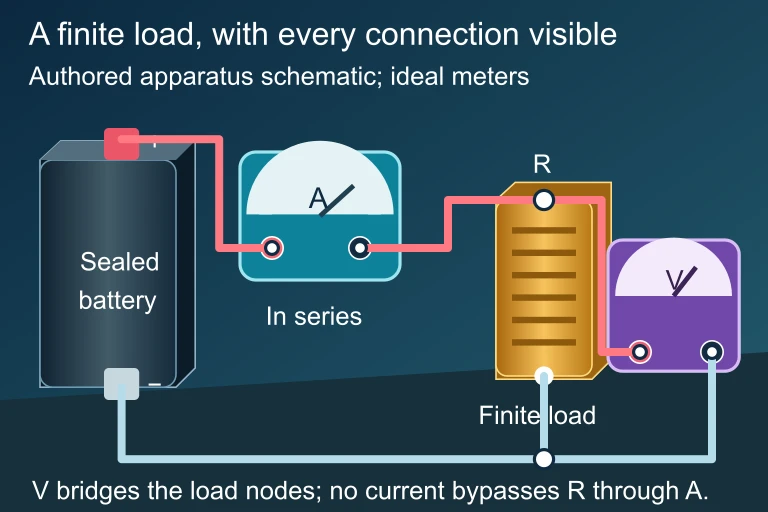 At a junction with no accumulating charge, the algebraic sum of branch currents is zero. A residual between measured incoming and outgoing currents needs uncertainty information before agreement can be assessed.
Current-balance residual
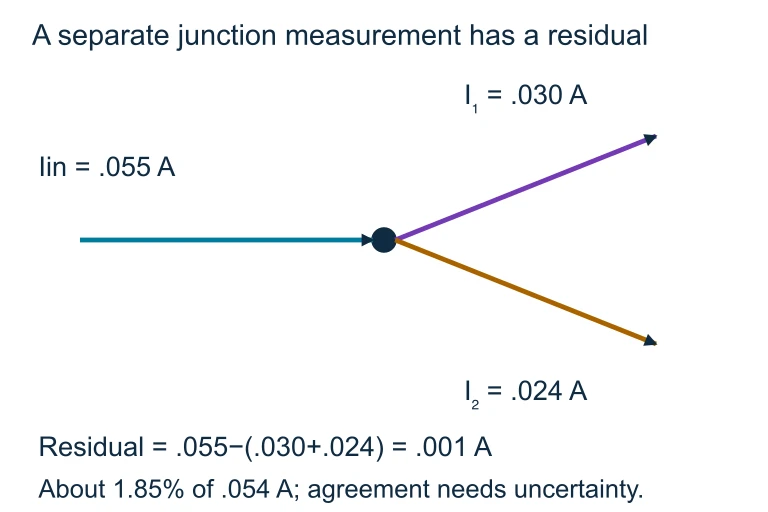 An incoming current 0.055 A and outgoing readings 0.030 A and 0.024 A leave a residual of 0.001 A. Deciding whether they agree with charge conservation requires the measurement uncertainties.
Junction Rule vs. Loop Rule
| Junction Rule (KCL) | Loop Rule (KVL) | |
|---|---|---|
| Conserves | Charge | Energy |
| Applies at | Junctions (nodes) | Closed loops |
| Equation | \( \sum I_{\text{in}} = \sum I_{\text{out}} \) | \( \sum \Delta V = 0 \) |
| Variables | Currents (\( I \)) | Voltages (\( V \)) |
| Use when | Current splits or merges | Traversing a closed path |
Series vs. Parallel Connections
In series, there are no junctions to analyze: the current is simply constant. In parallel, applying \( \sum I_{\text{in}} = \sum I_{\text{out}} \) at each junction gives you the relationship between branch currents.
How to Apply the Junction Rule
Example 1: Simple Junction
A junction has two incoming wires carrying \( I_1 = 4\,\text{A} \) and \( I_2 = 3\,\text{A} \). A single wire leaves the junction. Find the outgoing current \( I_3 \).
Example 2: Finding a Branch Current
At junction P, three branches meet. Current \( I_1 = 6\,\text{A} \) enters, while \( I_2 = 2\,\text{A} \) and \( I_3 \) leave. Find \( I_3 \).
Example 3: Two Junctions
A parallel circuit has two junctions, A and B. The total current from the battery is \( I = 10\,\text{A} \). At junction A, the current splits into three branches: \( I_1 = 3\,\text{A} \), \( I_2 = 5\,\text{A} \), and \( I_3 \). Find \( I_3 \) and verify at junction B.
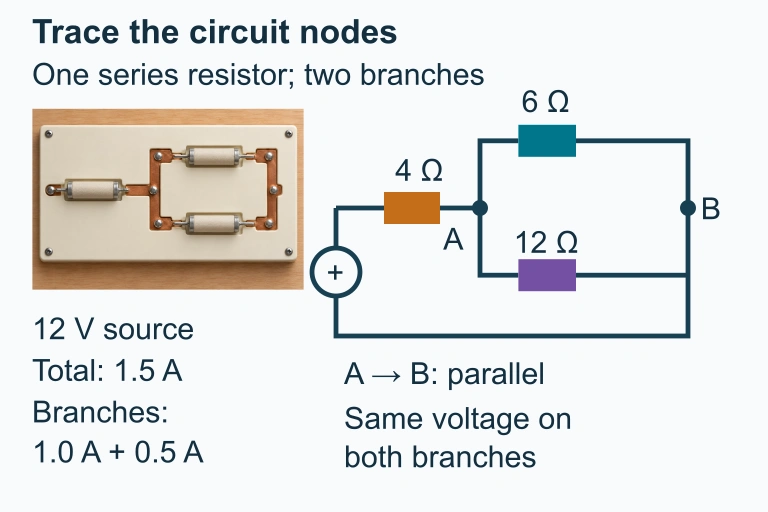
A separate compound-circuit example
This separate 12 V circuit uses 4 Ω in series with 6 Ω and 12 Ω in parallel. It supplements the deck’s existing junction example.
Find the current entering the parallel junction and the two branch currents.
Show answer and explanation
The parallel resistance is 4 Ω, so total resistance is 8 Ω and incoming current is 1.5 A. The 6 Ω branch carries 1.0 A and the 12 Ω branch carries 0.5 A; the currents sum to 1.5 A.
What If the Answer Is Negative?
When you solve a junction equation and get a negative value for a current, it simply means your assumed direction was wrong. The current actually flows in the opposite direction.
The Sign Convention
There are two equivalent ways to write the junction equation. Both give identical results:
List entering and leaving currents separately and set them equal.
Assign + to entering currents and - to leaving currents. Sum them all to zero.
Common Mistakes
Summary of Key Concepts
| Concept | Key Idea |
|---|---|
| Junction Rule | \( \sum I_{\text{in}} = \sum I_{\text{out}} \) |
| Basis | Conservation of charge |
| Applies at | Any node with 3+ wires |
| Alternative Form | \( \sum I_k = 0 \) |
| Negative Current | Direction is reversed |
| Paired With | Loop Rule (KVL) to solve circuits |
Question 1 of 5
At a junction, currents of 5 A and 3 A flow in. One wire carries 4 A out. What is the current in the other outgoing wire?
Question 2 of 5
Kirchhoff's Junction Rule is a direct consequence of the conservation of:
Question 3 of 5
Three wires meet at a junction. Wire A carries 7 A into the junction. Wire B carries 10 A out. What can you say about Wire C?
Question 4 of 5
You assume a current \( I_3 \) flows out of a junction and solve to get \( I_3 = -5\,\text{A} \). What does this mean?
Question 5 of 5
At a junction, four wires meet. Currents of 2 A, 5 A, and 1 A flow in. One wire carries current out. What is the outgoing current?