Kinetic Theory of
Temperature & Pressure
Explore how microscopic particle motion drives the macroscopic quantities \( T \) and \( P \) that govern the behavior of ideal gases.
What Is the Kinetic Theory of Gases?
The kinetic theory models a gas as a large collection of tiny particles in constant random motion. Every macroscopic property—pressure, temperature, and volume—emerges from the collective behavior of these particles.
Key Assumptions of the Model
Particles in Random Motion
Temperature = Average Kinetic Energy
For an ideal gas, the average translational kinetic energy per molecule is directly proportional to the absolute temperature:
This means temperature is not about how fast one molecule moves—it's about the average over all molecules. Double \( T \) and you double \( \overline{KE} \).
Root-Mean-Square Speed
Since \( \overline{KE} = \frac{1}{2}m v_{\text{rms}}^{2} \), we can solve for the rms speed of molecules:
Pressure from Molecular Collisions
Pressure is the force per unit area exerted on the container walls. Kinetic theory derives this from momentum transfer during elastic collisions:
This is the microscopic origin of the ideal gas law. More molecules, smaller volume, or faster speeds all mean more collisions per second and higher pressure.
A separate rigid-flask model
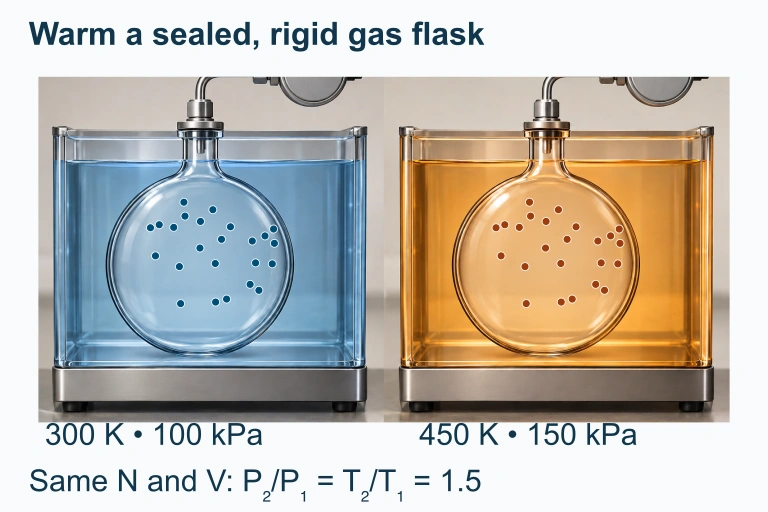
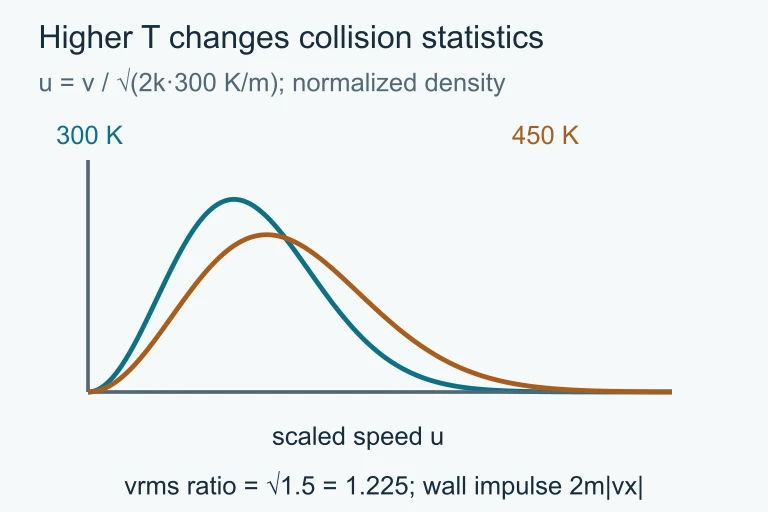
At fixed gas amount and volume, raising the temperature from 300 K to 450 K changes pressure from 100 kPa to 150 kPa. Dots represent molecules schematically; the companion shows normalized speed distributions.
Bridging Micro and Macro
Temperature vs Heat: Key Distinction
| Temperature \( T \) | Heat \( Q \) | |
|---|---|---|
| What is it? | Average KE per molecule | Energy transferred between systems |
| Depends on | Speed of molecules | Temperature difference, mass, material |
| Units | Kelvin (K) | Joules (J) |
| Extensive? | No (intensive) | Yes (extensive) |
| Kinetic theory | \( \overline{KE} = \frac{3}{2}k_BT \) | Net KE transfer via collisions |
Three Ways to Increase Pressure
The Maxwell-Boltzmann Distribution
How to Apply Kinetic Theory
Example 1: Average KE
Problem: Find the average translational kinetic energy of an oxygen molecule at room temperature (\( T = 300 \text{ K} \)).
Example 2: RMS Speed of \(\text{N}_2\)
Problem: What is the rms speed of nitrogen (\( \text{N}_2 \)) molecules at \( T = 500 \text{ K} \)? Molar mass \( M = 0.028 \text{ kg/mol} \).
Example 3: Pressure in a Container
Problem: A container of volume \( V = 0.02 \text{ m}^3 \) holds \( 5.0 \) moles of an ideal gas at \( T = 400 \text{ K} \). Find the pressure.
Common Mistakes
Summary of Key Equations
| Quantity | Equation | Key Dependence |
|---|---|---|
| Avg. KE per molecule | \( \frac{3}{2}k_BT \) | \( \propto T \) only |
| RMS speed | \( \sqrt{3RT/M} \) | \( \propto \sqrt{T/M} \) |
| Pressure (kinetic) | \( \frac{1}{3}\frac{N}{V}mv_{\text{rms}}^2 \) | \( \propto N, T, 1/V \) |
| Ideal gas law | \( PV = nRT \) | Macro form |
| Boltzmann form | \( PV = Nk_BT \) | Micro form |
Question 1 of 5
Two ideal gases, helium (\( M = 0.004 \text{ kg/mol} \)) and argon (\( M = 0.040 \text{ kg/mol} \)), are at the same temperature. Which statement is correct?
Question 2 of 5
If the absolute temperature of an ideal gas is tripled, by what factor does the rms speed change?
Question 3 of 5
A sealed container of gas is heated from \(300 \text{ K}\) to \(600 \text{ K}\) at constant volume. The pressure:
Question 4 of 5
According to kinetic theory, gas pressure arises from:
Question 5 of 5
The average translational kinetic energy of gas molecules at \( T = 600 \text{ K} \) is closest to: