Images Formed
by Mirrors
Explore how plane and curved mirrors form images using the laws of reflection and the mirror equation.
What Is an Image?
An image is the point from which reflected light rays appear to diverge or actually converge. When you look in a mirror, you perceive an object at a location determined by where the reflected rays meet or appear to meet.
The Law of Reflection
Plane Mirror Images
Concave vs Convex Mirrors
Key Mirror Terms
The Mirror Equation
$$\frac{1}{f} = \frac{1}{d_o} + \frac{1}{d_i}$$
Magnification Equation
$$m = \frac{h_i}{h_o} = -\frac{d_i}{d_o}$$
Concave: Object Beyond C
Concave: Object Between F and C
Concave: Object Inside F
Real vs Virtual Images
| Real Image | Virtual Image | |
|---|---|---|
| Light rays | Actually converge | Appear to diverge |
| Screen projection | Yes | No |
| Orientation | Inverted | Upright |
| \(d_i\) sign | Positive (\(+\)) | Negative (\(-\)) |
| \(m\) sign | Negative (inverted) | Positive (upright) |
| Location | In front of mirror | Behind mirror |
A concave mirror makes an image hang in front of it
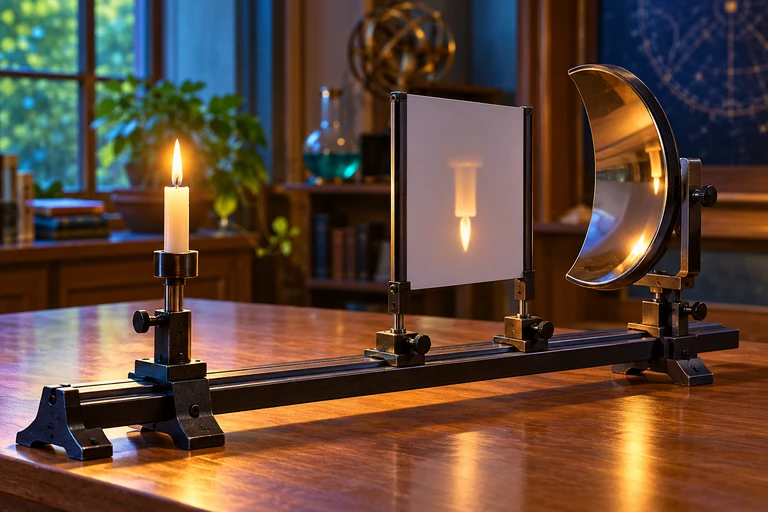 A concave mirror forms a real image where reflected rays converge. When the object is inside the focal length, the reflected rays diverge and their backward extensions locate an upright virtual image.
Real image in a concave mirror
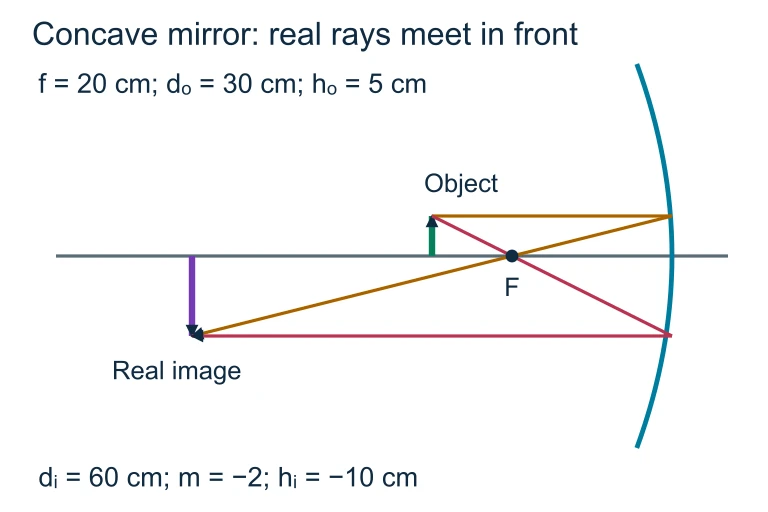 With focal length 20 cm, an object 30 cm in front of the mirror forms a real image 60 cm in front. A 5 cm object gives an inverted 10 cm image.
Virtual image inside the focal length
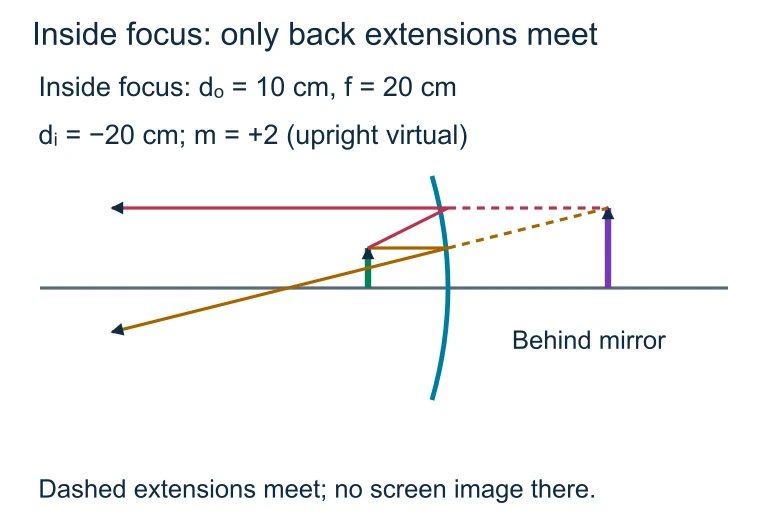 An object 10 cm in front of a concave mirror with f = 20 cm has image distance −20 cm and magnification +2. Only backward extensions meet behind the mirror.
How to Solve Mirror Problems
Example 1: Concave Mirror
An object is placed \(30\,\text{cm}\) from a concave mirror with focal length \(f = 10\,\text{cm}\). Find the image distance and magnification.
Example 2: Convex Mirror
An object is placed \(20\,\text{cm}\) from a convex mirror with focal length \(f = -15\,\text{cm}\). Describe the image.
Example 3: Finding Focal Length
A concave mirror produces a real image that is \(3\times\) the size of the object. If the object is at \(d_o = 20\,\text{cm}\), find the focal length.
Common Mistakes
Concave Mirror Image Summary
| Object Position | Image Position | Image Type | Size |
|---|---|---|---|
| Beyond C | Between F and C | Real, inverted | Diminished |
| At C | At C | Real, inverted | Same size |
| Between F and C | Beyond C | Real, inverted | Enlarged |
| At F | At infinity | No image | — |
| Inside F | Behind mirror | Virtual, upright | Enlarged |
Question 1 of 5
An object is placed at the center of curvature of a concave mirror. What type of image is formed?
Question 2 of 5
A convex mirror has a radius of curvature of 40 cm. What is its focal length?
Question 3 of 5
An object is placed 5 cm from a concave mirror with \(f = 10\,\text{cm}\). The image is:
Question 4 of 5
If the magnification of a mirror is \(m = -0.5\), the image is:
Question 5 of 5
An object is placed 12 cm from a concave mirror. The image forms at +60 cm. What is the focal length?