Images Formed by
Lenses
Explore how converging and diverging lenses bend light to form real and virtual images, governed by the thin lens equation.
What is a Lens?
A lens is a transparent optical element with curved surfaces that refracts light to either converge or diverge rays. Lenses are fundamental to cameras, eyeglasses, microscopes, and telescopes.
Key Vocabulary
Anatomy of a Converging Lens
The Thin Lens Equation
$$ \frac{1}{f} = \frac{1}{d_o} + \frac{1}{d_i} $$
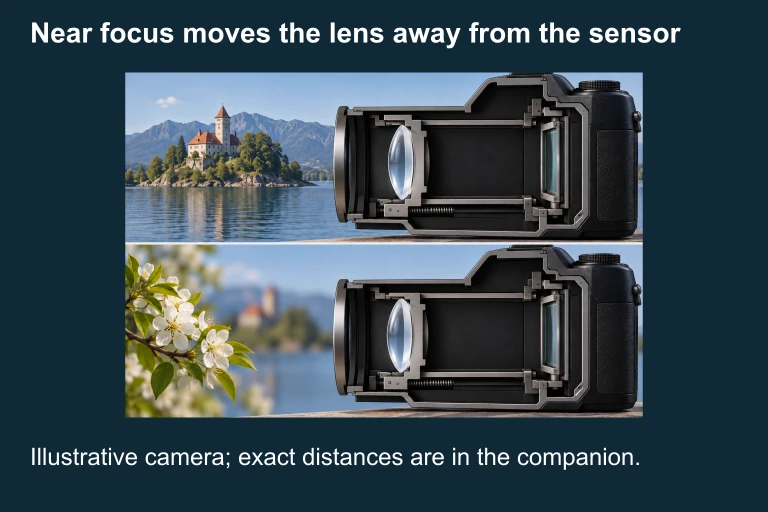
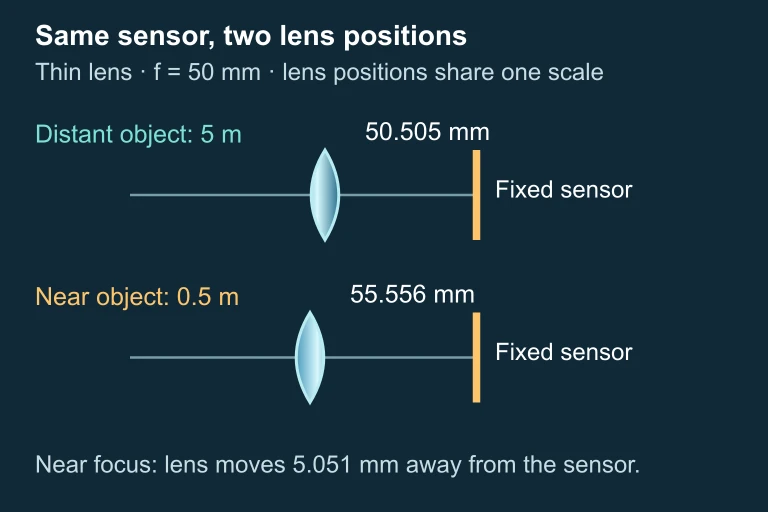
A separate camera-focusing model
Assume a 50 mm thin lens and a fixed sensor.
How does lens-to-sensor distance change as an object moves from 5 m to 0.5 m?
Show answer and explanation
The thin-lens model gives 50.505 mm and 55.556 mm respectively: the lens moves about 5.051 mm away from the sensor.
Magnification Equation
$$ m = \frac{h_i}{h_o} = -\frac{d_i}{d_o} $$
Converging vs Diverging Lenses
| Converging (Convex) | Diverging (Concave) | |
|---|---|---|
| Shape | Thicker in center | Thinner in center |
| Focal length | \( f > 0 \) | \( f < 0 \) |
| Parallel rays | Converge to \( F' \) | Diverge from \( F \) |
| Image type | Real or virtual | Always virtual |
| Image orientation | Inverted (real) or upright (virtual) | Always upright |
Converging Lens: Image Cases
A projection bench that crosses from real to virtual images
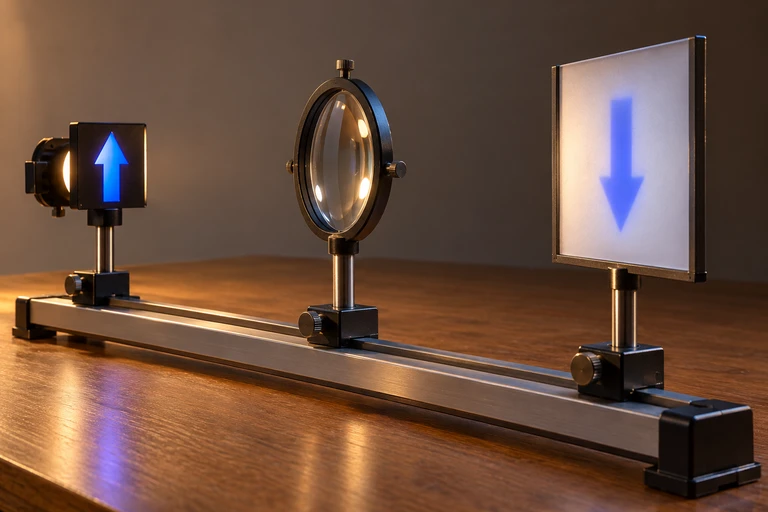 A converging lens can focus a real image onto a screen or form a virtual image whose location is found from backward ray extensions. Each panel states its own focal length, object distance and object height.
Real image on a screen
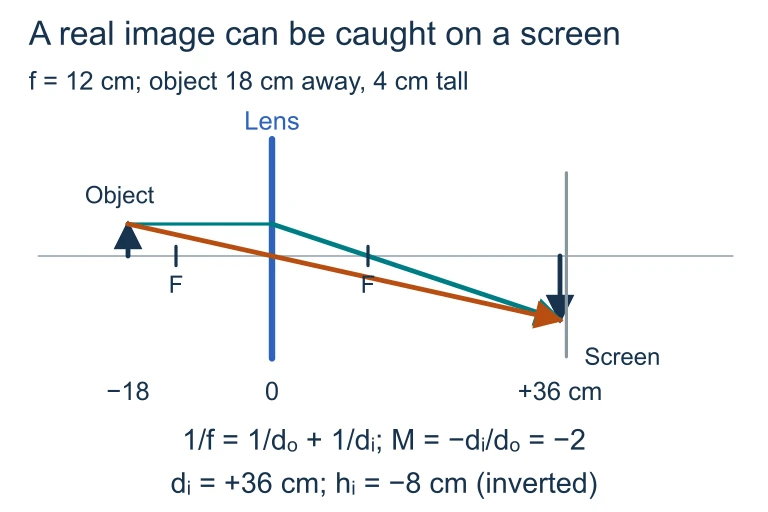 For a converging lens with f = 12 cm, an object 18 cm away and 4 cm tall forms an image 36 cm beyond the lens. Magnification is −2 and image height is −8 cm.
Virtual image in a converging lens
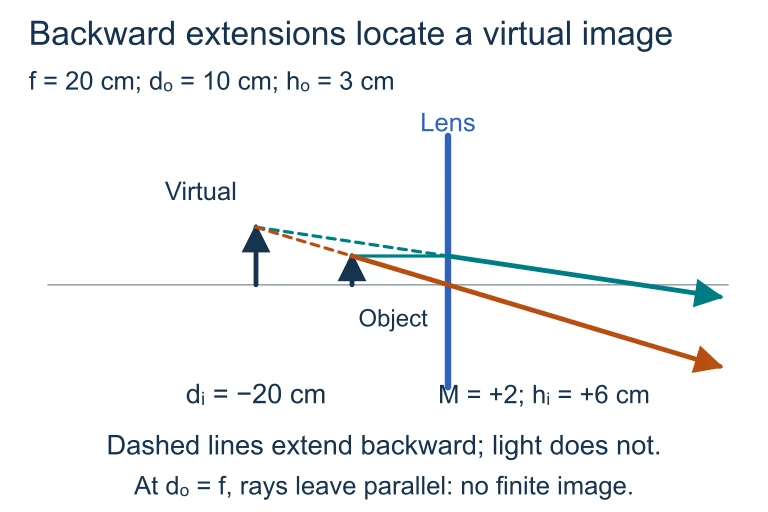 With f = 20 cm and object distance 10 cm, the image distance is −20 cm. A 3 cm object forms an upright 6 cm virtual image; dashed lines extend the rays backward.
Successive images in two lenses
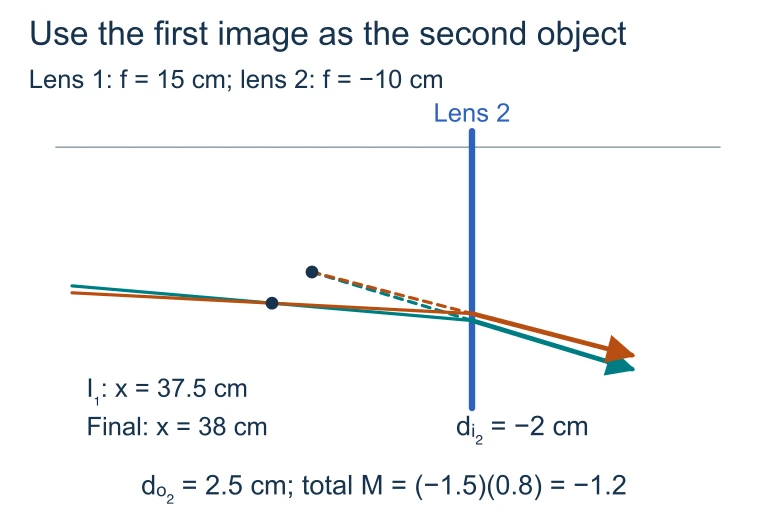 Use the first image as the second lens’s object. Here the first image is at x = 37.5 cm, the second lens is at x = 40 cm and the final image is at x = 38 cm; total magnification is −1.2.
Diverging Lens Ray Diagram
How to Apply the Thin Lens Equation
Example 1: Converging Lens
An object is placed 30 cm from a converging lens with focal length \( f = 10 \) cm. Find the image distance and magnification.
Example 2: Virtual Image (Converging)
An object is placed 5 cm from a converging lens with \( f = \) 10 cm. Where does the image form?
Example 3: Diverging Lens
An object is placed 20 cm from a diverging lens with \( f = \) \(-15\) cm. Find the image location and characteristics.
Lens Power
$$ P = \frac{1}{f} $$
The power of a lens is measured in diopters (D), where \( f \) is in meters. A stronger lens bends light more sharply.
Common Mistakes
Summary of Image Properties
| Object Position | Image Type | Orientation | Size |
|---|---|---|---|
| \( d_o > 2f \) (converging) | Real | Inverted | Diminished |
| \( d_o = 2f \) | Real | Inverted | Same size |
| \( f < d_o < 2f \) | Real | Inverted | Magnified |
| \( d_o < f \) (converging) | Virtual | Upright | Magnified |
| Any \( d_o \) (diverging) | Virtual | Upright | Diminished |
Question 1 of 5
An object is placed at a distance of \( 2f \) from a converging lens. What are the characteristics of the image formed?
Question 2 of 5
A diverging lens with \( f = -20 \) cm has an object placed 40 cm away. What is the image distance \( d_i \)?
Question 3 of 5
An object placed inside the focal point of a converging lens produces what type of image?
Question 4 of 5
A lens has a focal length of +25 cm. What is its power in diopters?
Question 5 of 5
If the magnification of a lens system is \( m = -3 \), which of the following is true about the image?