01 / 21

Fission, Fusion, and
Nuclear Decay

Explore how nuclei split, combine, and transform through the fundamental processes that power stars and reactors.

AP Physics 2

Inside the Atomic Nucleus

The nucleus contains protons (positive charge) and neutrons (no charge), collectively called nucleons. We describe any nucleus with two numbers:

\( Z \): Atomic Number
Number of protons: determines the element's identity.
\( A \): Mass Number
Total nucleons: \( A = Z + N \), where \( N \) is the neutron count.

Binding Energy and Mass Defect

The mass of a nucleus is always less than the sum of its individual nucleons. This missing mass, called the mass defect \( \Delta m \), is converted into energy that holds the nucleus together.

Mass Number (A) Binding Energy / Nucleon (MeV) 0 2 4 6 8 Fe-56 Fusion Fission H He C Pb U

Why Nuclei Transform

Nuclei "want" to reach the highest binding energy per nucleon: the peak near iron-56. Light nuclei get there by fusing; heavy nuclei get there by splitting. Unstable nuclei that can do neither undergo radioactive decay to move toward stability.

1
Fusion: light nuclei combine, climbing up the binding-energy curve.
2
Fission: heavy nuclei split, sliding down from the right side of the curve.
3
Decay: unstable nuclei emit particles or energy to reach a more stable configuration.

Nuclear Fission: Splitting Heavy Nuclei

n U-235 (absorbs n) U-236* Ba-141 (Z=56) Kr-92 (Z=36) 3n + Energy (~200 MeV)

Reactor moderation and cooling

These schematic panels distinguish fuel, neutron moderation and absorption, and the separate coolant loops. Decay heat persists after fission is reduced.
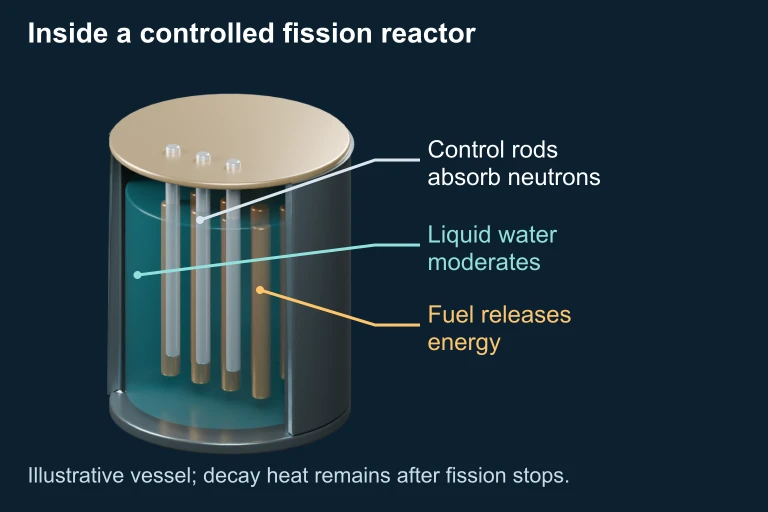
PWR fuel releases fission energy; water moderates; rods absorb neutrons; decay heat persists.
In a pressurized-water reactor, fuel releases fission energy, water moderates neutrons, and control rods absorb neutrons. Decay heat persists after fission is reduced.
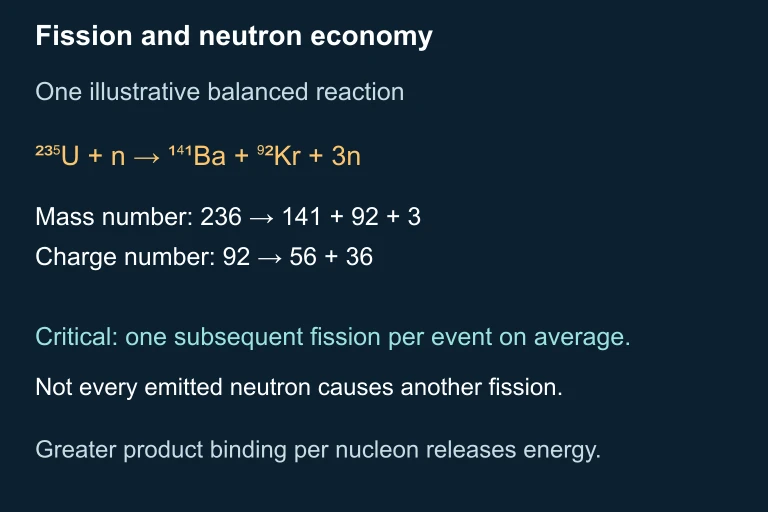
Balanced U-235 fission reaction and neutron economy distinguish continuing, escaping and absorbed neutrons.
Balanced reaction and neutron economy.
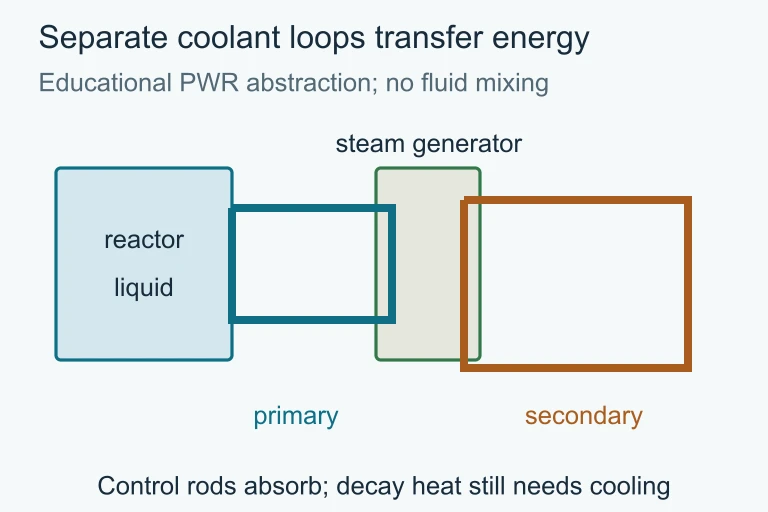
Water moderates neutrons, control rods absorb neutrons, and coolant removes heat. The primary coolant transfers energy through the steam generator to a separate secondary loop without mixing the fluids. Heat removal remains necessary after fission is reduced because decay heat persists.

Nuclear Fusion: Combining Light Nuclei

D (H-2) T (H-3) He-5* He-4 (alpha) n + 17.6 MeV

Charged and neutral fusion products

The deuterium–tritium example produces a charged alpha and a neutral neutron. A purely toroidal field alone does not establish stable confinement.
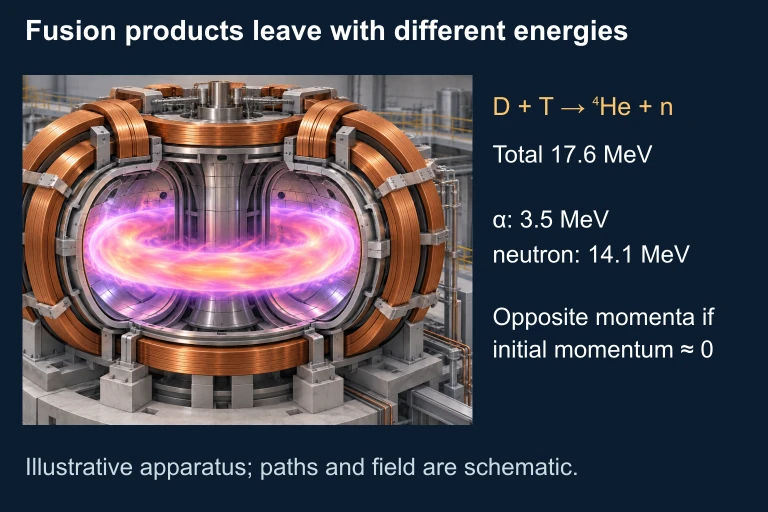
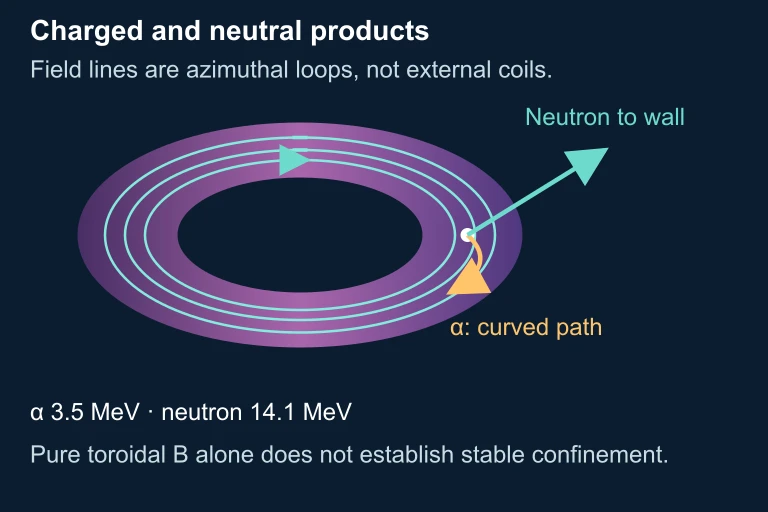
D+T→He-4+n releases 17.6 MeV, partitioned 3.5/14.1 MeV; equal opposite momenta stated.
Deuterium–tritium fusion produces a charged alpha particle and a neutral neutron with about 17.6 MeV total kinetic energy. The vessel is illustrative.
Alpha path bends in magnetic field, neutral neutron passes out; schematic confinement limitation is explicit.
Retained magnetic-field schematic; pure toroidal field alone does not establish stable confinement.

Types of Radioactive Decay

Unstable nuclei spontaneously emit particles or photons to become more stable. The three primary types of decay differ in what is emitted and how they change \( Z \) and \( A \).

\( \alpha \) Decay
Emits \( {}^{4}_{2}\text{He} \). Changes: \( Z \to Z - 2 \), \( A \to A - 4 \).
\( \beta^{-} \) Decay
A neutron becomes a proton, emitting an electron and antineutrino. \( Z \to Z + 1 \), \( A \) unchanged.
\( \gamma \) Decay
Excited nucleus emits a high-energy photon. Both \( Z \) and \( A \) are unchanged.

Conservation Laws in Nuclear Reactions

Every nuclear reaction must obey these conservation rules. Use them to predict unknown products and verify equations.

1
Conservation of nucleon number (mass number): total \( A \) on the left equals total \( A \) on the right.
2
Conservation of charge (atomic number): total \( Z \) on the left equals total \( Z \) on the right.
3
Conservation of energy: total energy (including mass-energy) is conserved. The Q-value \( Q = (m_{\text{reactants}} - m_{\text{products}})c^2 \) gives the energy released or absorbed.
4
Conservation of momentum: total momentum of all particles before and after is equal.

Fission vs. Fusion: Key Distinctions

Fission Fusion
Process Heavy nucleus splits Light nuclei combine
Fuel U-235, Pu-239 H-2, H-3, He-3
Conditions Neutron bombardment \( \sim 10^7 \) K temperature
Energy per Reaction ~200 MeV ~17.6 MeV (D-T)
Energy per Nucleon ~0.9 MeV ~3.5 MeV
Radioactive Waste Significant Minimal
Current Use Power plants Stars; research reactors

Half-Life and Exponential Decay

Radioactive decay is a random, statistical process. The half-life \( t_{1/2} \) is the time for half of the radioactive atoms in a sample to decay.

Time (half-lives)
\( \frac{N}{N_0} \)
1.0 0.75 0.50 0.25 0 0 1 2 3 4 5 1/2 1/4

How to Balance Nuclear Equations

1
Write the known species: identify the parent nucleus and the emitted particle (or the reaction type).
2
Balance mass numbers (\( A \)): total \( A \) on the left must equal total \( A \) on the right.
3
Balance atomic numbers (\( Z \)): total \( Z \) on the left must equal total \( Z \) on the right.
4
Identify the unknown: use \( A \) and \( Z \) of the unknown product to determine the element from the periodic table.
5
Verify: double-check that both \( A \) and \( Z \) balance, and that the element matches \( Z \).

Example 1: \( \alpha \) Decay of Radium-226

Problem: Radium-226 undergoes alpha decay. Write the complete nuclear equation and identify the daughter nucleus.

1
Parent and emission: \( {}^{226}_{88}\text{Ra} \rightarrow {}^{A}_{Z}X + {}^{4}_{2}\text{He} \)
2
Balance \( A \): \( 226 = A + 4 \), so \( A = 222 \).
3
Balance \( Z \): \( 88 = Z + 2 \), so \( Z = 86 \). Element 86 is Radon (Rn).

Example 2: \( \beta^{-} \) Decay of Carbon-14

Problem: Carbon-14 undergoes \( \beta^{-} \) decay. Find the daughter nucleus and calculate the energy released if the mass difference is \( \Delta m = 2.78 \times 10^{-31} \) kg.

1
Equation: \( {}^{14}_{6}\text{C} \rightarrow {}^{A}_{Z}X + {}^{\;0}_{-1}e + \bar{\nu}_e \)
2
Balance \( A \): \( 14 = A + 0 \), so \( A = 14 \).
3
Balance \( Z \): \( 6 = Z + (-1) \), so \( Z = 7 \). Element 7 is Nitrogen (N).
4
Energy: \( E = \Delta m \cdot c^2 = (2.78 \times 10^{-31})(3.0 \times 10^8)^2 = 2.50 \times 10^{-14} \) J \( \approx 0.156 \) MeV

Example 3: Half-Life Calculation

Problem: A sample initially contains \( 8.0 \times 10^{20} \) atoms of iodine-131 (\( t_{1/2} = 8.0 \) days). How many atoms remain after 24 days?

1
Count half-lives: \( \frac{24}{8.0} = 3 \) half-lives.
2
Apply decay formula: \( N = N_0 \left(\frac{1}{2}\right)^3 = N_0 \times \frac{1}{8} \).
3
Calculate: \( N = \frac{8.0 \times 10^{20}}{8} = 1.0 \times 10^{20} \) atoms.

Common Mistakes to Avoid

✕ Forgetting the Electron's \( Z \)
In \( \beta^{-} \) decay, the electron has \( Z = -1 \), not 0. Omitting this makes \( Z \) unbalanced.
✕ Confusing Energy per Nucleon
Fusion releases more energy per nucleon than fission, not more total energy per reaction.
✕ Half-Life Division Errors
Dividing remaining atoms by 2 repeatedly is correct: do NOT subtract half the original each time.

Decay Types at a Glance

Property \( \alpha \) \( \beta^{-} \) \( \beta^{+} \) \( \gamma \)
Particle \( {}^{4}_{2}\text{He} \) \( {}^{\;0}_{-1}e \) \( {}^{0}_{+1}e \) Photon
\( \Delta Z \) \(-2\) \(+1\) \(-1\) 0
\( \Delta A \) \(-4\) 0 0 0
Penetrating Power Low (paper stops it) Medium (aluminum) Medium (aluminum) High (lead/concrete)
Ionizing Power Highest Medium Medium Lowest

Question 1 of 5

Polonium-210 undergoes alpha decay. What is the daughter nucleus?

Question 2 of 5

Which process releases more energy per nucleon?

Question 3 of 5

A radioactive sample has a half-life of 5 hours. If you start with 400 g, how much remains after 15 hours?

Question 4 of 5

In \( \beta^{-} \) decay, a neutron transforms into a proton. Which conservation law determines that an electron must be emitted?

Question 5 of 5

The mass defect of a helium-4 nucleus is \( 0.0304 \) u. Given that \( 1\;\text{u} = 931.5\;\text{MeV}/c^2 \), what is the total binding energy?