Entropy & the
Second Law
Discover why disorder always increases, how \(\Delta S\) governs every spontaneous process, and what the Second Law really means for heat engines and the universe.
What Is Entropy?
Entropy (\(S\)) is a state function that measures the number of microscopic arrangements (microstates) consistent with a system's macroscopic properties. The more ways particles can be arranged while keeping the same temperature, pressure, and volume, the higher the entropy.
Microstates and Disorder
Why Does Entropy Matter?
The Second Law of Thermodynamics
This law does not forbid local entropy decreases: a refrigerator lowers the entropy inside, but the total entropy (system + surroundings) still increases.
Refrigerator energy balance
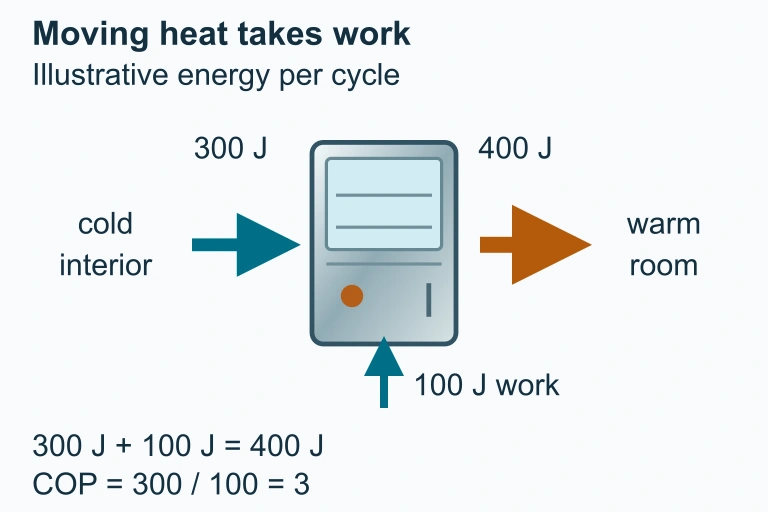
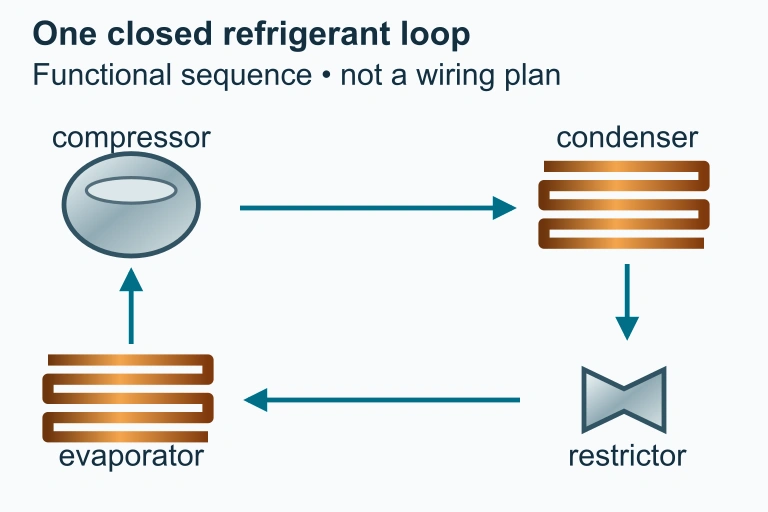
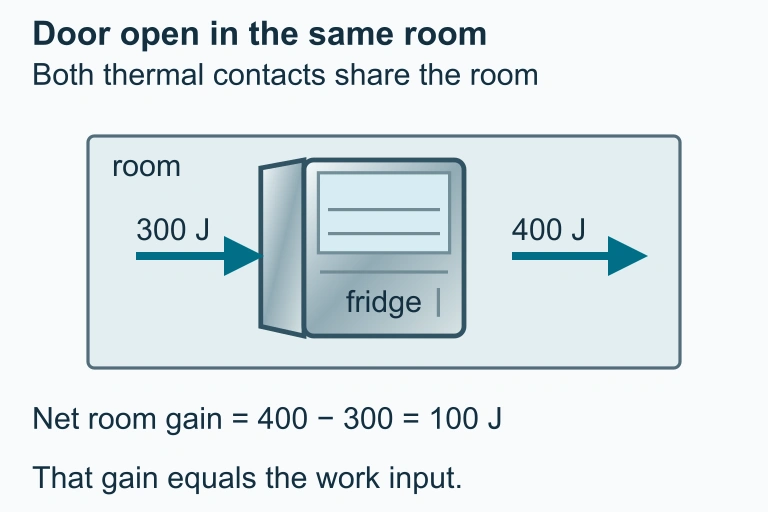
A separate illustrative cycle removes 300 J from a cold interior, receives 100 J of work, and rejects 400 J. The loop is functional, not a wiring diagram. When the open refrigerator exchanges heat with the same closed room, that room gains the work input.
Calculating \(\Delta S\)
Heat Engine and Entropy Flow
Reversible vs Irreversible
| Reversible | Irreversible | |
|---|---|---|
| Speed | Infinitely slow (quasi-static) | Finite speed |
| \(\Delta S_{\text{universe}}\) | = 0 | > 0 |
| Equilibrium | Always at equilibrium | System out of equilibrium |
| Examples | Ideal Carnot cycle | Free expansion, friction, mixing |
| Real-world? | Idealization only | All real processes |
The Carnot Limit
The only way to reach 100% efficiency is \(T_C = 0\) K, which is physically impossible by the Third Law.
How to Solve Entropy Problems
Example 1: Ice Melting
Problem: 0.50 kg of ice melts at \(0^\circ\text{C}\) (\(273\) K). The latent heat of fusion is \(L_f = 3.34 \times 10^5\) J/kg. What is the entropy change of the ice?
Example 2: Heat Transfer
Problem: 5000 J of heat flows from a hot reservoir at 500 K to a cold reservoir at 250 K. Find \(\Delta S_{\text{universe}}\).
Example 3: Carnot Efficiency
Problem: A Carnot engine operates between a hot source at 800 K and a cold sink at 300 K. If it absorbs \(Q_H = 2000\) J per cycle, find the work output and efficiency.
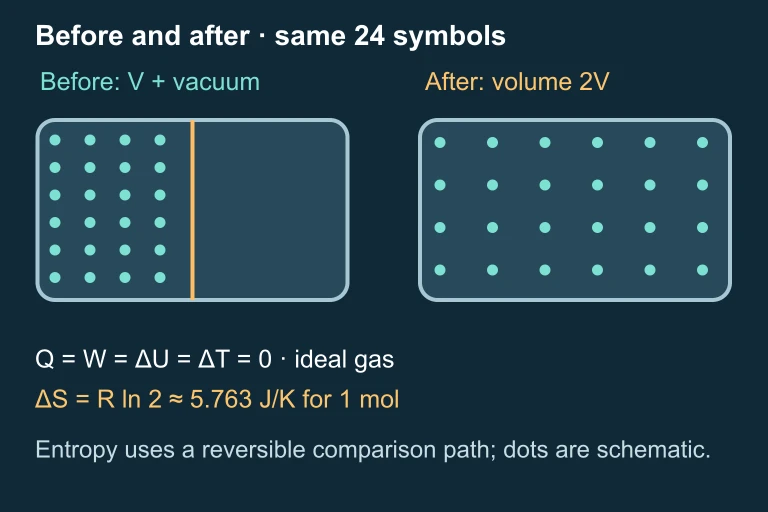
Free Expansion: \(Q = 0\) but \(\Delta S > 0\)
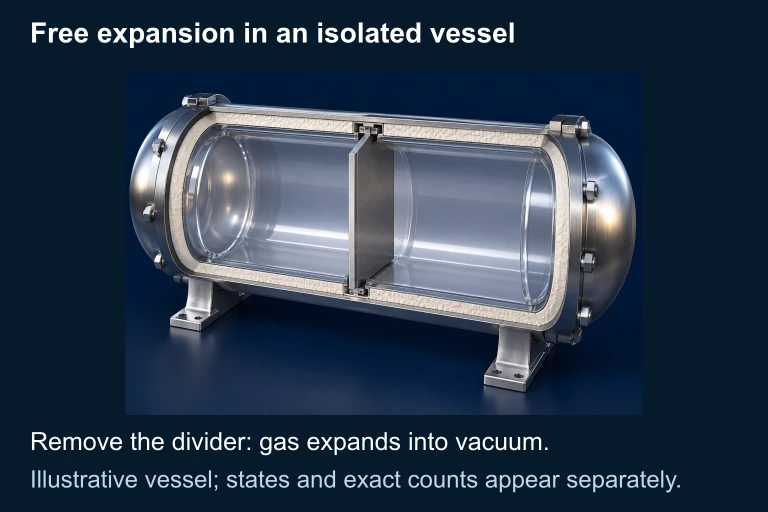
Ideal-gas free expansion
For one mole of ideal gas freely expanding from V to 2V into vacuum in an isolated rigid vessel, internal energy and temperature remain constant and entropy increases by R ln 2.
Common Mistakes
Key Formulas Summary
| Concept | Formula | Key Detail |
|---|---|---|
| Entropy change | \(\Delta S = \frac{Q_{\text{rev}}}{T}\) | Reversible process, constant \(T\) |
| Second Law | \(\Delta S_{\text{universe}} \geq 0\) | Equality for reversible only |
| Carnot efficiency | \(\eta = 1 - \frac{T_C}{T_H}\) | Max efficiency, both in K |
| Boltzmann entropy | \(S = k_B \ln \Omega\) | Microscopic definition |
| Engine work | \(W = Q_H - Q_C\) | Energy conservation |
Question 1 of 5
According to the Second Law of Thermodynamics, what happens to the total entropy of an isolated system during any spontaneous process?
Question 2 of 5
A Carnot engine operates between \(T_H = 600\) K and \(T_C = 200\) K. What is its maximum efficiency?
Question 3 of 5
2000 J of heat flows from a reservoir at 400 K to one at 200 K. What is the entropy change of the universe?
Question 4 of 5
During free expansion of an ideal gas into a vacuum, which of the following is true?
Question 5 of 5
A refrigerator removes heat from a cold space and deposits it in a warm room. Does this violate the Second Law?