Emission & Absorption
Spectra
Discover how atoms produce unique spectral fingerprints through quantized energy transitions, connecting quantum theory to real-world applications.
What Is a Spectrum?
When white light passes through a prism, it separates into a continuous band of colors: every wavelength from violet to red is present. This is a continuous spectrum.
Quantized Energy Levels
Electrons in atoms can only occupy discrete energy levels. They cannot exist between these levels. The energy of the \( n \)-th level in hydrogen is given by:
Photon Energy and Transitions
When an electron transitions between energy levels, it either emits or absorbs a photon whose energy equals the difference between the two levels:
The Emission Spectrum
When atoms in a hot, low-pressure gas are excited, electrons drop from higher to lower energy levels. Each transition produces a photon of a specific wavelength, creating bright colored lines on a dark background.
The Absorption Spectrum
When white light passes through a cool gas, atoms absorb photons at exactly the same wavelengths they would emit. The result: dark lines on an otherwise continuous rainbow background.
The Bohr Model Connection
Emission vs. Absorption
| Feature | Emission | Absorption |
|---|---|---|
| Appearance | Bright lines on dark background | Dark lines on rainbow background |
| Electron transition | Higher → Lower level | Lower → Higher level |
| Photon | Released | Absorbed |
| Source condition | Hot, low-pressure gas | Cool gas in front of white light |
| Line positions | Same wavelengths for same element | |
Three source conditions at one spectrometer
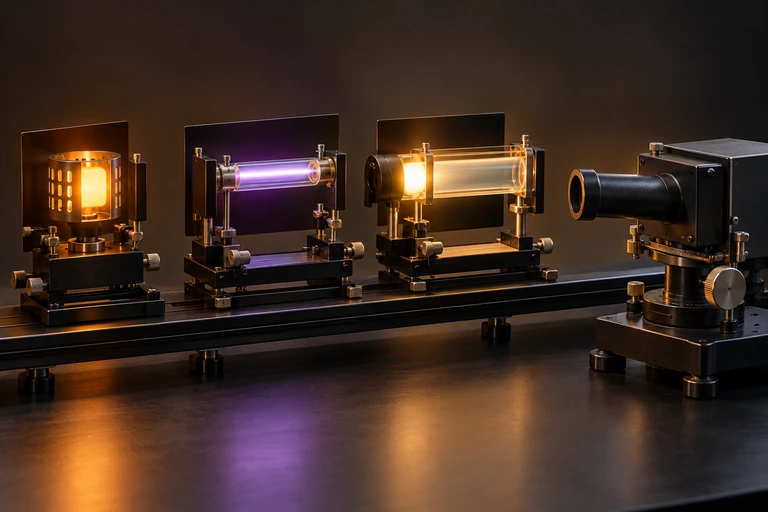 A dense thermal source produces a continuum, an excited dilute gas produces emission lines, and cooler gas in front of a continuum can produce absorption lines. Photon energies match allowed atomic energy differences.
Three source conditions at one spectrometer
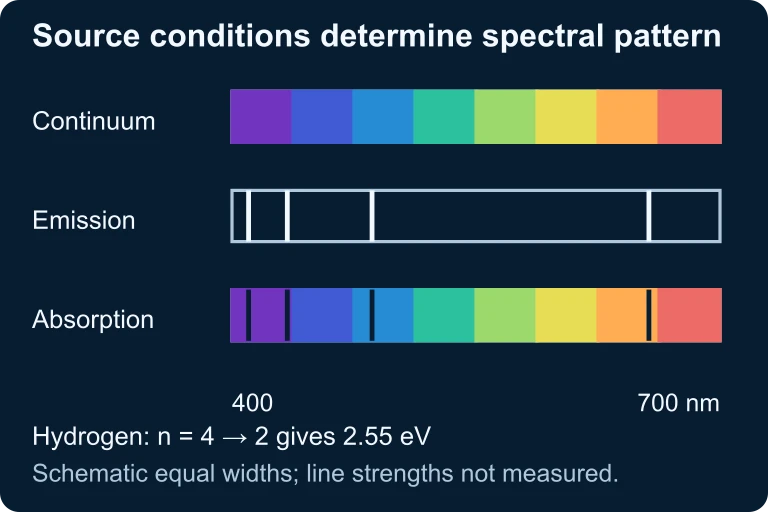 A dense thermal source produces a continuum, an excited dilute gas produces emission lines, and cooler gas in front of a continuum can produce absorption lines. Photon energies match allowed atomic energy differences.
Hydrogen Spectral Series
Hydrogen's emission lines are grouped into series based on the lower energy level of each transition:
How to Calculate Spectral Lines
Example 1: Balmer Series Transition
An electron in hydrogen drops from \( n = 3 \) to \( n = 2 \). Find the wavelength of the emitted photon.
Example 2: Lyman Series Photon
A photon is absorbed by a hydrogen atom, exciting the electron from \( n = 1 \) to \( n = 3 \). What is the photon's wavelength?
Example 3: Identifying an Element
A star's absorption spectrum shows dark lines at 589 nm and 590 nm. These match the known emission wavelengths of sodium. Therefore, the star's atmosphere contains sodium gas.
Applications of Spectra
Common Mistakes
Key Equations Summary
| Concept | Equation | Key Detail |
|---|---|---|
| Energy levels | \( E_n = -\frac{13.6}{n^2} \) eV | Hydrogen only |
| Photon energy | \( E = hf = \frac{hc}{\lambda} \) | \( hc = 1240 \text{ eV}\cdot\text{nm} \) |
| Rydberg formula | \( \frac{1}{\lambda} = R_H\!\left(\frac{1}{n_f^2} - \frac{1}{n_i^2}\right) \) | \( R_H = 1.097 \times 10^7 \text{ m}^{-1} \) |
| Energy difference | \( \Delta E = |E_f - E_i| \) | Always positive |
Question 1 of 5
An electron in a hydrogen atom transitions from \( n = 4 \) to \( n = 2 \). What type of spectrum does this produce, and in what region?
Question 2 of 5
A photon with energy 10.2 eV strikes a hydrogen atom in the ground state. What happens?
Question 3 of 5
Which transition in hydrogen produces the photon with the shortest wavelength?
Question 4 of 5
A cool gas is placed between a white-light source and a spectrometer. The resulting spectrum shows dark lines at 486 nm and 656 nm. What can you conclude?
Question 5 of 5
A hydrogen atom in the \( n = 3 \) state can emit photons at how many different wavelengths?