Electromagnetic
Waves
Explore the nature, properties, and equations governing electromagnetic radiation: from radio waves to gamma rays.
What Are Electromagnetic Waves?
An electromagnetic (EM) wave is a transverse wave consisting of oscillating electric and magnetic fields that propagate through space. Unlike mechanical waves, EM waves require no medium: they travel through a vacuum at the speed of light.
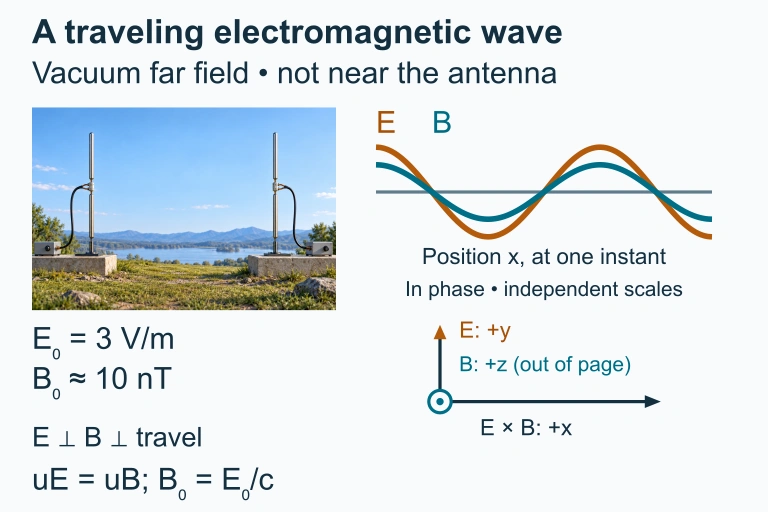
Oscillating \(\vec{E}\) and \(\vec{B}\) Fields
A vacuum far-field wave
This plane-wave model uses independent field scales. At the illustrated positive phase E points +y, B points +z out of the page, and E × B points +x.
The Electromagnetic Spectrum
All electromagnetic waves travel at \( c = 3.0 \times 10^8 \;\text{m/s} \) in vacuum. They differ only in wavelength \((\lambda)\) and frequency \((f)\). From radio waves (\(\lambda \sim \text{km}\)) to gamma rays (\(\lambda \sim 10^{-12}\;\text{m}\)), the physics is the same.
The Fundamental Wave Equation
$$ c = \lambda f $$
Photon Energy
$$ E = hf = \frac{hc}{\lambda} $$
Mechanical vs Electromagnetic Waves
| Mechanical Waves | EM Waves | |
|---|---|---|
| Medium required? | Yes | No |
| Speed in vacuum | Cannot propagate | \( 3.0 \times 10^8 \;\text{m/s} \) |
| Examples | Sound, water waves | Light, radio, X-rays |
| Type | Longitudinal or transverse | Always transverse |
| Oscillation | Particles of medium | \(\vec{E}\) and \(\vec{B}\) fields |
Maxwell's Equations: The Foundation
James Clerk Maxwell unified electricity and magnetism into four elegant equations. Together, they predict that oscillating charges produce electromagnetic waves that travel at the speed of light.
$$ \oint \vec{E} \cdot d\vec{A} = \frac{q_{enc}}{\varepsilon_0} $$
$$ \oint \vec{B} \cdot d\vec{A} = 0 $$
$$ \oint \vec{E} \cdot d\vec{l} = -\frac{d\Phi_B}{dt} $$
$$ \oint \vec{B} \cdot d\vec{l} = \mu_0 I_{enc} + \mu_0 \varepsilon_0 \frac{d\Phi_E}{dt} $$
Deriving \( c \) from Maxwell
$$ c = \frac{1}{\sqrt{\mu_0 \varepsilon_0}} $$
Intensity and the Inverse Square Law
$$ I = \frac{P}{4\pi r^2} $$
How to Solve EM Wave Problems
Example 1: Finding Frequency
Problem: A radio station broadcasts at a wavelength of \(\lambda = 3.0\;\text{m}\). What is the frequency of the signal?
Example 2: Photon Energy
Problem: Calculate the energy of a single photon of green light with \(\lambda = 550\;\text{nm}\).
Example 3: Intensity at a Distance
Problem: A light bulb radiates \( P = 60\;\text{W} \) uniformly in all directions. What is the intensity at \( r = 2.0\;\text{m} \)?
Common Mistakes
Key Equations Summary
| Equation | Formula | Use Case |
|---|---|---|
| Wave equation | \( c = \lambda f \) | Relate \(\lambda\) and \(f\) |
| Photon energy | \( E = hf = \dfrac{hc}{\lambda} \) | Energy of a photon |
| Speed from Maxwell | \( c = \dfrac{1}{\sqrt{\mu_0 \varepsilon_0}} \) | Derive \( c \) from constants |
| Intensity | \( I = \dfrac{P}{4\pi r^2} \) | Intensity at distance \(r\) |
| E-B relationship | \( E = cB \) | Relate E and B field amplitudes |
Question 1 of 5
An EM wave has a frequency of \( 6.0 \times 10^{14}\;\text{Hz} \). What is its wavelength?
Question 2 of 5
Which of the following is true about all electromagnetic waves?
Question 3 of 5
A photon has energy \( 4.0 \times 10^{-19}\;\text{J} \). What is its frequency?
(\( h = 6.63 \times 10^{-34}\;\text{J}\cdot\text{s} \))
Question 4 of 5
A point source emits \( P = 100\;\text{W} \). If you move from \( r = 1\;\text{m} \) to \( r = 3\;\text{m} \), the intensity becomes what fraction of its original value?
Question 5 of 5
In an electromagnetic wave, the electric and magnetic fields are oriented: