Electric
Power
Understand how energy is transferred in electrical circuits, master the key formulas for power dissipation, and connect voltage, current, and resistance to real-world energy use.
What Is Electric Power?
Electric power is the rate at which electrical energy is transferred by a circuit. Whenever charge flows through a potential difference, energy is converted from electrical potential energy into other forms: heat, light, motion, or sound.
Energy, Work, and Power
Why Electric Power Matters
Every electrical device you use has a power rating. Understanding power lets you:
The Core Power Equations
Power in a Simple Circuit
A real battery bench with an internal-loss cutaway
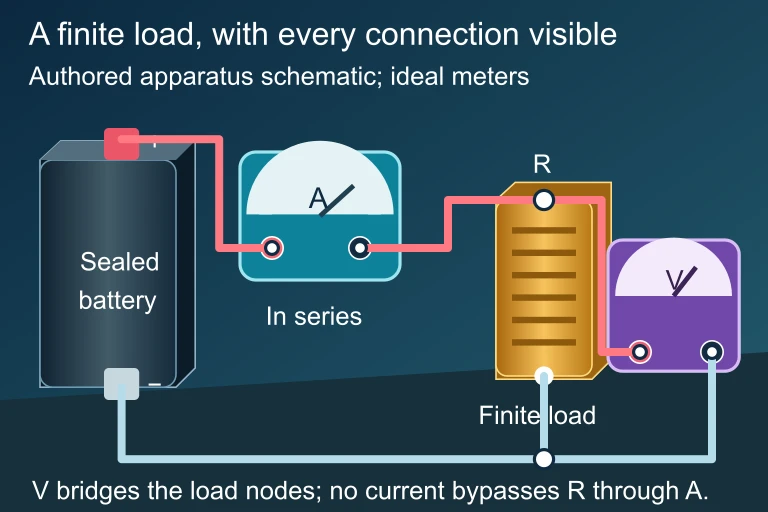 During discharge, internal resistance makes terminal voltage smaller than the emf. The source power divides between useful load power and internal heating.
Load power and internal heating
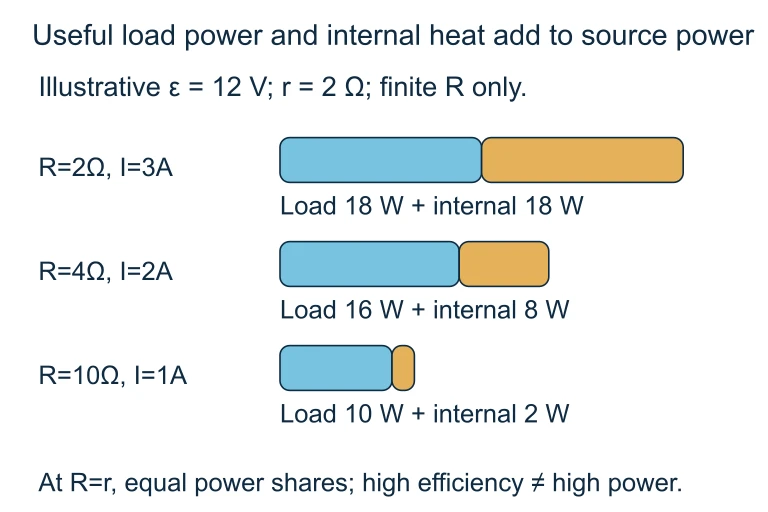 For emf 12 V and internal resistance 2 Ω, loads of 2, 4 and 10 Ω draw 3, 2 and 1 A. Useful load powers are 18, 16 and 10 W; internal heating is 18, 8 and 2 W.
Power vs. Energy
| Power (P) | Energy (E) | |
|---|---|---|
| Definition | Rate of energy transfer | Total energy transferred |
| Formula | \( P = IV \) | \( E = Pt \) |
| SI Unit | Watt (W) = J/s | Joule (J) = W·s |
| Practical Unit | Kilowatt (kW) | Kilowatt-hour (kWh) |
| Analogy | How fast water flows | How much water has flowed |
Choosing the Right Formula
How to Apply the Equations
Example 1: Basic Power
A resistor carries \( I = 3 \text{ A} \) of current when connected to a \( V = 12 \text{ V} \) battery. Find the power dissipated.
Example 2: Using Resistance
A \( 50\;\Omega \) heating element is connected to a \( 120 \text{ V} \) outlet. Find the power consumed and the energy used in \(2 \text{ hours}\).
Example 3: Series Resistors
Two resistors, \( R_1 = 4\;\Omega \) and \( R_2 = 6\;\Omega \), are in series with a \( 20 \text{ V} \) battery. Find the power dissipated by each resistor.
Power in Parallel Circuits
In a parallel circuit, each branch has the same voltage across it. The formula \( P = V^2/R \) is especially useful here because \( V \) is constant for all branches.
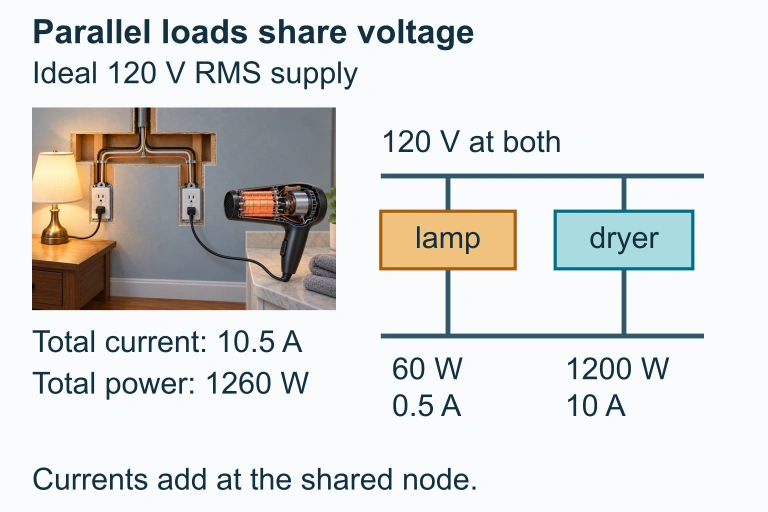
Parallel resistive loads
This separate ideal RMS example treats the devices as resistive loads.
A 60 W lamp and a 1200 W dryer are connected in parallel to a 120 V RMS supply. Find the branch currents, total current and power.
Show answer and explanation
The branch currents are 0.5 A and 10 A. The total current is 10.5 A and total power is 1260 W.
\( P = I^2R \) vs. \( P = V^2/R \)
Common Mistakes
Summary of Key Formulas
| Formula | Variables Needed | Best Used When |
|---|---|---|
| \( P = IV \) | Current, Voltage | Both I and V are known |
| \( P = I^2R \) | Current, Resistance | Series circuits (same I) |
| \( P = \frac{V^2}{R} \) | Voltage, Resistance | Parallel circuits (same V) |
| \( E = Pt \) | Power, Time | Finding total energy used |
| \( \text{Cost} = E \times \text{rate} \) | Energy (kWh), Rate | Calculating electric bills |
Question 1 of 5
A \(9 \text{ V}\) battery drives a current of \(0.5 \text{ A}\) through a circuit. What is the power delivered by the battery?
Question 2 of 5
A \(240 \text{ V}\) appliance has a resistance of \(60 \;\Omega\). How much power does it consume?
Question 3 of 5
Two resistors, \( R_1 = 5\;\Omega \) and \( R_2 = 10\;\Omega \), are connected in series to a \(30 \text{ V}\) source. Which resistor dissipates more power?
Question 4 of 5
Two resistors, \( R_1 = 5\;\Omega \) and \( R_2 = 10\;\Omega \), are connected in parallel across a \(20 \text{ V}\) source. Which resistor dissipates more power?
Question 5 of 5
A \(1500 \text{ W}\) space heater runs for \(4 \text{ hours}\). At a rate of \(\$0.15/\text{kWh}\), how much does it cost to operate?