Electric Potential
Energy
Understand the energy stored in configurations of charges, how it relates to Coulomb's law, and how to calculate \( U_E \) for point charges and systems.
What Is Electric Potential Energy?
Electric potential energy is the energy stored in a system due to the positions of charged objects relative to each other. Just as gravitational potential energy depends on the arrangement of masses, \( U_E \) depends on the arrangement of charges.
Analogy: Gravity vs Electricity
Visualizing the Energy Landscape
The Core Formula
Understanding the Sign of \( U_E \)
Potential Energy vs Electric Potential
| Potential Energy \( U_E \) | Electric Potential \( V \) | |
|---|---|---|
| Definition | Energy of a system of charges | Energy per unit charge at a point |
| Formula | \( U_E = k\frac{q_1 q_2}{r} \) | \( V = k\frac{q}{r} \) |
| Units | Joules (J) | Volts (V = J/C) |
| Depends on | Both charges + distance | Source charge + distance |
| Relationship | \( U_E = qV \) | |
Connection to Work and Force
The work done by the electric force as a charge moves is equal to the negative change in potential energy:
Systems of Multiple Charges
For a system with more than two charges, the total electric potential energy is the sum of all pairwise interactions:
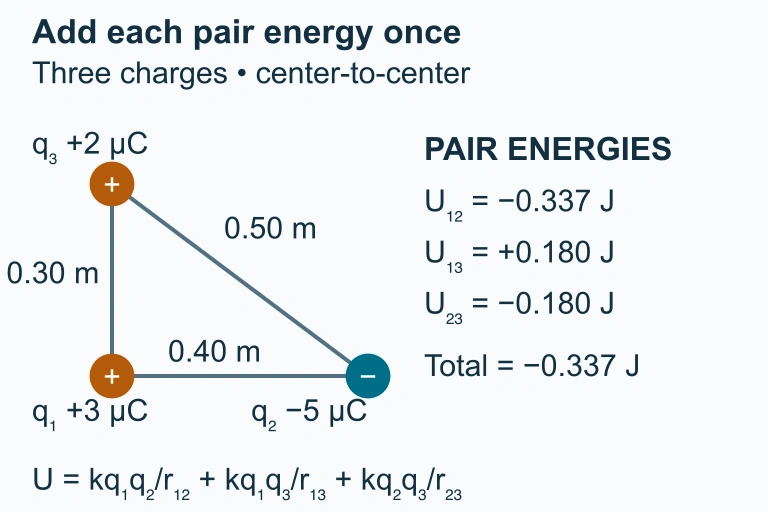
Separate three-charge assembly
The charges and distances below are separate from the existing worked example.
For charges q1 = +3 μC, q2 = −5 μC and q3 = +2 μC, with r12 = 0.40 m, r13 = 0.30 m and r23 = 0.50 m, find the total assembly energy.
Show answer and explanation
Add each unique signed pair energy once: −0.337 J + 0.180 J − 0.180 J = −0.337 J.
How to Calculate \( U_E \)
Example 1: Two Point Charges
Example 2: Three-Charge System
Example 3: Energy Conservation
A proton (\( q = +1.6 \times 10^{-19} \) C, \( m = 1.67 \times 10^{-27} \) kg) is released from rest at a distance of 0.50 m from a fixed \( +5 \; \mu\text{C} \) charge. What is its speed at 1.00 m?
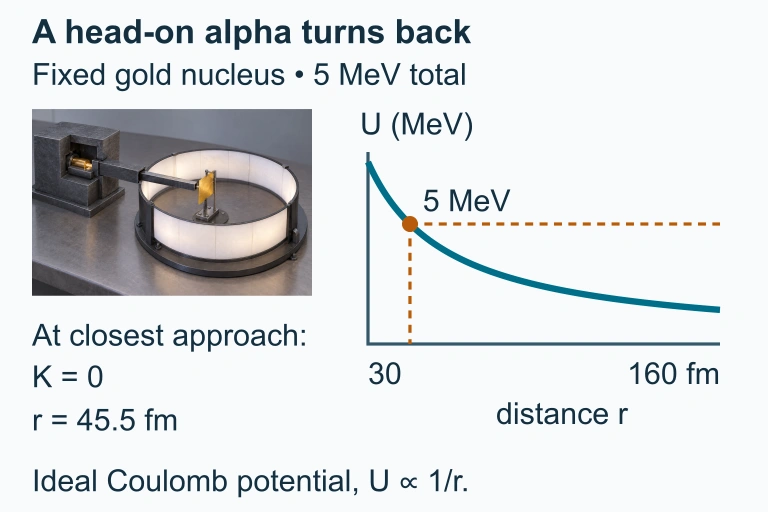
A head-on Coulomb turning point
This separate example uses an ideal fixed gold nucleus.
An alpha particle with 5.0 MeV of initial kinetic energy approaches a gold nucleus directly from very far away. How close does it come?
Show answer and explanation
At closest approach its kinetic energy is zero. Equating 5.0 MeV to the electric potential energy gives a closest approach of about 45.5 fm.
The Electron Volt (eV)
At atomic scales, the Joule is inconveniently large. Physicists use the electron volt: the energy gained by one electron charge moving through a potential difference of 1 volt.
Common Mistakes to Avoid
Summary of Key Formulas
| Quantity | Formula | Units |
|---|---|---|
| Electric PE (2 charges) | \( U_E = k\frac{q_1 q_2}{r} \) | J |
| Electric PE (system) | \( U = \sum_{i<j} k\frac{q_i q_j}{r_{ij}} \) | J |
| Electric Potential | \( V = k\frac{q}{r} \) | V (J/C) |
| PE from Potential | \( U_E = qV \) | J |
| Work by Electric Force | \( W = -\Delta U_E \) | J |
| Energy Conservation | \( K_i + U_i = K_f + U_f \) | J |
Question 1 of 5
Two charges of \( +4 \; \mu\text{C} \) and \( -2 \; \mu\text{C} \) are separated by 0.10 m. What is the electric potential energy of this system?
Question 2 of 5
If the distance between two point charges is doubled, the electric potential energy of the system:
Question 3 of 5
A system of two like charges has \( U_E = +0.36 \) J. What does this positive value mean physically?
Question 4 of 5
Three identical charges of \( +1 \; \mu\text{C} \) are placed at the vertices of an equilateral triangle with side length 0.10 m. What is the total electric potential energy?
Question 5 of 5
An electron (\( q = -1.6 \times 10^{-19} \) C) moves from a point where \( V = +200 \) V to a point where \( V = +50 \) V. The change in its electric potential energy is: