Electric
Potential
Understand how voltage describes the energy landscape for charges, master the equations for point charges, and connect potential to electric fields.
What Is Electric Potential?
Electric potential \( V \) at a point in space is the electric potential energy per unit charge. It tells you how much energy a positive test charge would have at that location, without needing to know the charge's size.
Think of electric potential like altitude on a hill: it describes the "height" of the energy landscape. A charge released from high potential rolls toward low potential, just as a ball rolls downhill.
The Energy Landscape
A Scalar Quantity
Unlike the electric field \( \vec{E} \), which is a vector, electric potential \( V \) is a scalar. This means it has magnitude but no direction, making calculations much simpler when multiple charges are present.
Potential of a Point Charge
Sign matters: Positive charges create positive potential that decreases with distance. Negative charges create negative potential that increases (becomes less negative) with distance.
Superposition of Potentials
For a system of multiple point charges, the total electric potential at any point is the algebraic sum of the individual potentials:
Potential vs. Potential Energy
| Electric Potential \( V \) | Potential Energy \( U_E \) | |
|---|---|---|
| Definition | Energy per unit charge | Total energy of a charge in a field |
| Formula | \( V = kq/r \) | \( U_E = qV = kq_1 q_2 / r \) |
| Units | Volts (V = J/C) | Joules (J) |
| Type | Property of the field | Property of a charge in the field |
| Depends on test charge? | No | Yes: \( U_E = qV \) |
Potential Difference and Voltage
In practice, we almost always measure differences in potential, not absolute values. The potential difference between two points is called voltage:
Connecting \( \vec{E} \) and \( V \)
For parallel plates separated by distance \( d \): \( \Delta V = Ed \). The field is uniform between the plates.
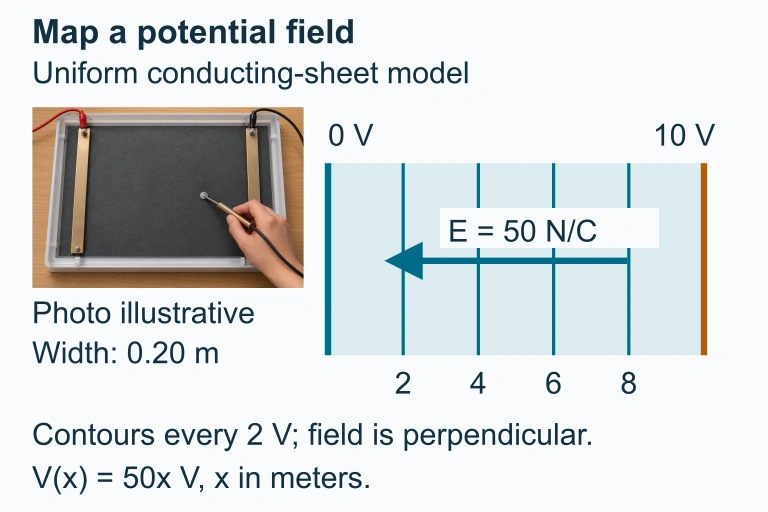
A separate conducting-sheet model
This synthetic planar model has a 0.20 m width and potential rising from 0 V to 10 V. Its field points toward lower potential; it does not replace the deck’s point-charge equipotentials.
How to Solve Problems
Example 1: Single Charge
A charge of \( q = +3.0 \; \mu\text{C} \) is located at the origin. Find the electric potential at a point \( P \) that is 0.50 m away.
Example 2: Two Charges
Charges \( q_1 = +4.0 \; \mu\text{C} \) and \( q_2 = -2.0 \; \mu\text{C} \) are separated by 0.60 m. Find \( V \) at the midpoint between them.
Example 3: Energy and Speed
A proton (\( q = 1.6 \times 10^{-19} \) C, \( m = 1.67 \times 10^{-27} \) kg) is accelerated from rest through a potential difference of 500 V. Find its final speed.
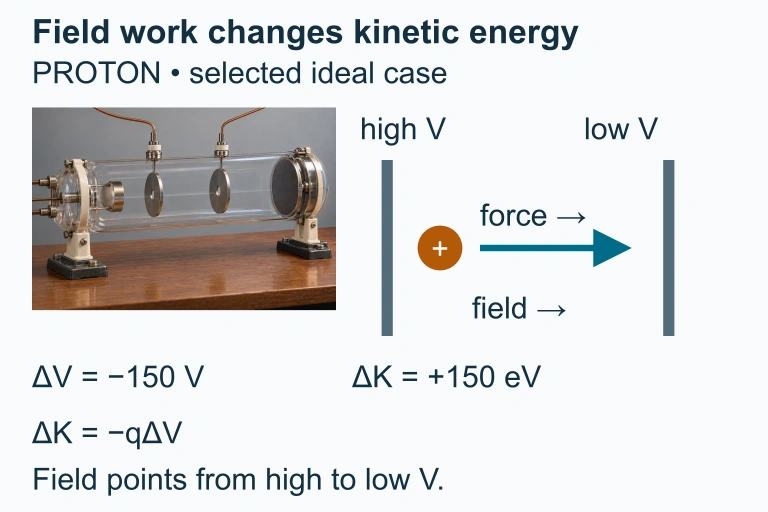
Proton accelerated through 150 V
This is a separate 150 V proton example; the deck’s worked problem uses 500 V.
A proton starts from rest and moves through a potential drop of 150 V. What kinetic energy does it gain?
Show answer and explanation
Its kinetic energy increases by 150 eV, or approximately 2.4 × 10⁻¹⁷ J. With the proton mass 1.67 × 10⁻²⁷ kg, its speed is approximately 1.70 × 10⁵ m/s.
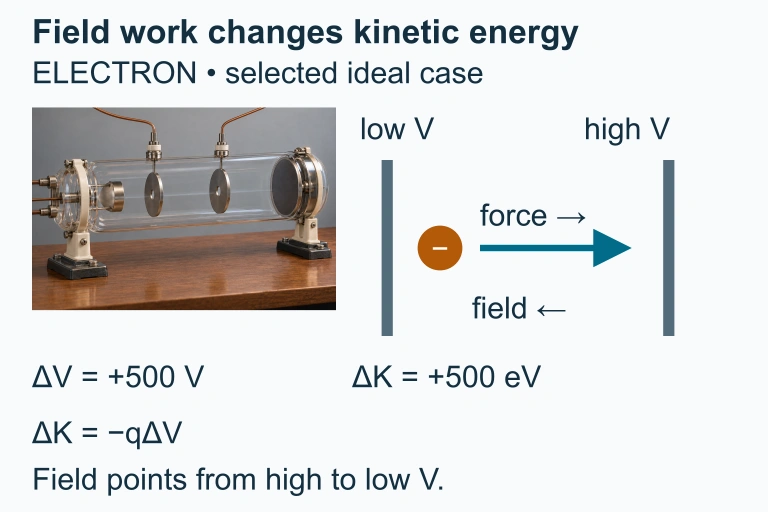
Electron sign comparison
For the separate electron model, the potential increases by 500 V. The negative charge accelerates opposite the electric field and gains 500 eV.
Equipotential Surfaces
Common Mistakes
Key Formulas Summary
| Concept | Formula | Notes |
|---|---|---|
| Point charge potential | \( V = kq/r \) | Scalar, includes sign of \( q \) |
| Superposition | \( V = \sum kq_i / r_i \) | Add algebraically |
| Potential energy | \( U_E = qV \) | Two-charge: \( U = kq_1 q_2 / r \) |
| Potential difference | \( \Delta V = V_B - V_A \) | \( W = -q\Delta V \) |
| Uniform field | \( E = -\Delta V / \Delta x \) | Parallel plates: \( \Delta V = Ed \) |
| Energy conservation | \( \Delta K = |q\Delta V| \) | For speed from rest: \( \frac{1}{2}mv^2 = |q\Delta V| \) |
Question 1 of 5
What are the SI units of electric potential?
Question 2 of 5
A charge of \( -5.0 \; \mu\text{C} \) creates an electric potential at a point 0.20 m away. What is the potential at that point?
Question 3 of 5
Two charges, \( +3 \; \mu\text{C} \) and \( -3 \; \mu\text{C} \), are separated by 0.40 m. What is the electric potential at the exact midpoint between them?
Question 4 of 5
An electron is released from rest and accelerates through a potential difference of 200 V. What is the kinetic energy it gains?
Question 5 of 5
Why is electric potential a scalar rather than a vector?