Electric
Fields
Explore how charges create invisible force fields that shape the behavior of other charges: from Coulomb's law to field lines, superposition, and real-world applications.
What Is an Electric Field?
An electric field is a region of space around a charged object where another charge would experience a force. Instead of thinking about "action at a distance," we say the source charge creates a field, and the field exerts the force.
Visualizing Field Lines
Why Do Electric Fields Matter?
Electric fields are the bridge between a source charge and the force experienced by other charges. They let us analyze situations without needing to know exactly what charge will arrive at a given point: the field is already there, waiting.
Coulomb's Law and the Point-Charge Field
Dividing by the test charge \(q_0\), the electric field due to a single point charge \(Q\) at distance \(r\) is:
The Inverse-Square Falloff
Because \(E \propto 1/r^2\), the field weakens rapidly with distance. Doubling the distance cuts the field to one-quarter.
Field vs. Force: Key Distinction
| Electric Field \(\vec{E}\) | Electric Force \(\vec{F}\) | |
|---|---|---|
| Depends on | Source charge & position only | Source charge, position, and test charge |
| Formula | \(E = kQ/r^2\) | \(F = qE\) |
| Units | N/C (or V/m) | N (newtons) |
| Nature | Property of space | Interaction between charges |
| Analogy | Gravitational field \(\vec{g}\) | Weight \(\vec{W} = m\vec{g}\) |
The Superposition Principle
When multiple source charges are present, the total electric field at any point is the vector sum of the individual fields produced by each charge.
How to Calculate the Field
Example 1: Single Point Charge
Find the electric field 0.30 m from a point charge \(Q = +5.0\;\mu\text{C}\).
Example 2: Two Charges on a Line
Charges \(q_1 = +3\;\mu\text{C}\) at \(x = 0\) and \(q_2 = -3\;\mu\text{C}\) at \(x = 0.40\;\text{m}\). Find \(\vec{E}\) at the midpoint \(x = 0.20\;\text{m}\).
Example 3: Field Components
Charge \(Q = +4\;\mu\text{C}\) sits at the origin. Find \(\vec{E}\) at point \(P = (0.30, 0.40)\;\text{m}\).
Uniform Electric Fields
Between two large, parallel, oppositely charged plates, the electric field is nearly uniform: constant in magnitude and direction everywhere between the plates.
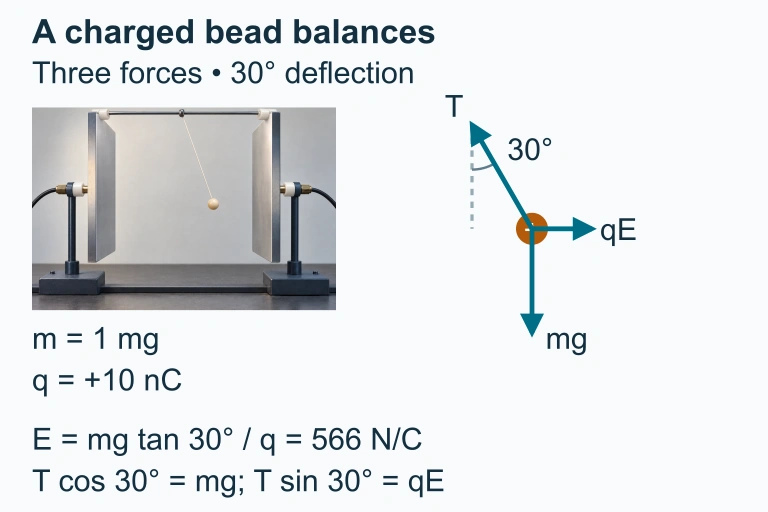
A charged bead in equilibrium
This separate ideal measurement model uses a positive bead between uniform-field plates.
A 1 mg bead with charge +10 nC hangs at 30° to the vertical. What horizontal field balances it?
Show answer and explanation
Horizontal and vertical force balance give E = mg tan(30°)/q ≈ 566 N/C.
Fields Inside Conductors
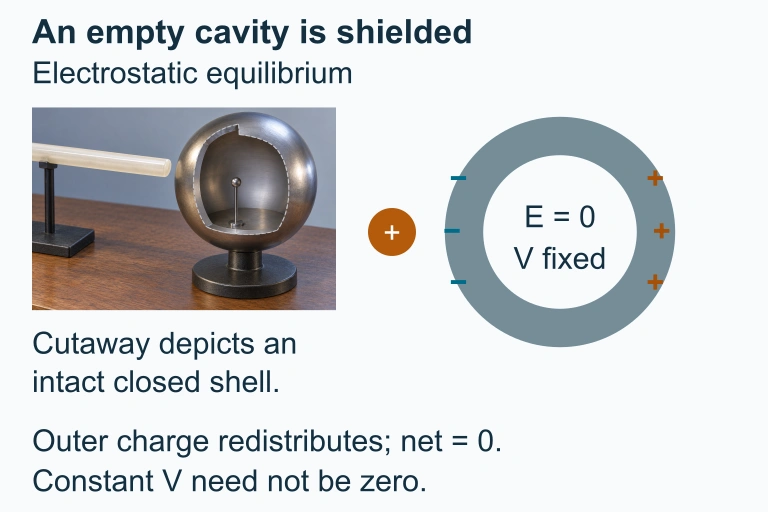
Shielding an empty cavity
The cutaway represents an intact closed conducting shell with no charge inside its cavity. At electrostatic equilibrium its cavity field is zero and the constant potential need not be zero.
Common Mistakes to Avoid
Summary of Key Formulas
| Concept | Formula | Key Note |
|---|---|---|
| Point charge field | \(E = kQ/r^2\) | Inverse-square law |
| Force from field | \(\vec{F} = q\vec{E}\) | Direction depends on sign of \(q\) |
| Superposition | \(\vec{E}_{\text{net}} = \sum \vec{E}_i\) | Vector sum of all sources |
| Parallel plates | \(E = V/d\) | Uniform between plates |
| Coulomb's constant | \(k = 8.99 \times 10^9\) | N·m²/C² |
Question 1 of 5
What are the SI units of the electric field?
Question 2 of 5
If you double the distance from a point charge, the electric field magnitude becomes:
Question 3 of 5
A charge of \(q = -2\;\mu\text{C}\) is placed in a region where \(\vec{E} = 500\;\text{N/C}\) to the right. What is the force on the charge?
Question 4 of 5
Two equal positive charges are placed on the x-axis, equidistant from the origin. What is the electric field at the origin?
Question 5 of 5
The electric field between two parallel plates with voltage \(V = 120\;\text{V}\) separated by \(d = 0.02\;\text{m}\) is: