Electric
Current
Explore the flow of charge through conductors, understand \( I = \frac{\Delta Q}{\Delta t} \), and master the physics of current, drift velocity, and current density.
What is Electric Current?
Electric current is the rate of flow of electric charge through a cross-sectional area of a conductor. When a potential difference is applied across a wire, free charges (typically electrons) begin to drift, producing a measurable current.
Visualizing Charge Flow
Why Does Current Matter?
Electric current is the foundation of every circuit analysis problem in AP Physics 2. Understanding current lets you analyze how energy is transferred in circuits, how magnetic fields arise, and how devices convert electrical energy into useful work.
The Current Equation
Drift Velocity and Current
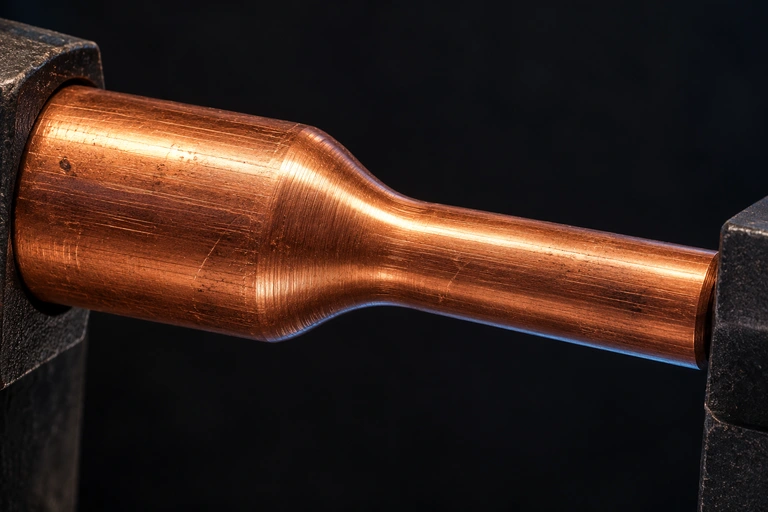
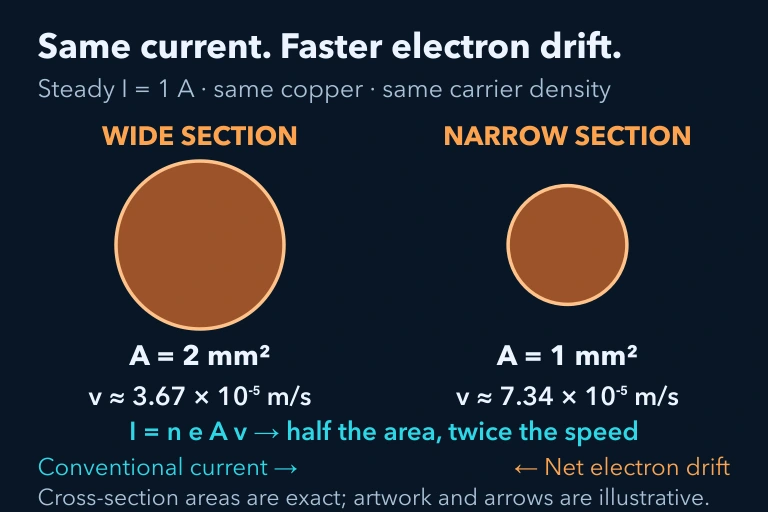
Constant-current neck model
This separate model fixes current at 1 A and carrier density at 8.5 × 10²⁸ m⁻³. When area falls from 2 to 1 mm² the electron drift speed doubles. Electron drift opposes conventional current.
Current Density \( \vec{J} \)
Current density describes how current is distributed across a cross-section. It is a vector quantity pointing in the direction of conventional current flow.
Conventional vs. Electron Current
| Conventional Current | Electron Current | |
|---|---|---|
| Direction | + to − (high to low potential) | − to + (opposite to \( \vec{E} \)) |
| Charge carrier | Positive (by convention) | Electrons (negative) |
| Used in | Circuit analysis, AP exams | Microscopic physics |
| Same magnitude? | Yes: \( |I| \) is identical | |
How to Solve Current Problems
Example 1: Basic Current
A wire carries \( 15\,\text{C} \) of charge past a point in \( 3\,\text{s} \). What is the current?
Example 2: Drift Velocity
A copper wire with cross-sectional area \( A = 2.0 \times 10^{-6}\,\text{m}^2 \) carries \( I = 3.0\,\text{A} \). Copper has \( n = 8.5 \times 10^{28}\,\text{m}^{-3} \) free electrons. Find \( v_d \).
Example 3: Time-Varying Current
A current is given by \( I(t) = 4t + 2 \) (in amperes, with \( t \) in seconds). How much charge flows from \( t = 0 \) to \( t = 3\,\text{s} \)?
Reading an \( I \)-vs-\( t \) Graph
Conservation of Current
Common Mistakes
Summary of Key Equations
| Quantity | Equation | Units |
|---|---|---|
| Current | \( I = \frac{\Delta Q}{\Delta t} \) | A (amperes) |
| Drift velocity form | \( I = nAv_d|q| \) | A |
| Current density | \( J = \frac{I}{A} = n|q|v_d \) | \( \text{A/m}^2 \) |
| Charge from varying \( I \) | \( Q = \int I\,dt \) | C (coulombs) |
| Junction rule | \( \sum I_{\text{in}} = \sum I_{\text{out}} \) | Conservation law |
Question 1 of 5
A wire carries a steady current of \( 2.0\,\text{A} \). How much charge passes through a cross-section in \( 10\,\text{s} \)?
Question 2 of 5
In the equation \( I = nAv_d|q| \), doubling the cross-sectional area while halving the drift velocity will:
Question 3 of 5
A current \( I(t) = 6t \) amperes flows through a wire. What is the total charge that passes from \( t = 0 \) to \( t = 4\,\text{s} \)?
Question 4 of 5
At a junction, \( 5\,\text{A} \) enters and the wire splits into two branches. If branch 1 carries \( 3\,\text{A} \), what is the current in branch 2?
Question 5 of 5
The drift velocity in a copper wire is approximately \( 10^{-4}\,\text{m/s} \). Why does a lamp turn on almost instantly when you flip the switch?