Electric Charge &
Electric Force
Master the fundamentals of Coulomb's Law, understand how charged objects interact, and solve problems involving electrostatic forces.
What Is Electric Charge?
Electric charge is a fundamental property of matter that causes it to experience a force when placed near other charged matter. Charge comes in two types: positive and negative.
Two Key Principles of Charge
How Charges Interact
Conductors vs Insulators
Coulomb's Law: The Core Equation
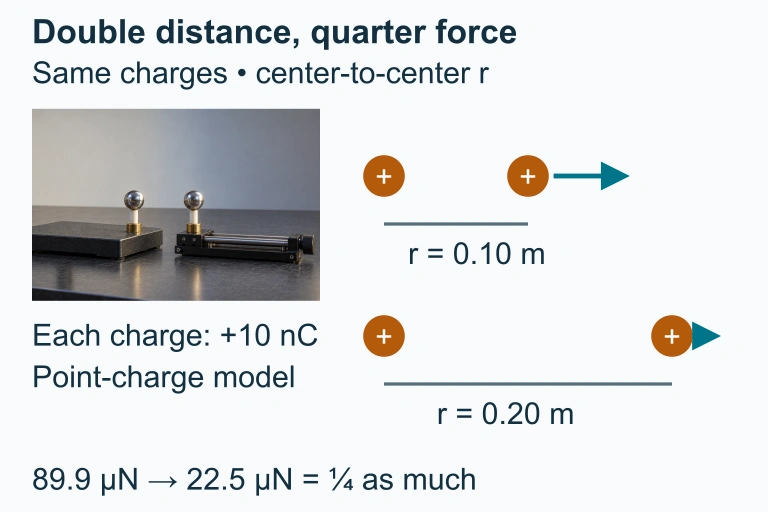
The Inverse-Square Relationship
A separate inverse-square calculation
For two +10 nC point charges, increasing the center-to-center distance from 0.10 m to 0.20 m reduces the repulsive force from 89.9 μN to 22.5 μN.
Coulomb's Law vs Gravity
| Coulomb's Law | Newton's Gravity | |
|---|---|---|
| Equation | \( F = k\frac{|q_1||q_2|}{r^2} \) | \( F = G\frac{m_1 m_2}{r^2} \) |
| Dependence | Inverse-square in \( r \) | Inverse-square in \( r \) |
| Direction | Attract or repel | Attract only |
| Relative Strength | Much stronger | Much weaker |
| Source | Charge (\( q \)) | Mass (\( m \)) |
The Superposition Principle
When multiple charges are present, the net force on any one charge is the vector sum of the individual forces from every other charge:
How to Apply Coulomb's Law
Example 1: Two Point Charges
Find the magnitude and direction of the electric force between them.
Example 2: Distance Doubles
Using the same charges from Example 1, what is the force if the distance is doubled to \( r = 0.40 \;\text{m} \)?
Example 3: Three Charges in a Line
Find the net force on charge B.
Force Is a Vector
Coulomb's Law gives you the magnitude. You must determine the direction separately using the sign of each charge.
Common Mistakes to Avoid
Summary: Key Formulas & Facts
| Concept | Key Detail |
|---|---|
| Coulomb's Law | \( F = k\frac{|q_1||q_2|}{r^2} \) |
| Coulomb's Constant | \( k = 8.99 \times 10^{9} \; \text{N}\cdot\text{m}^2/\text{C}^2 \) |
| Elementary Charge | \( e = 1.6 \times 10^{-19} \) C |
| Like Charges | Repel (force pushes apart) |
| Unlike Charges | Attract (force pulls together) |
| Superposition | \( \vec{F}_{\text{net}} = \sum \vec{F}_i \) |
| Inverse-Square | Double \( r \) → \( \frac{1}{4} \) the force |
Question 1 of 5
Two charges of \( +4\;\mu\text{C} \) and \( -2\;\mu\text{C} \) are separated by \( 0.30 \;\text{m} \). What is the magnitude of the electric force between them?
Question 2 of 5
If the distance between two point charges is tripled, the electric force between them becomes:
Question 3 of 5
Two positive charges are placed near each other. The electric force between them is:
Question 4 of 5
A charge of \( +6\;\mu\text{C} \) is placed midway between \( +2\;\mu\text{C} \) on the left and \( +2\;\mu\text{C} \) on the right, each \( 0.10 \;\text{m} \) away. What is the net force on the middle charge?
Question 5 of 5
Which statement about electric charge is false?