Conservation of
Electric Energy
Master how electric potential energy and kinetic energy transform within electric fields, governed by the work-energy theorem and conservation principles.
What is Electric Potential Energy?
Electric potential energy is the energy stored in a system of charges due to their positions. When a charge \( q \) is placed at a point where the electric potential is \( V \), its potential energy is:
Like gravitational PE, electric PE depends on configuration: the relative positions of charges, not their absolute locations.
Potential vs. Potential Energy
Why Conservation Matters
As a positive charge moves from high potential to low potential (along \( \vec{E} \)), its potential energy decreases and its kinetic energy increases. The total mechanical energy is conserved when only electric forces do work.
The Conservation Law
This is identical in form to gravitational energy conservation. The electric field plays the role gravity plays: it is a conservative force, so the work done depends only on initial and final positions, not the path taken.
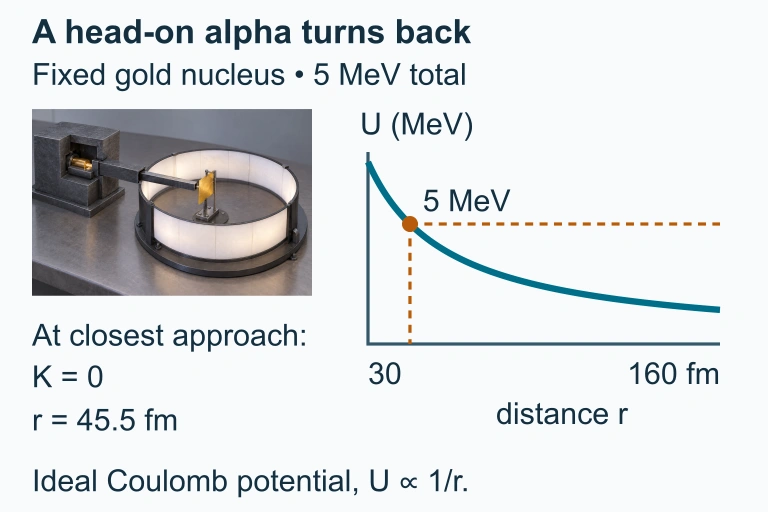
A head-on Coulomb turning point
Consider an ideal model with a fixed gold nucleus and no non-electric forces.
An alpha particle with 5.0 MeV of initial kinetic energy approaches a gold nucleus directly from very far away. How close does it come?
Show answer and explanation
At closest approach the alpha particle momentarily has zero kinetic energy. Equating 5.0 MeV to the electric potential energy of charges +2e and +79e gives a closest distance of about 45.5 fm.
Work Done by the Electric Field
The work done by the electric force on a charge \( q \) moving through a potential difference \( \Delta V \) is:
Combining these two results gives us the conservation equation. A positive charge accelerated through a potential drop \( \Delta V < 0 \) gains kinetic energy: \( W_E = q(V_i - V_f) > 0 \).
Energy in a Uniform Field
Conservative vs. Non-Conservative
| Conservative | Non-Conservative | |
|---|---|---|
| Examples | Electric force, gravity | Friction, air resistance |
| Path dependence | Path-independent | Path-dependent |
| Closed-loop work | \( W = 0 \) | \( W \neq 0 \) |
| Has a PE function? | Yes | No |
| Energy equation | \( K_i + U_i = K_f + U_f \) | \( K_i + U_i + W_{nc} = K_f + U_f \) |
How to Apply Conservation
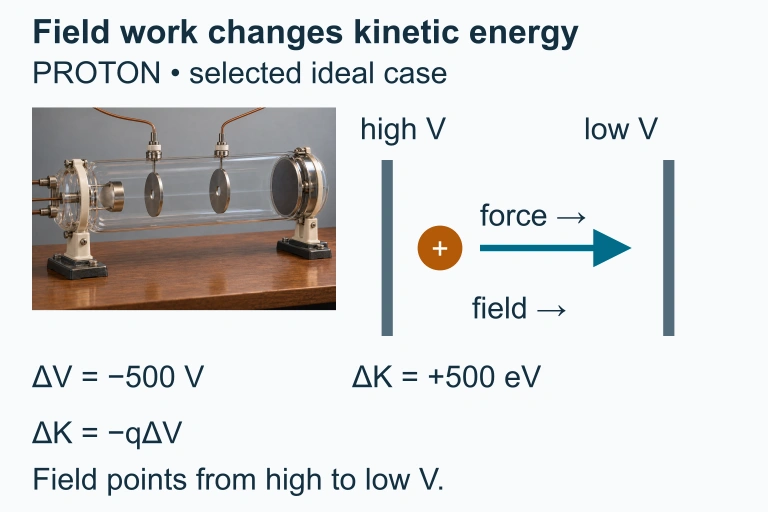
Example 1: Proton in a Uniform Field
A proton (\( q = 1.6 \times 10^{-19} \) C, \( m = 1.67 \times 10^{-27} \) kg) starts from rest and is accelerated through a potential difference of \( \Delta V = -500 \) V. Find its final speed.
Example 2: Two Point Charges
A charge \( q_1 = +3 \;\mu\text{C} \) is fixed. A charge \( q_2 = +2 \;\mu\text{C} \) (\( m = 4 \times 10^{-6} \) kg) starts from rest at \( r_i = 0.10 \) m. How fast is \( q_2 \) moving when it reaches \( r_f = 0.50 \) m?
Example 3: Electron in an Electric Field
An electron (\( q = -1.6 \times 10^{-19} \) C) moves from point A at \( V_A = 0 \) V to point B at \( V_B = +120 \) V, starting with speed \( v_i = 6.0 \times 10^5 \) m/s. Does it reach B?
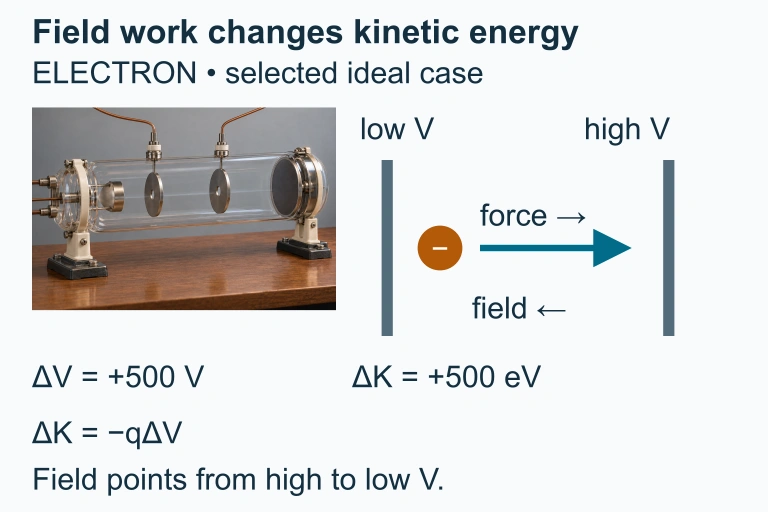
Electron sign comparison
This separate electron example uses a 500 V rise, rather than the 120 V rise in the existing example. Because the electron is negatively charged, its force is opposite the electric field.
The Electron-Volt (eV)
The electron-volt is a convenient energy unit at atomic scales. It equals the kinetic energy gained by a charge of magnitude \( e \) accelerated through 1 V:
Energy Bar Diagrams
Energy bar diagrams are a powerful visual tool. The KE bar and \( U_E \) bar must always sum to the same total height. As one grows, the other shrinks by exactly the same amount.
Common Mistakes
Summary of Key Equations
| Quantity | Equation | Units |
|---|---|---|
| Electric PE | \( U_E = qV \) | Joules (J) |
| PE (two charges) | \( U_E = k\frac{q_1 q_2}{r} \) | Joules (J) |
| Conservation | \( K_i + U_i = K_f + U_f \) | Joules (J) |
| Work by E-field | \( W_E = q(V_i - V_f) \) | Joules (J) |
| Electron-volt | \( 1\;\text{eV} = 1.6 \times 10^{-19}\;\text{J} \) | eV or J |
| With external work | \( K_i + U_i + W_{nc} = K_f + U_f \) | Joules (J) |
Question 1 of 5
A proton is released from rest in a uniform electric field. As it accelerates, which statement is correct?
Question 2 of 5
An electron is accelerated from rest through a potential difference of \( +200 \) V. What kinetic energy does it gain?
Question 3 of 5
Two positive point charges \( q_1 \) and \( q_2 \) are held at separation \( r \). When released, what happens to the total electric potential energy of the system?
Question 4 of 5
A charge of \( +5 \;\mu\text{C} \) moves from a point where \( V = 400 \;\text{V} \) to a point where \( V = 100 \;\text{V} \). What is the work done by the electric field?
Question 5 of 5
Which of the following is true about the electric force?