Conservation of
Electric Charge
Explore how charge is conserved in every physical process, and master the three methods of charging objects: friction, conduction, and induction.
What is Electric Charge?
Electric charge is a fundamental property of matter that causes it to experience a force when placed in an electromagnetic field. There are two types: positive \(+\) and negative \(-\).
Conductors vs Insulators
Materials differ in how freely their charges can move. This distinction is essential for understanding how objects become charged.
Why Does Charge Conservation Matter?
Every physical process, from rubbing a balloon on your hair to particle collisions at CERN, obeys a strict rule: the total electric charge of an isolated system never changes.
The Law of Conservation of Charge
Mathematically, for any process involving objects \( A \) and \( B \):
This law holds for every physical process: friction, conduction, induction, nuclear reactions, and particle creation/annihilation.
Visualizing Charge Transfer
Charging by Friction
When two different materials are rubbed together, electrons transfer from one to the other. Which material gains or loses electrons depends on the triboelectric series.
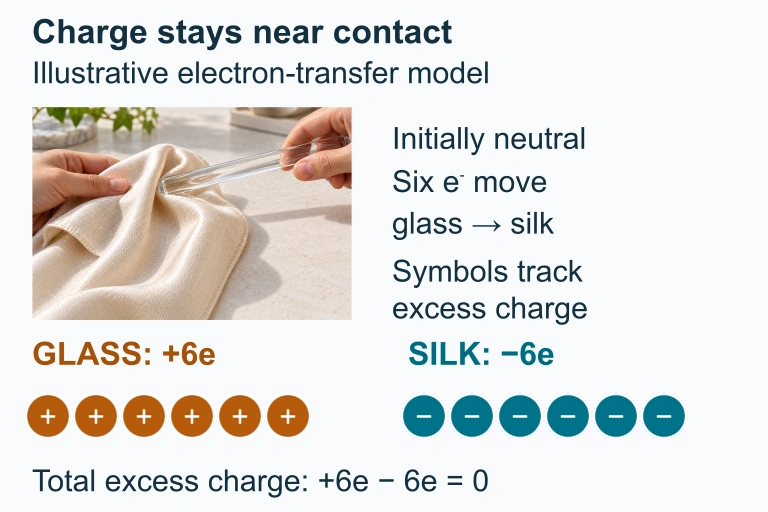
Illustrative charge transfer
Initially neutral glass and silk exchange six electron units in this model. The glass loses electrons, the silk gains them, and the net excess charge remains zero; the ionic background is fixed.
Charging by Conduction
A charged object touches a neutral conductor. Charge flows until both objects reach the same potential. The neutral object ends up with the same sign of charge as the charged object.
Charging by Induction
A charged object is brought near but not touching a neutral conductor. Charges in the conductor rearrange. If the conductor is grounded while the charged object is nearby, it acquires a charge with the opposite sign.
An induction experiment that remembers the removal order
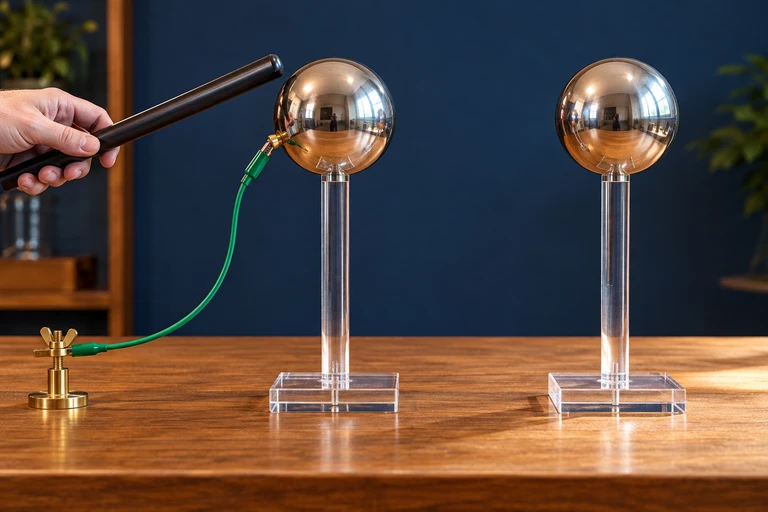 Electrons move during charging; protons remain in the material. Contact between identical isolated spheres shares their total charge, while charging by induction depends on the order in which grounding and the nearby rod are removed.
Charge sharing between identical spheres
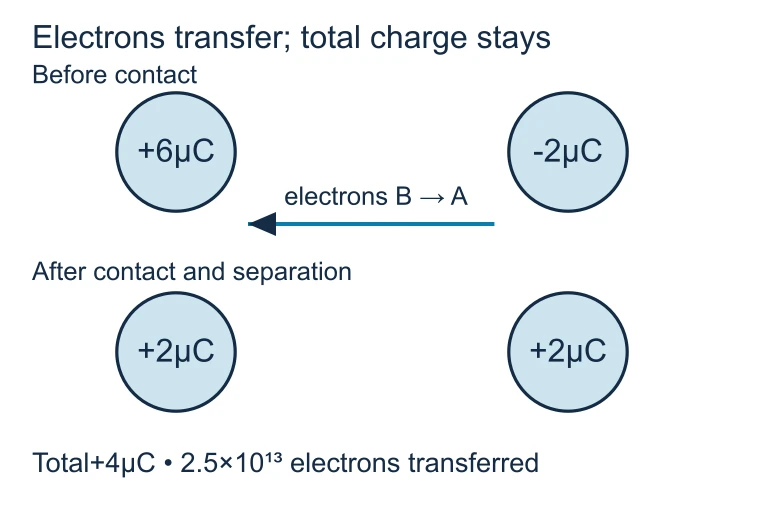 Identical isolated spheres with +6 μC and −2 μC share their total +4 μC equally after contact. Both end at +2 μC; 2.5 × 10¹³ electrons transfer from the initially negative sphere to the positive sphere.
Charging by induction
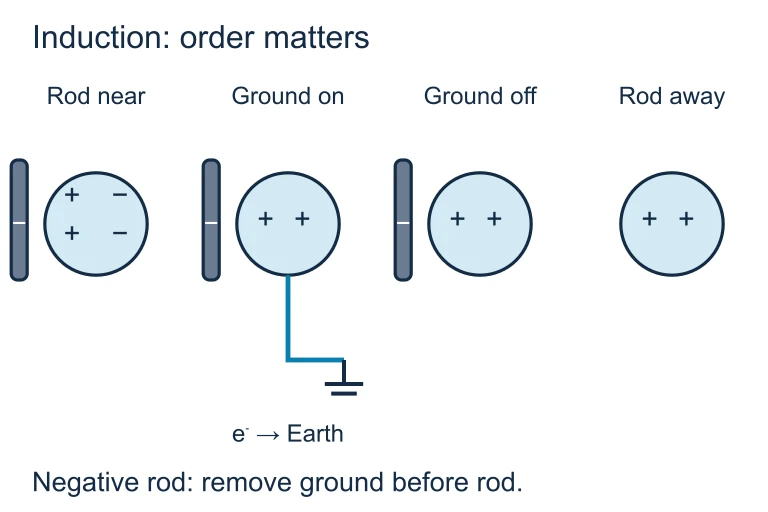 Bring a negative rod near a conductor, then ground the conductor so electrons can leave. Remove the ground while the rod remains nearby, and only then remove the rod; the conductor retains positive charge.
Conduction vs Induction
| Conduction | Induction | |
|---|---|---|
| Contact Required? | Yes: direct touch | No: nearby only |
| Final Sign | Same as charging object | Opposite to charging object |
| Grounding Needed? | No | Yes (to remove charge) |
| Source Object Changes? | Yes: loses some charge | No: keeps all its charge |
| Charge Conserved? | Always ✓ | Always ✓ |
Charge Polarization
Polarization is the redistribution of charge within an object due to a nearby charged object, without any charge transfer. It occurs in both conductors and insulators.
Solving Charge Conservation Problems
Example 1: Two Spheres Touch
Two identical conducting spheres, A with charge \( +8 \,\mu\text{C} \) and B with charge \( -2 \,\mu\text{C} \), are brought into contact and then separated. What is the final charge on each?
Example 2: Three-Sphere Problem
Three identical conducting spheres have charges \( +12 \,\mu\text{C} \), \( -6 \,\mu\text{C} \), and \( 0 \,\mu\text{C} \). Spheres 1 and 2 touch, separate, then sphere 2 touches sphere 3 and separates. Find all final charges.
Example 3: Induction with Grounding
A rod with charge \( -10 \,\mu\text{C} \) is held near a neutral conducting sphere. The sphere is grounded, and then the ground wire is removed before the rod is taken away. What is the sphere's final charge?
Common Mistakes
Charging Methods Summary
| Method | Friction | Conduction | Induction |
|---|---|---|---|
| Contact? | Yes (rubbing) | Yes (touching) | No |
| Materials | Two different insulators | Conductor touches conductor | Conductor near charge + ground |
| Result Sign | Opposite on each | Same as source | Opposite to source |
| Source Changes? | Yes: both change | Yes: loses charge | No: unchanged |
| Conservation? | ✓ | ✓ | ✓ |
Question 1 of 5
Two identical conducting spheres carry charges \( +10 \,\mu\text{C} \) and \( -4 \,\mu\text{C} \). They are brought into contact and separated. What is the charge on each sphere after separation?
Question 2 of 5
A negatively charged rod is used to charge a neutral conductor by induction (with grounding). What sign of charge does the conductor acquire?
Question 3 of 5
A glass rod is rubbed with silk. The rod becomes positively charged with \( +5 \,\mu\text{C} \). What charge does the silk have?
Question 4 of 5
A charged balloon sticks to a neutral wall. This is best explained by:
Question 5 of 5
In a nuclear reaction, a neutron decays into a proton, an electron, and an antineutrino: \( n \to p^+ + e^- + \bar{\nu} \). The antineutrino has zero charge. Is charge conserved?