01 / 21

Compton
Scattering

Explore how photons collide with electrons, proving light carries momentum and behaves as a particle.

AP Physics 2

What Is Compton Scattering?

Compton scattering is the inelastic scattering of a high-energy photon (typically an X-ray or gamma ray) by a free electron. The photon transfers part of its energy and momentum to the electron, causing the scattered photon to emerge with a longer wavelength.

Key Terms You Need to Know

Photon
A quantum of electromagnetic radiation with energy \( E = hf \) and momentum \( p = h/\lambda \).
Wavelength Shift
The increase \( \Delta\lambda = \lambda' - \lambda \) in the photon's wavelength after scattering.
Scattering Angle
The angle \( \theta \) between the incident photon direction and the scattered photon direction.

Why Compton Scattering Matters

In 1923, Arthur Holly Compton directed X-rays at a graphite target and measured the scattered radiation. Classical wave theory predicted no wavelength change, but Compton observed a clear shift to longer wavelengths that depended on the scattering angle.

The Compton Equation

$$ \Delta\lambda = \lambda' - \lambda = \frac{h}{m_e c}\,(1 - \cos\theta) $$

\( \lambda \)
Incident photon wavelength
\( \lambda' \)
Scattered photon wavelength
\( \theta \)
Scattering angle of the photon
\( \frac{h}{m_e c} \)
Compton wavelength of the electron: \( 2.43 \times 10^{-12} \) m

Scattering Diagram

Incident Photon wavelength: \( \lambda \) \(e^-\) at rest Scattered Photon wavelength: \( \lambda' \) Recoil Electron \( \theta \) \( \phi \)

Conservation Laws at Work

The Compton equation is derived by applying conservation of energy and conservation of momentum to the photon-electron collision, treating the photon as a relativistic particle.

1
Energy conservation: \( hf + m_e c^2 = hf' + E_e \), where \( E_e \) is the total relativistic energy of the recoil electron.
2
Momentum (x-component): \( \frac{h}{\lambda} = \frac{h}{\lambda'}\cos\theta + p_e\cos\phi \)
3
Momentum (y-component): \( 0 = \frac{h}{\lambda'}\sin\theta - p_e\sin\phi \)
4
Eliminate \( p_e \) and \( \phi \) to obtain: \( \Delta\lambda = \frac{h}{m_e c}(1 - \cos\theta) \)

A separate 90° example

For a nearly free electron and a 71 pm incident photon, the selected diagram shows momentum-vector addition; the deck’s worked wavelength is 70 pm.
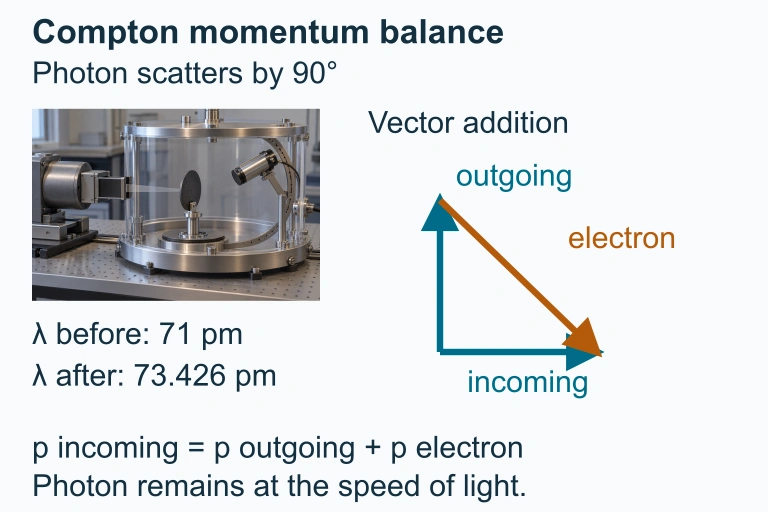
At 90° scattering, λ 71→73.426 pm; photon/electron momentum triangle closes head-to-tail.
For 90° scattering from a nearly free electron, the incoming photon momentum is the vector sum of the scattered photon and electron momenta.

Compton vs. Photoelectric vs. Classical

Compton Scattering Photoelectric Effect Classical (Thomson)
Photon after Scattered, lower energy Absorbed completely Same wavelength
Electron Free; recoils Bound; ejected Oscillates, re-radiates
Wavelength shift \( \Delta\lambda > 0 \) N/A (absorbed) \( \Delta\lambda = 0 \)
Proves Photon momentum Photon energy quanta Wave nature only

Scattering and absorption

In Compton scattering a photon leaves; in the separate photoelectric model a 6.20 eV photon is absorbed and a 2.00 eV work function leaves 4.20 eV maximum kinetic energy.
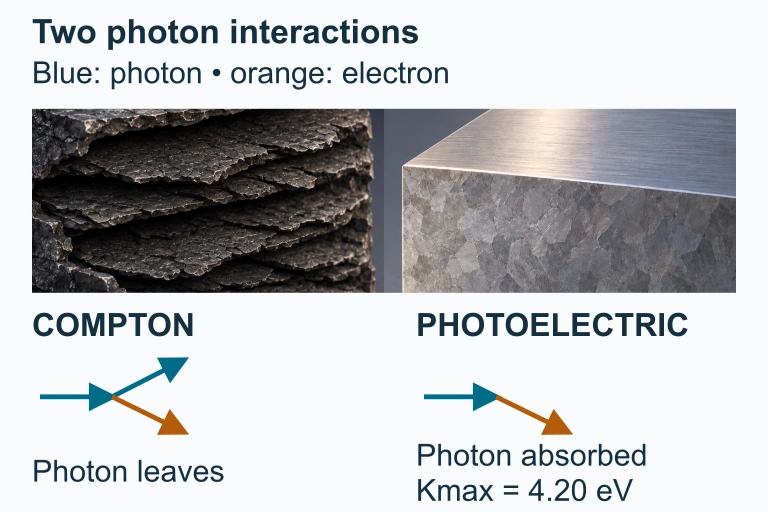
Compton retains scattered photon plus recoil electron; photoelectric absorption consumes photon and emits electron.
In Compton scattering a photon leaves after transferring momentum to an electron. In the selected photoelectric example, a 6.20 eV photon is absorbed and a 2.00 eV work function leaves a maximum electron kinetic energy of 4.20 eV.

Special Cases of \( \theta \)

\( \theta = 0^\circ \)
\( \cos 0^\circ = 1 \), so \( \Delta\lambda = 0 \). The photon passes straight through: no scattering.
\( \theta = 90^\circ \)
\( \cos 90^\circ = 0 \), so \( \Delta\lambda = \frac{h}{m_e c} = 2.43 \) pm. Shift equals one Compton wavelength.
\( \theta = 180^\circ \)
\( \cos 180^\circ = -1 \), so \( \Delta\lambda = \frac{2h}{m_e c} = 4.86 \) pm. Maximum shift: photon bounces back.

\( \Delta\lambda \) vs. Scattering Angle

θ (degrees)
\( \Delta\lambda \) (pm)
0 45 90 135 180 0 1 2 3 4 4.86 2.43 pm 4.86 pm

How to Apply the Equation

1
Identify knowns: What are the incident wavelength \( \lambda \) and scattering angle \( \theta \)?
2
Recall the Compton wavelength: \( \frac{h}{m_e c} = 2.43 \times 10^{-12} \) m \( = 2.43 \) pm.
3
Compute the shift: \( \Delta\lambda = 2.43\,(1 - \cos\theta) \) pm.
4
Find the new wavelength: \( \lambda' = \lambda + \Delta\lambda \).
5
Energy/frequency: Use \( E' = hc/\lambda' \) or \( f' = c/\lambda' \) if needed.

Worked Example: \( 90^\circ \) Scatter

An X-ray photon with wavelength \( \lambda = 0.0700 \) nm scatters off a free electron at \( \theta = 90^\circ \). Find the scattered wavelength \( \lambda' \).

1
\( \Delta\lambda = 2.43\,(1 - \cos 90^\circ) = 2.43\,(1 - 0) = 2.43 \) pm
2
Convert: \( \lambda = 0.0700 \) nm \( = 70.0 \) pm
3
\( \lambda' = 70.0 + 2.43 = 72.43 \) pm \( = 0.0724 \) nm

Worked Example: Backscatter Energy

A gamma-ray photon with energy \( E = 500 \) keV undergoes Compton scattering at \( \theta = 180^\circ \). Find the energy of the scattered photon and the kinetic energy of the recoil electron.

1
Initial wavelength: \( \lambda = \frac{hc}{E} = \frac{1240\;\text{eV}\!\cdot\!\text{nm}}{500{,}000\;\text{eV}} = 0.00248 \) nm \( = 2.48 \) pm
2
\( \Delta\lambda = 2.43\,(1 - \cos 180^\circ) = 2.43 \times 2 = 4.86 \) pm
3
\( \lambda' = 2.48 + 4.86 = 7.34 \) pm
4
\( E' = \frac{hc}{\lambda'} = \frac{1240}{0.00734} \approx 169 \) keV
5
Recoil KE: \( K_e = E - E' = 500 - 169 = 331 \) keV

Worked Example: Finding \( \theta \)

An X-ray with \( \lambda = 0.100 \) nm scatters off an electron. The scattered photon has \( \lambda' = 0.1024 \) nm. What is the scattering angle?

1
\( \Delta\lambda = 0.1024 - 0.1000 = 0.0024 \) nm \( = 2.4 \) pm
2
\( 2.4 = 2.43\,(1 - \cos\theta) \Rightarrow 1 - \cos\theta = 0.988 \)
3
\( \cos\theta = 0.012 \Rightarrow \theta = \cos^{-1}(0.012) \approx 89.3^\circ \)

Common Mistakes to Avoid

✕ Using frequency shift
The Compton formula gives the wavelength shift, not a frequency shift. Don't write \( \Delta f = \ldots \).
✕ Forgetting units
The Compton wavelength is in picometers (pm). Mixing nm and pm leads to answers off by factors of 1000.
✕ Wrong angle
\( \theta \) is the photon scattering angle, not the electron recoil angle \( \phi \). They are different.

Summary Table

Quantity Formula / Value Notes
Wavelength shift \( \Delta\lambda = \frac{h}{m_e c}(1-\cos\theta) \) Always \( \geq 0 \)
Compton wavelength \( \frac{h}{m_e c} = 2.43 \) pm Constant for electron
Max shift \( 2 \times 2.43 = 4.86 \) pm At \( \theta = 180^\circ \)
Photon momentum \( p = h/\lambda \) Key to derivation
Photon energy \( E = hf = hc/\lambda \) Decreases after scatter

Question 1 of 5

In Compton scattering, when a photon scatters at \( \theta = 90^\circ \), the wavelength shift is:

Question 2 of 5

What does Compton scattering demonstrate about photons?

Question 3 of 5

An X-ray with \( \lambda = 0.050 \) nm scatters at \( \theta = 180^\circ \). What is \( \lambda' \)?

Question 4 of 5

The wavelength shift in Compton scattering depends on which of the following?

Question 5 of 5

A photon scatters off an electron at \( \theta = 60^\circ \). The wavelength shift is: