Compound
DC Circuits
Master the analysis of circuits containing both series and parallel combinations using Kirchhoff's Laws and equivalent resistance techniques.
What Is a Compound Circuit?
A compound circuit (also called a combination circuit) contains resistors connected in both series and parallel within the same network. Unlike pure series or pure parallel circuits, compound circuits require a systematic approach: identify sub-groups, reduce them step by step, and then work backwards to find individual currents and voltages.
Series vs Parallel Recap
Anatomy of a Compound Circuit
Kirchhoff's Laws
Equivalent Resistance Formulas
Series vs Parallel: Key Distinction
| Series | Parallel | |
|---|---|---|
| Current | Same through all | Splits among branches |
| Voltage | Divides across each | Same across all |
| \( R_{eq} \) | \( R_1 + R_2 + \cdots \) | \( \left(\frac{1}{R_1} + \frac{1}{R_2} + \cdots\right)^{-1} \) |
| \( R_{eq} \) size | Larger than largest | Smaller than smallest |
| If one breaks | Entire circuit stops | Other branches continue |
How to Solve a Compound Circuit
Example 1: Basic Compound
Tracing another circuit
In this separate 12 V model a 4 Ω series resistor precedes 6 Ω and 12 Ω branches. Both branches share the same node-to-node voltage.
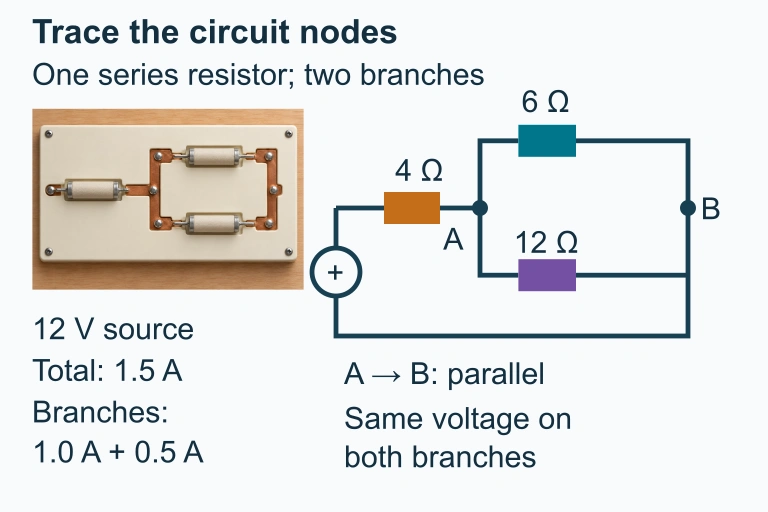
A separate compound-circuit illustration
These values differ from the existing worked example.
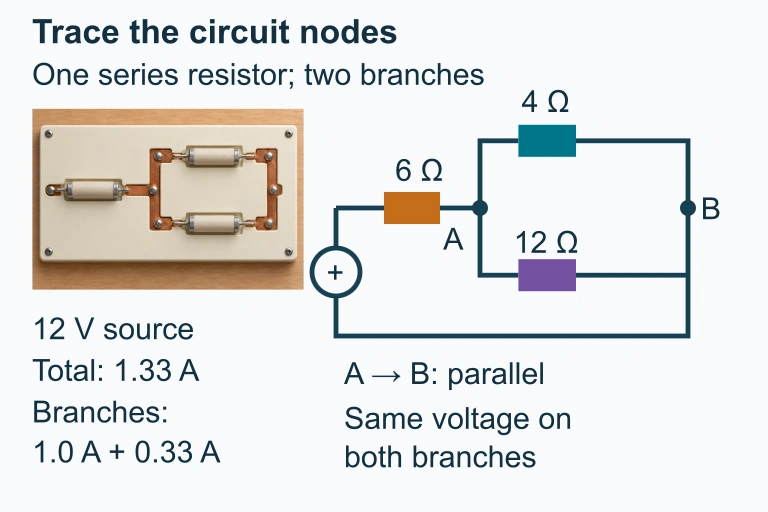
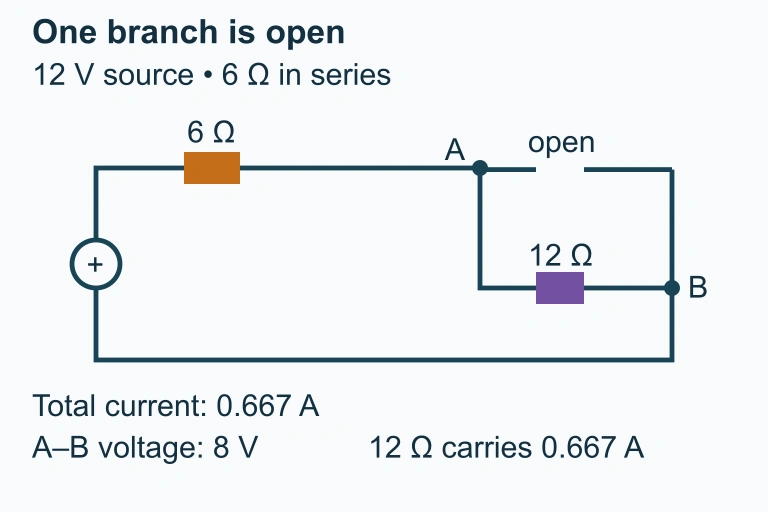
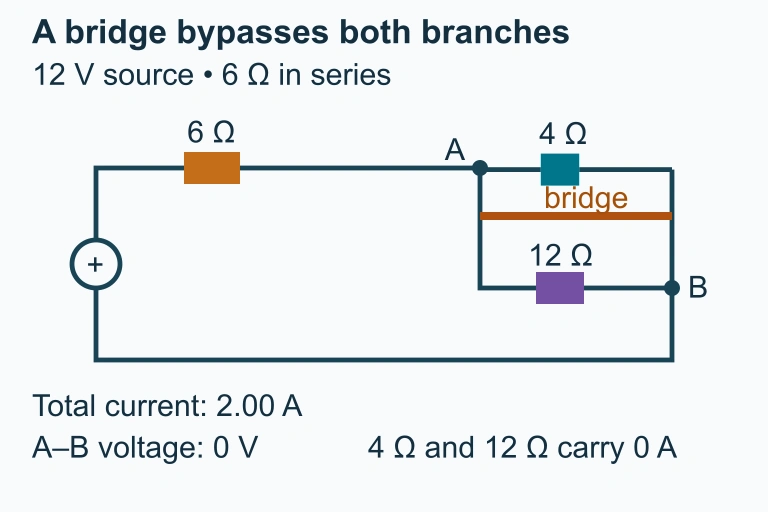
A 12 V ideal battery connects to a 6 Ω series resistor and a parallel pair of 4 Ω and 12 Ω resistors. Find the equivalent resistance and branch currents. What changes when one branch opens or a wire bridges the parallel pair?
Show answer and explanation
The parallel pair has resistance 3 Ω; the total is 9 Ω and the initial current is 4/3 A. The 4 Ω and 12 Ω branches carry 1 A and 1/3 A. Opening the 4 Ω branch leaves total current 2/3 A; a bridge across the pair leaves 2 A through the series resistor and zero current through the parallel resistors.
Example 2: Three-Stage Reduction
Consider a \(24\,\text{V}\) battery connected to: \( R_1 = 8\,\Omega \) in series with a parallel pair of \( R_2 = 12\,\Omega \) and (\( R_3 = 6\,\Omega \) in series with \( R_4 = 6\,\Omega \)).
Example 2: Expanding Back
Power in Compound Circuits
Power dissipated by each resistor can be found using any form of the power equation, once you know two of the three quantities \( V \), \( I \), \( R \) for that specific resistor:
Batteries with Internal Resistance
Voltage and Current Dividers
Common Mistakes
Summary of Key Formulas
| Concept | Formula | When to Use |
|---|---|---|
| Ohm's Law | \( V = IR \) | Any single resistor |
| Series \( R_{eq} \) | \( R_1 + R_2 + \cdots \) | Same current path |
| Parallel \( R_{eq} \) | \( \left(\sum \frac{1}{R_i}\right)^{-1} \) | Same voltage across |
| KCL (Junction) | \( \sum I_{\text{in}} = \sum I_{\text{out}} \) | Any junction |
| KVL (Loop) | \( \sum \Delta V = 0 \) | Any closed loop |
| Power | \( P = IV = I^2R = \frac{V^2}{R} \) | Any element |
Question 1 of 5
A \(10\,\Omega\) resistor is in series with a parallel combination of \(6\,\Omega\) and \(3\,\Omega\). What is the total equivalent resistance?
Question 2 of 5
In the circuit from Question 1, if the battery provides \(24\,\text{V}\), what is the voltage across the parallel combination?
Question 3 of 5
Two identical resistors are connected in parallel. Their equivalent resistance is \(5\,\Omega\). What is the resistance of each resistor?
Question 4 of 5
A battery with emf \( \varepsilon = 9\,\text{V} \) and internal resistance \( r = 1\,\Omega \) is connected to a \(2\,\Omega\) external resistor. What is the terminal voltage of the battery?
Question 5 of 5
In a compound circuit, \(3\,\text{A}\) enters a junction. The junction splits into two branches with resistances \(4\,\Omega\) and \(12\,\Omega\). What is the current through the \(4\,\Omega\) resistor?