Capacitors
Storing Electric Energy
Master the physics of capacitors: from the definition of capacitance \( C = Q/V \) to energy storage, dielectrics, and series/parallel combinations.
What Is a Capacitor?
A capacitor is a device that stores electric charge and energy in an electric field. The simplest form consists of two conducting plates separated by an insulating gap. When a voltage is applied, equal and opposite charges accumulate on each plate.
The Parallel-Plate Capacitor
Key Quantities in Capacitor Physics
Energy Stored in a Capacitor
Work must be done to move charge from one plate to the other against the increasing electric field. The total energy stored is:
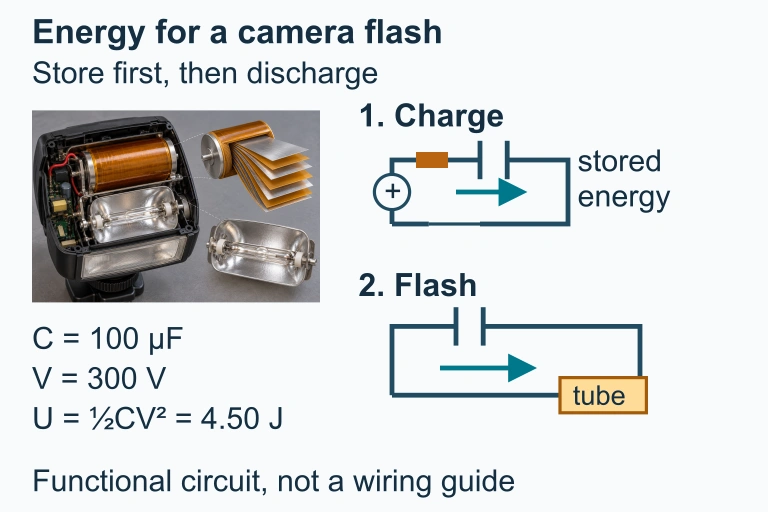
Energy for a camera flash
In a separate ideal calculation, 100 μF charged to 300 V stores 4.50 J. The schematic is functional energy routing, not complete flash wiring.
Dielectrics: Boosting Capacitance
Series vs Parallel Capacitors
Circuit Diagrams
Isolated vs Connected Capacitor
| Isolated (battery removed) | Connected (battery stays) | |
|---|---|---|
| Charge \( Q \) | Constant | Can change |
| Voltage \( V \) | Can change | Constant |
| Insert dielectric | \( V \) decreases, \( U \) decreases | \( Q \) increases, \( U \) increases |
| Which stays fixed? | \( Q \) | \( V \) |
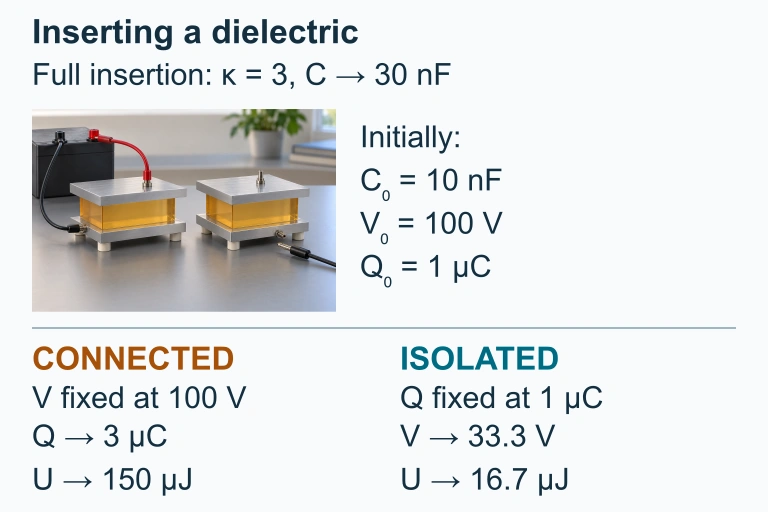
A separate dielectric comparison
Full insertion with κ = 3 triples the capacitance. This 10 nF, 100 V example is separate from the deck’s worked values; connected voltage stays fixed, while isolated charge stays fixed.
How to Solve Capacitor Problems
Example 1: Finding Capacitance
A parallel-plate capacitor has plates of area \( A = 0.02 \; \text{m}^2 \) separated by \( d = 1.0 \; \text{mm} \). Find the capacitance.
Example 2: Series Combination
Two capacitors, \( C_1 = 6 \; \mu\text{F} \) and \( C_2 = 3 \; \mu\text{F} \), are connected in series to a \( 12 \; \text{V} \) battery. Find \( C_{\text{eq}} \), total charge, and voltage across each.
Example 3: Dielectric Insertion
A \( 100 \; \text{pF} \) capacitor is charged to \( 50 \; \text{V} \), then disconnected from the battery. A dielectric with \( \kappa = 4 \) is inserted. Find the new voltage and energy.
Common Mistakes
Capacitor Summary
| Quantity | Formula | Key Insight |
|---|---|---|
| Capacitance | \( C = Q/V \) | Geometry-dependent |
| Parallel-plate | \( C = \kappa \varepsilon_0 A/d \) | \( \uparrow A \) or \( \downarrow d \) → \( \uparrow C \) |
| Energy | \( U = \frac{1}{2}CV^2 \) | Stored in E-field |
| Series | \( 1/C_{\text{eq}} = \sum 1/C_i \) | Same \( Q \), split \( V \) |
| Parallel | \( C_{\text{eq}} = \sum C_i \) | Same \( V \), split \( Q \) |
Question 1 of 5
A parallel-plate capacitor has its plate separation doubled while remaining connected to a battery. What happens to the stored energy?
Question 2 of 5
Three capacitors of \( 2 \; \mu\text{F} \), \( 3 \; \mu\text{F} \), and \( 6 \; \mu\text{F} \) are connected in series. What is the equivalent capacitance?
Question 3 of 5
A capacitor is charged and then isolated from the battery. A dielectric with \( \kappa = 3 \) is inserted. What happens to the voltage?
Question 4 of 5
A \( 10 \; \mu\text{F} \) capacitor is charged to \( 20 \; \text{V} \). How much energy is stored?
Question 5 of 5
Two identical capacitors are first charged in parallel to voltage \( V \), then reconnected in series (battery removed). What is the total voltage across the series combination?