Boundary Behavior
of Waves & Polarization
Explore what happens when waves encounter boundaries: reflection, transmission, and polarization phenomena that govern light and mechanical waves.
What Happens at a Boundary?
When a wave traveling through one medium reaches the boundary with a different medium, three things can occur simultaneously: part of the wave reflects, part transmits (refracts), and some energy may be absorbed.
Fixed vs. Free End Reflection
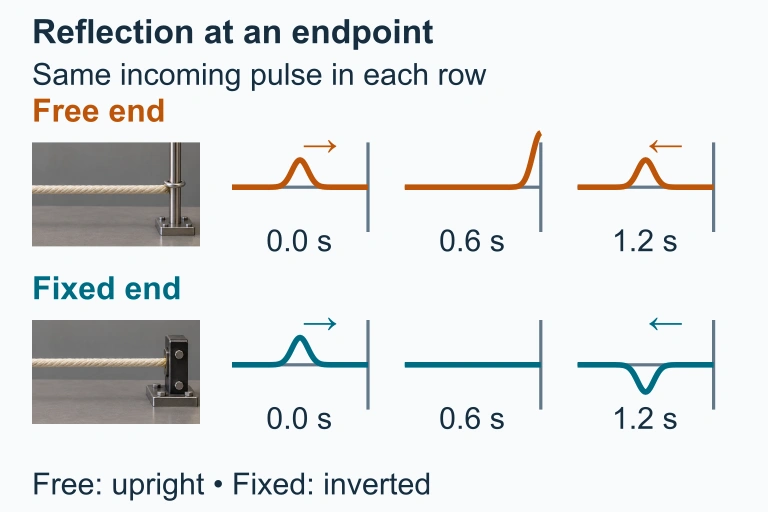
Endpoint reflection
The same ideal pulse reaches a free and a fixed endpoint. At complete overlap the free endpoint doubles in displacement, while the fixed end remains stationary.
Transmission: Less Dense to More Dense
When a wave passes from a less dense medium to a more dense medium, the transmitted wave has a shorter wavelength and slower speed, while the reflected wave is inverted. The frequency remains constant.
What Is Polarization?
Polarization is the restriction of a transverse wave's oscillation to a single plane. Only transverse waves (like light) can be polarized: longitudinal waves (like sound) cannot, because their oscillation is always along the direction of travel.
Malus's Law: Intensity After a Polarizer
When polarized light of intensity \( I_0 \) passes through a second polarizer (analyzer) whose transmission axis is at angle \( \theta \) to the polarization direction, the transmitted intensity is:
Three tactile polarizing sheets reveal a surprising brighter path
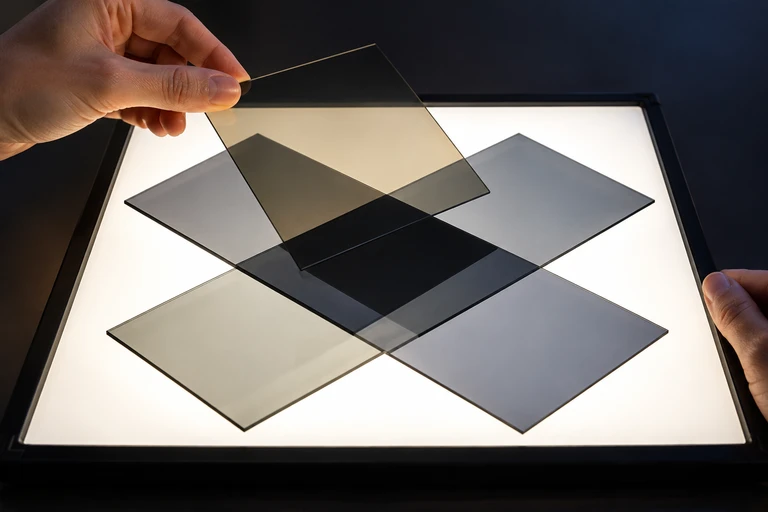 A middle polarizer can transmit light between two crossed outer polarizers. Starting with unpolarized light, apply the one-half factor at the first sheet and Malus’s law at each later sheet.
Three tactile polarizing sheets reveal a surprising brighter path
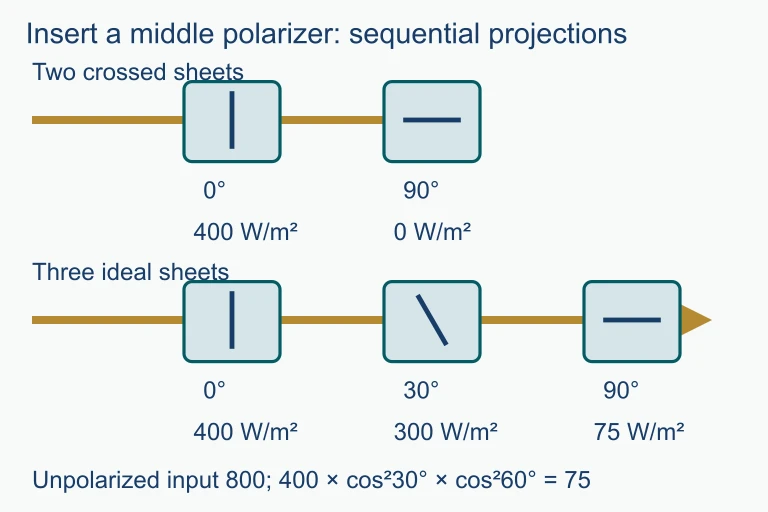 A middle polarizer can transmit light between two crossed outer polarizers. Starting with unpolarized light, apply the one-half factor at the first sheet and Malus’s law at each later sheet.
Snell's Law at a Boundary
When light hits a boundary between two media at an angle, the transmitted ray bends. Snell's Law relates the angles to the indices of refraction:
Total Internal Reflection
When light travels from a more dense to a less dense medium and the angle of incidence exceeds the critical angle \( \theta_c \), no light transmits: it all reflects. This is total internal reflection (TIR).
Key Distinction: Reflection Phase Shifts
| Fixed End / Less-to-More Dense | Free End / More-to-Less Dense | |
|---|---|---|
| Reflected Pulse | Inverted (\(180^\circ\) phase shift) | Upright (no phase shift) |
| Transmitted Pulse | Always upright | Always upright |
| Transmitted Speed | Slower | Faster |
| Transmitted Wavelength | Shorter | Longer |
| Frequency | Always constant | |
How to Solve Boundary Problems
Example 1: Pulse at a Boundary
A wave pulse on a light rope reaches the junction with a heavier rope. The wave speed drops from \( 4 \text{ m/s} \) to \( 2 \text{ m/s} \). If the incident pulse has a wavelength of \( 0.8 \text{ m} \), find the transmitted wavelength and describe the reflected pulse.
Example 2: Applying Snell's Law
Light passes from air (\( n_1 = 1.00 \)) into glass (\( n_2 = 1.50 \)) at an angle of incidence of \( 45^\circ \). Find the angle of refraction.
Example 3: Malus's Law with Two Polarizers
Unpolarized light of intensity \( I_{\text{unpol}} = 100 \text{ W/m}^2 \) passes through a polarizer and then through an analyzer oriented at \( 60^\circ \) to the first. Find the final intensity.
Brewster's Angle: Polarization by Reflection
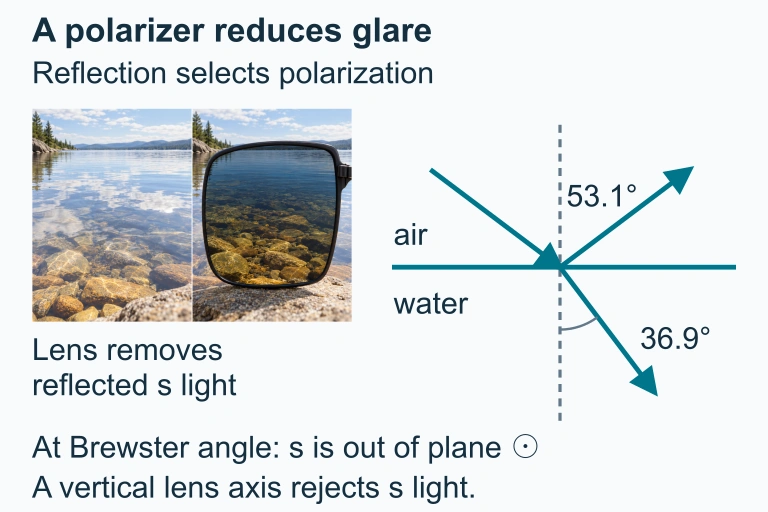
At a specific angle of incidence called Brewster's angle \( \theta_B \), the reflected light is completely polarized. The reflected and refracted rays are perpendicular to each other.
A Brewster-angle example
For the ideal air–water interface shown, reflected light is s-polarized at 53.1°. A vertical transmission axis rejects the horizontal reflected component.
Common Mistakes
Summary of Key Relationships
| Concept | Equation | Key Condition |
|---|---|---|
| Wave Speed | \( v = f\lambda \) | \( f \) constant at boundaries |
| Snell's Law | \( n_1\sin\theta_1 = n_2\sin\theta_2 \) | At refractive boundary |
| Critical Angle | \( \sin\theta_c = \dfrac{n_2}{n_1} \) | Only when \( n_1 > n_2 \) |
| Malus's Law | \( I = I_0\cos^2\theta \) | Polarized light through analyzer |
| Brewster's Angle | \( \tan\theta_B = \dfrac{n_2}{n_1} \) | Reflected light fully polarized |
Question 1 of 5
A wave pulse travels from a thin rope to a thick rope. Which statement is correct about the reflected pulse?
Question 2 of 5
Light travels from glass (\( n = 1.5 \)) into air (\( n = 1.0 \)). What is the critical angle for total internal reflection?
Question 3 of 5
Unpolarized light of intensity \( 200 \text{ W/m}^2 \) passes through two polarizers with their transmission axes at \( 30^\circ \) to each other. What is the final intensity?
Question 4 of 5
Which type of wave cannot be polarized?
Question 5 of 5
A wave with frequency \( 10 \text{ Hz} \) and speed \( 20 \text{ m/s} \) enters a medium where the speed is \( 15 \text{ m/s} \). What is the wavelength in the new medium?