Blackbody
Radiation
Explore how perfect absorbers emit thermal radiation, the laws governing spectral intensity, and the quantum breakthrough that reshaped physics.
What Is a Blackbody?
A blackbody is an idealized object that absorbs all incoming electromagnetic radiation, regardless of frequency or angle. It reflects nothing and transmits nothing. When heated, it re-emits radiation with a characteristic spectrum that depends only on its temperature.
The Blackbody Spectrum
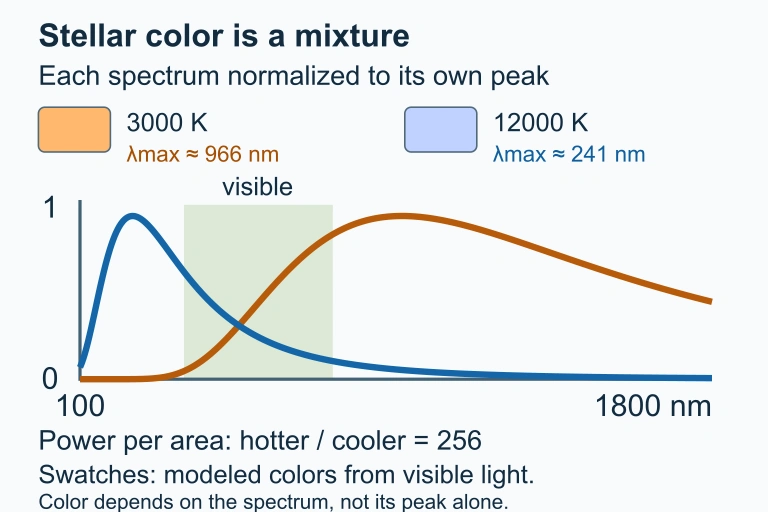
Color depends on the full visible spectrum
This separate comparison uses 3000 K and 12000 K. Each curve is normalized to its own peak. Apparent color depends on the full visible spectrum and the observer’s response; peak wavelength alone does not determine it.
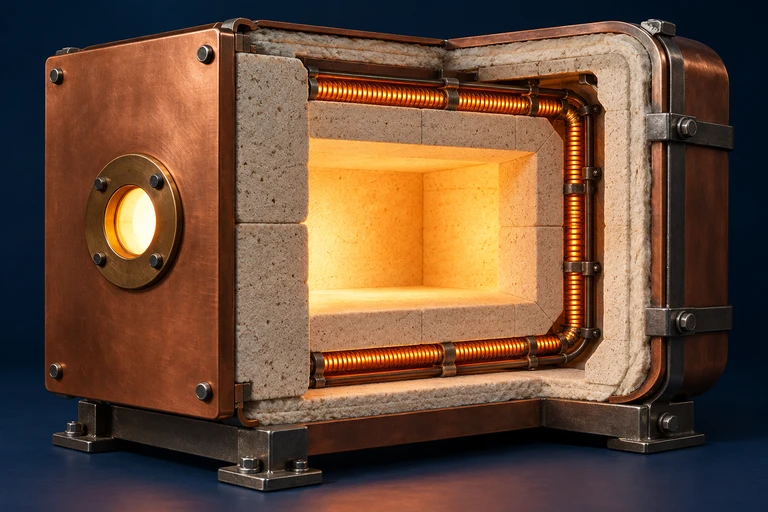
A glowing cavity reveals why surface color is not a single wavelength
 A blackbody emits a broad spectrum. As temperature increases, the peak of Bλ moves to shorter wavelength and total emitted power per area grows as T⁴.
A glowing cavity reveals why surface color is not a single wavelength
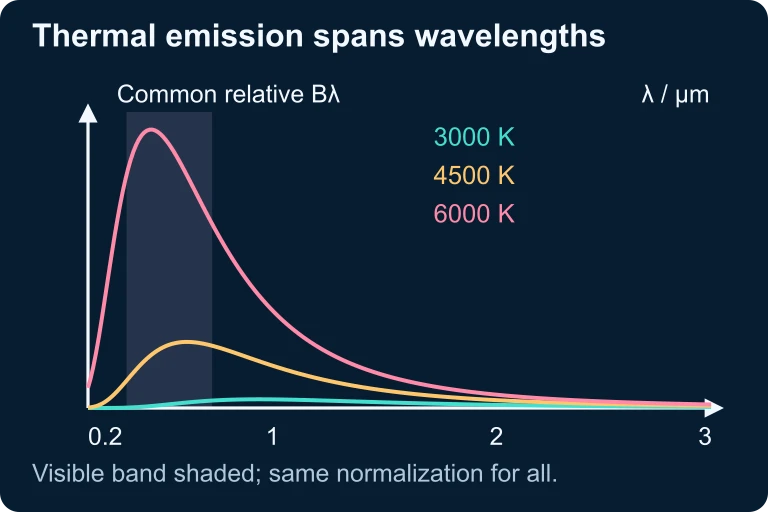 A blackbody emits a broad spectrum. As temperature increases, the peak of Bλ moves to shorter wavelength and total emitted power per area grows as T⁴.
Why Does It Matter?
Wien's Displacement Law
The wavelength at which a blackbody emits most intensely is inversely proportional to its temperature:
Hotter objects glow bluer (shorter \( \lambda_{\max} \)); cooler objects glow redder (longer \( \lambda_{\max} \)).
Stefan-Boltzmann Law
The total power radiated by a blackbody is proportional to the fourth power of its absolute temperature:
Planck's Radiation Law
Planck modeled the blackbody spectrum by proposing that energy is emitted in discrete quanta, not continuously:
The Ultraviolet Catastrophe
Classical vs. Quantum
| Classical (Rayleigh-Jeans) | Quantum (Planck) | |
|---|---|---|
| Energy | Continuous | Quantized: \( E = nhf \) |
| Short \( \lambda \) | Diverges to infinity | Falls to zero |
| Long \( \lambda \) | Matches experiment | Matches experiment |
| Overall fit | Fails at UV | Perfect match |
Energy Quantization
The energy of a single quantum (photon) emitted at frequency \( f \) is:
How to Solve Blackbody Problems
Example 1: Wien's Law
The Sun's surface temperature is approximately \( T = 5778 \text{ K} \). Find the peak emission wavelength.
Example 2: Stefan-Boltzmann
A spherical blackbody has radius \( r = 0.1 \text{ m} \) and temperature \( T = 1000 \text{ K} \). Find the total radiated power.
Example 3: Comparing Stars
Star A has temperature \( T_A = 4000 \text{ K} \) and Star B has temperature \( T_B = 8000 \text{ K} \). Both have the same radius. How does their power output compare?
Common Mistakes
Key Formulas Summary
| Law | Formula | Tells You |
|---|---|---|
| Wien's Displacement | \( \lambda_{\max} = \dfrac{b}{T} \) | Peak wavelength |
| Stefan-Boltzmann | \( P = \sigma A T^4 \) | Total radiated power |
| Planck's Law | \( B(\lambda,T) = \dfrac{2hc^2}{\lambda^5}\dfrac{1}{e^{\,hc/(\lambda k_B T)}-1} \) | Spectral intensity |
| Photon Energy | \( E = hf = \dfrac{hc}{\lambda} \) | Energy per quantum |
Question 1 of 5
If the surface temperature of a blackbody is doubled, by what factor does its total radiated power change?
Question 2 of 5
A blackbody has a peak emission wavelength of 600 nm. What is its approximate surface temperature?
Question 3 of 5
The "ultraviolet catastrophe" refers to the failure of classical physics to predict which aspect of blackbody radiation?
Question 4 of 5
Star X has twice the radius (\(r_X = 2r_Y\)) and twice the temperature (\(T_X = 2T_Y\)) of Star Y. What is the ratio \( P_X / P_Y \)?
Question 5 of 5
According to Planck, the energy of a photon with frequency \( f \) is given by which expression?