
SECTION 1
Historical Context & Motivation
For centuries, the nature of heat puzzled philosophers and scientists alike. Early thinkers imagined heat as a weightless, invisible fluid called caloric that flowed from hot bodies to cold ones. While the caloric theory could explain certain observations — such as the sensation of warmth spreading from a fire — it fundamentally failed to account for heat generated by friction, where no reservoir of caloric seemed to exist. The modern understanding that heat is a transfer of microscopic kinetic energy between particles took shape over roughly two centuries of experimental and theoretical work, ultimately giving rise to the field of thermodynamics.
1798 • Rumford's Cannon-Boring Experiment
1843 • Joule's Mechanical Equivalent of Heat
1850 • Clausius and the Second Law
1871 • Maxwell and Boltzmann's Kinetic Theory
This historical arc raises a central question for AP Physics 2: given that energy spontaneously transfers from regions of higher temperature to regions of lower temperature, what governs the rate of that transfer, what mechanisms carry it out, and when does the transfer stop? Understanding thermal equilibrium — the state in which net energy exchange ceases — is the key to answering these questions and is foundational to every thermodynamic analysis you will encounter.
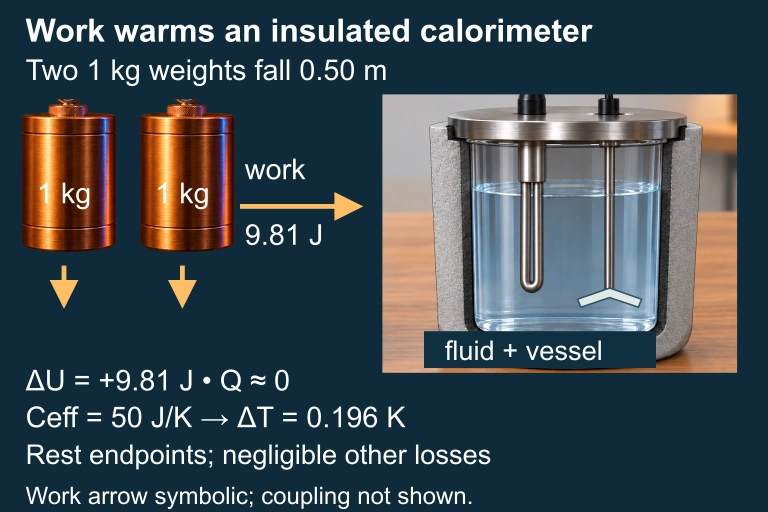 An energy-transfer schematic: two falling weights provide work to the fluid and vessel, with negligible heat transfer.
SECTION 2
Core Principles & Definitions
Before examining the mathematics, it is essential to establish a precise vocabulary. In thermodynamics, thermal energy refers to the total internal kinetic energy associated with the random motion of atoms and molecules within a substance. Temperature is a macroscopic quantity proportional to the average translational kinetic energy per particle. Heat (symbol Q) is not a property stored in an object but rather the process by which thermal energy transfers from one system to another due to a temperature difference. These distinctions are subtle yet critical: a large lake at 20 °C holds far more thermal energy than a small cup of coffee at 80 °C, even though the coffee is at a higher temperature.
Conduction
Convection
Radiation
Thermal Equilibrium
Zeroth Law of Thermodynamics
KEY TAKEAWAY
SECTION 3
Visualizing Heat Transfer Mechanisms
In the diagram above, notice how each mechanism involves a fundamentally different physical process. Conduction depends on the thermal conductivity of the material and the temperature gradient across it — the steeper the gradient, the faster the energy flows. Convection, by contrast, depends on fluid dynamics: as a fluid parcel absorbs energy near a heat source, it expands, becomes less dense, and rises, while cooler fluid descends to replace it, forming a continuous circulation loop. Radiation is unique in that it does not require matter at all; the Sun heats the Earth across roughly 150 million kilometers of vacuum entirely through electromagnetic radiation. In real-world systems, all three mechanisms often operate simultaneously — for instance, a pot of boiling water involves conduction through the pot's metal base, convection within the circulating water, and radiation from the stove element.
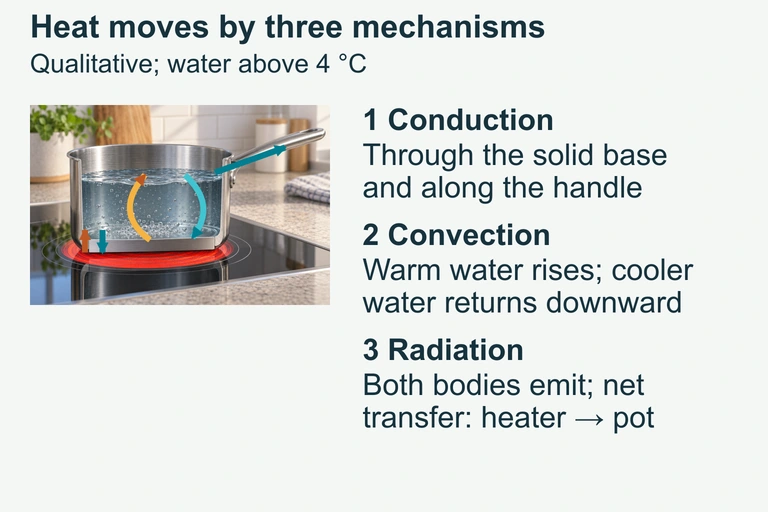 One pot composite illustrates conduction through a solid handle, warm liquid rising and cooler liquid descending, and text explaining two-way radiation with net transfer from the hotter heater to the cooler pot. The liquid circulation is a qualitative single-phase convection model, distinct from boiling bubbles.
SECTION 4
Mathematical Framework
The quantitative treatment of thermal energy transfer in AP Physics 2 centers on calorimetry equations and the concept of thermal equilibrium. When two objects at different temperatures are placed in thermal contact within an insulated system, energy flows from the hotter object to the cooler one until both reach a common final temperature. Conservation of energy requires that the energy lost by the hot object equals the energy gained by the cold object.
HEAT TRANSFER (SENSIBLE)
where Q is the heat transferred (J), m is mass (kg), c is specific heat capacity (J/(kg·°C)), and ΔT = T_final − T_initial is the change in temperature. A positive Q means the system absorbs energy; a negative Q means it releases energy.
CONSERVATION OF ENERGY (CALORIMETRY)
Equivalently, m₁c₁( − T₁) + m₂c₂( − T₂) = 0, where subscripts 1 and 2 refer to the hot and cold objects respectively, and is the common equilibrium temperature. This equation assumes a perfectly insulated system with no phase changes.
HEAT TRANSFER (PHASE CHANGE)
where L is the latent heat (J/kg) — either for fusion (melting/freezing) or for vaporization (boiling/condensation). During a phase change, temperature remains constant while energy is absorbed or released to break or form intermolecular bonds.
FOURIER'S LAW OF CONDUCTION
where P is the rate of heat transfer (W), k is thermal conductivity (W/(m·K)), A is cross-sectional area (m²), and L is the thickness of the material (m). This equation governs steady-state conduction through a slab.
The calorimetry equation is the workhorse of thermal equilibrium problems on the AP exam. When solving for the equilibrium temperature , you set the total energy change of the system to zero and solve the resulting linear equation. If a phase change is involved, you must first determine whether enough energy is available to complete the phase transition; if not, the system reaches equilibrium at the phase-change temperature with a mixture of phases present.
SECTION 5
Heating Curves & Energy Distribution
A heating curve provides an invaluable visual representation of how a substance's temperature changes as energy is continuously added at a constant rate. The curve's sloped segments correspond to temperature increases within a single phase, while its horizontal plateaus represent phase transitions during which the substance absorbs latent heat without changing temperature. Understanding this graph is essential for reasoning about multi-step calorimetry problems, where you must identify which portions of the heating process involve Q = mcΔT and which involve Q = mL.
Several key observations emerge from the heating curve. First, the slope of each warming segment is inversely proportional to the product mc for that phase — a larger specific heat capacity or larger mass means a gentler slope, indicating that more energy is needed per degree of temperature change. Second, the width of each plateau is proportional to mL, the total energy required to complete that phase transition. For water, the latent heat of vaporization ( ≈ 2.26 × 10⁶ J/kg) is roughly 6.7 times larger than the latent heat of fusion ( ≈ 3.34 × 10⁵ J/kg), which is why the boiling plateau is dramatically wider. On AP Physics 2, you should be prepared to extract quantitative information from such curves — for example, calculating specific heat from a given slope or identifying the phase present at a particular point on the curve.
AP EXAM TIP
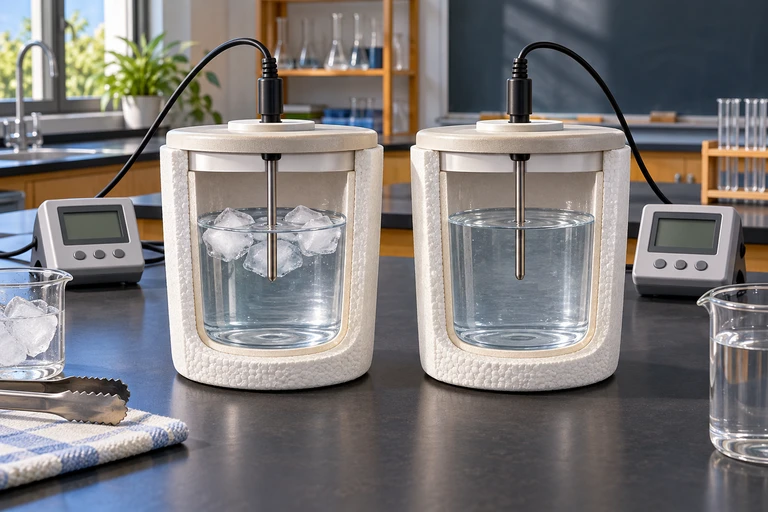 Before finding the final temperature of an ice–water mixture, compare the heat available from cooling the warm water with the energy required to melt the ice.
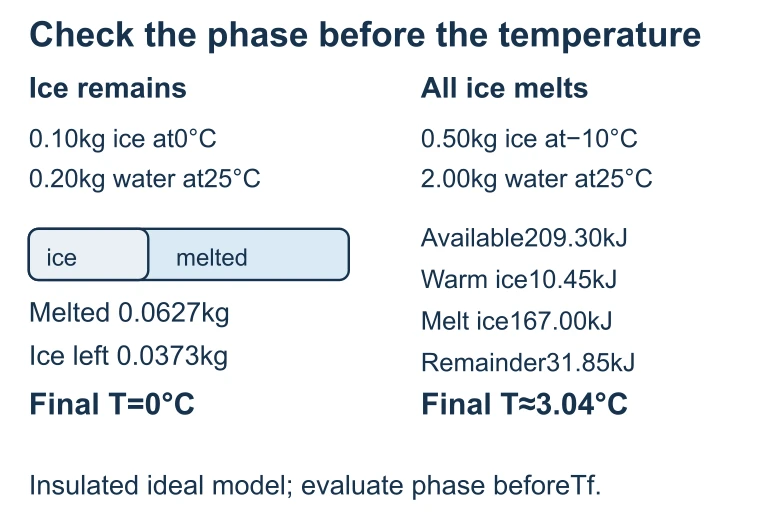 Before finding the final temperature of an ice–water mixture, compare the heat available from cooling the warm water with the energy required to melt the ice.
SECTION 6
Worked Example: Calorimetry with Phase Change
Consider the following problem: A 0.50 kg block of ice at −10.0 °C is placed in an insulated container with 2.00 kg of water at 25.0 °C. Find the final equilibrium temperature and state. Use c_ice = 2,090 J/(kg·°C), c_water = 4,186 J/(kg·°C), and = 3.34 × 10⁵ J/kg.
Calorimetry: Ice Placed in Warm Water
- 1
Step 1 — Identify the Energy Budget
The ice must first warm from −10.0 °C to 0 °C, then melt completely, and finally (if energy permits) the resulting meltwater warms further. The warm water cools from 25.0 °C toward equilibrium. We need to check whether enough energy is available from the warm water to accomplish all of this. - 2
Step 2 — Calculate Energy to Warm Ice to 0 °C
Q₁ = m_ice × c_ice × ΔT = (0.50 kg)(2,090 J/(kg·°C))(0 − (−10.0)) = (0.50)(2,090)(10.0)Q₁ = 10,450 J - 3
Step 3 — Calculate Energy to Melt All the Ice
Q₂ = m_ice × = (0.50 kg)(3.34 × 10⁵ J/kg)Q₂ = 167,000 J - 4
Step 4 — Calculate Maximum Energy Available from Warm Water Cooling to 0 °C
Q_available = m_water × c_water × ΔT = (2.00 kg)(4,186 J/(kg·°C))(25.0 − 0)Q_available = 209,300 J - 5
Step 5 — Check Energy Feasibility
Total energy needed to warm and melt all the ice: Q₁ + Q₂ = 10,450 + 167,000 = 177,450 J. Since 209,300 J > 177,450 J, the warm water provides enough energy to fully melt the ice, with 209,300 − 177,450 = 31,850 J remaining. This leftover energy warms the combined 2.50 kg of liquid water above 0 °C. - 6
Step 6 — Solve for Final Equilibrium Temperature
After all ice has melted, the system is 2.50 kg of water. The warm water has already released 177,450 J to bring the ice to 0 °C water. Now set up the calorimetry equation for the remaining energy exchange: m_total × c_water × ( − 0) = 31,850 J, which gives (2.50)(4,186)() = 31,850, so = 31,850 / 10,465≈ 3.04 °C - 7
Step 7 — State the Final Answer
The final equilibrium temperature is approximately 3.0 °C, and the final state is entirely liquid water. All ice has melted completely.
VERIFICATION CHECK
SECTION 7
Comparing Heat Transfer Mechanisms
While all three heat transfer mechanisms — conduction, convection, and radiation — serve to transport thermal energy down temperature gradients, they differ profoundly in their physical requirements, dominant contexts, and governing equations. The table below synthesizes the key distinctions you need for the AP exam.
| Property | Conduction | Convection | Radiation |
|---|---|---|---|
| Medium Required | Solid (or fluid at rest) | Fluid (liquid or gas) | None — works through vacuum |
| Mechanism | Molecular collisions and electron diffusion | Bulk fluid mass transport | Electromagnetic wave emission/absorption |
| Rate Equation | P = kAΔT/L | P = hAΔT (Newton's cooling) | P = εσAT⁴ (Stefan-Boltzmann) |
| Temperature Dependence | Linear (∝ ΔT) | Linear (∝ ΔT) | Strongly nonlinear (∝ T⁴) |
| Key Material Property | Thermal conductivity (k) | Convective coefficient (h) | Emissivity (ε) |
| Typical Example | Metal spoon in hot soup | Ocean currents, weather patterns | Sunlight reaching Earth |
Comparison of the three fundamental heat transfer mechanisms
KEY TAKEAWAY
SECTION 8
Connection to the Laws of Thermodynamics
Thermal energy transfer and equilibrium form the empirical bedrock upon which the formal laws of thermodynamics are built. In AP Physics 2, you treat these concepts primarily through calorimetry and the Zeroth Law, but it is valuable to see how they connect to the broader thermodynamic framework, especially the First and Second Laws, which you will encounter in more advanced physics and engineering courses.
| Concept | AP Physics 2 Treatment | Advanced / University Physics |
|---|---|---|
| Thermal Equilibrium | Two objects reach the same final temperature; Q_lost + Q_gained = 0 | Defined by entropy maximization; equilibrium is the most probable macrostate in statistical mechanics |
| Heat Flow Direction | Hot → cold, taken as an empirical fact (Zeroth Law) | Derived from the Second Law; ΔS_universe > 0 for all spontaneous processes |
| Energy Conservation | Applied via calorimetry: total Q = 0 in an insulated system | Generalized as the First Law: ΔU = Q − W, incorporating PdV work and internal energy |
| Rate of Transfer | Fourier's law for conduction; qualitative understanding of convection and radiation | Heat equation (partial differential equation), Navier-Stokes for convection, Planck radiation law |
| Phase Transitions | Q = mL at constant temperature; heating curves | Clausius-Clapeyron equation relates phase boundaries to entropy and volume changes |
AP Physics 2 treatment versus advanced university physics
The key insight for your AP preparation is that the calorimetry problems you solve are a direct application of the First Law of Thermodynamics in the special case where no work is done (W = 0), so ΔU = Q. Meanwhile, the directionality of heat flow — always from hot to cold spontaneously — is a manifestation of the Second Law. When you encounter PV diagrams and heat engines later in the course, the equilibrium and energy-transfer principles established here will serve as your conceptual anchor.
SECTION 9
Practice Problems
Question 1: CONCEPTUAL
- A. Energy was lost to the environment despite the insulation.
- B. The objects have different values of the product mc (mass × specific heat), so they require different amounts of energy per degree of temperature change.
- C. A phase change occurred in one of the objects, absorbing extra energy at constant temperature.
- D. Heat always transfers more slowly as the temperature difference decreases, making the equilibrium temperature unpredictable.
Show answer (B)
Question 2: BASIC CALCULATION
- A. 24 °C
- B. 30 °C
- C. 42 °C
- D. 60 °C
Show answer (B)
Question 3: INTERMEDIATE
- A. 14.4 W
- B. 28.9 W
- C. 57.8 W
- D. 115.5 W
Show answer (B)
Question 4: APPLIED
5 ptsShow answer
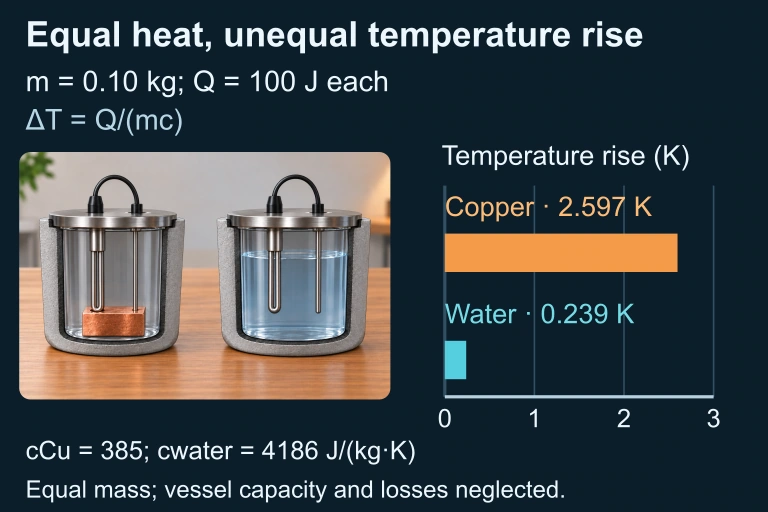 A synthetic no-loss comparison adds 100 J to 0.10 kg of each material. Copper rises by 2.597 K and water by 0.239 K on the same zero-based scale. Container and heater heat capacities are neglected; equal masses do not imply equal volumes. This compares specific heat, not thermal conductivity.
Question 5: CRITICAL THINKING
4 ptsShow answer
SUMMARY
Key Concepts Review
Summary
Thermal energy is the total internal kinetic energy of a system's particles, while temperature measures average translational kinetic energy per particle. Heat (Q) is energy in transit due to a temperature difference, transferred via three mechanisms: conduction (molecular collisions in direct contact), convection (bulk fluid motion), and radiation (electromagnetic waves requiring no medium). The Zeroth Law of Thermodynamics establishes that thermal equilibrium is transitive, justifying the use of thermometers and the concept of temperature itself.
Quantitatively, Q = mcΔT governs temperature changes within a single phase, while Q = mL applies during phase transitions at constant temperature. Conservation of energy in an insulated system requires Q_lost + Q_gained = 0, which you solve to find the equilibrium temperature. For problems involving phase changes, always verify whether sufficient energy exists to complete the transition — if not, the system equilibrates at the phase-change temperature with coexisting phases. Fourier's law (P = kAΔT/L) gives the steady-state conduction rate and connects material properties to energy flow rates.