
SECTION 1
Historical Context & Motivation
At the close of the nineteenth century, classical physics stood on seemingly unshakable foundations: Newton's mechanics described motion, Maxwell's equations unified electricity and magnetism, and thermodynamics governed heat and energy. Yet a handful of stubborn experimental puzzles—blackbody radiation, atomic spectra, and the behavior of light striking metal surfaces—exposed deep cracks in the classical framework. The photoelectric effect, the phenomenon in which light ejects electrons from a material, became one of the most decisive of these puzzles. Classical wave theory predicted that any frequency of light, given enough intensity, should eventually liberate electrons—but experiments told a dramatically different story.
1887 • Hertz Observes the Effect
1899 • Thomson Measures Charge Carriers
1902 • Lenard's Frequency Experiments
1905 • Einstein's Quantum Explanation
1916 • Millikan's Precise Verification
The central question the photoelectric effect forced physicists to answer was both simple and revolutionary: why does the energy of ejected electrons depend on the color (frequency) of light rather than its brightness (intensity)? Answering this question required abandoning the continuous-wave model of light and embracing the concept of energy quantization—a shift that laid the groundwork for all of quantum mechanics.
SECTION 2
Core Principles & Definitions
Understanding the photoelectric effect requires internalizing several foundational ideas that together explain why classical physics fails and why a particle model of light succeeds. Each principle below represents a testable prediction that distinguishes the quantum picture from the classical one, and mastering all of them is essential for the AP Physics 2 exam.
Photon Energy
Work Function (ϕ)
Threshold Frequency (f₀)
Kinetic Energy of Photoelectrons
Intensity & Photocurrent
KEY TAKEAWAY
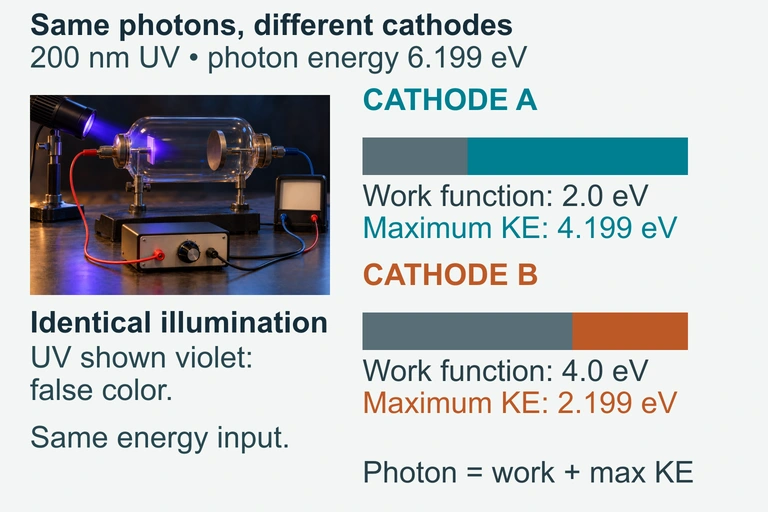 At the same 200 nm photon energy, hypothetical work functions 2 and 4 eV leave maximum electron kinetic energies 4.199 and 2.199 eV. The UV beam is false color. Use the separate illustrative photocurrent panel for stopping potentials.
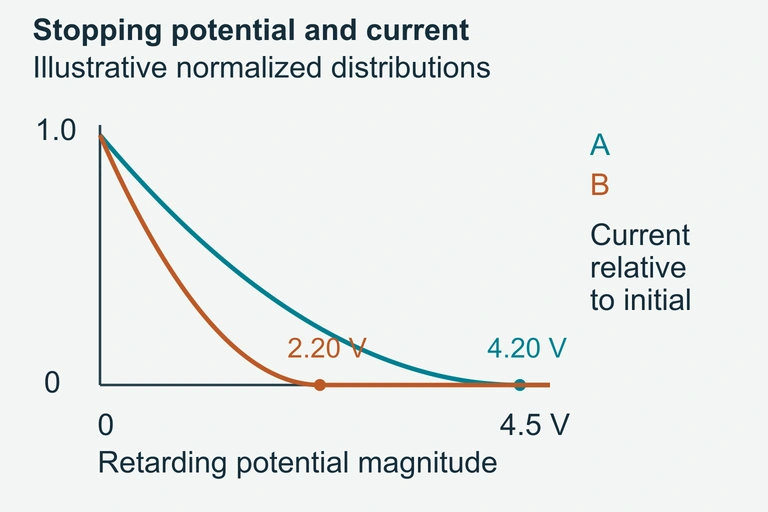 Illustrative normalized photocurrent curves reach zero at retarding-potential magnitudes 4.2 and 2.2 V. Their shapes are chosen illustrations, not measured data.
SECTION 3
Visual Explanation — The Photoelectric Apparatus
In the apparatus above, monochromatic light of known frequency illuminates a clean metal surface (the cathode) inside an evacuated tube. When the photon energy exceeds the work function, electrons are ejected and travel across the gap to the collector plate (anode), producing a measurable current. By applying a reverse (stopping) potential between the plates, an experimenter can gradually slow the photoelectrons until none reach the anode. The voltage at which the current drops to zero is called the stopping potential V₀, and it is directly related to the maximum kinetic energy of the emitted electrons by K_max = eV₀, where e is the elementary charge.
Two results that defied classical wave theory are especially important. First, emission is instantaneous—even at extremely low intensities, electrons appear without the time delay that wave theory would demand for energy accumulation. Second, below the threshold frequency, no electrons are emitted regardless of how bright the light is. These observations are naturally explained if light energy arrives in indivisible photon quanta.
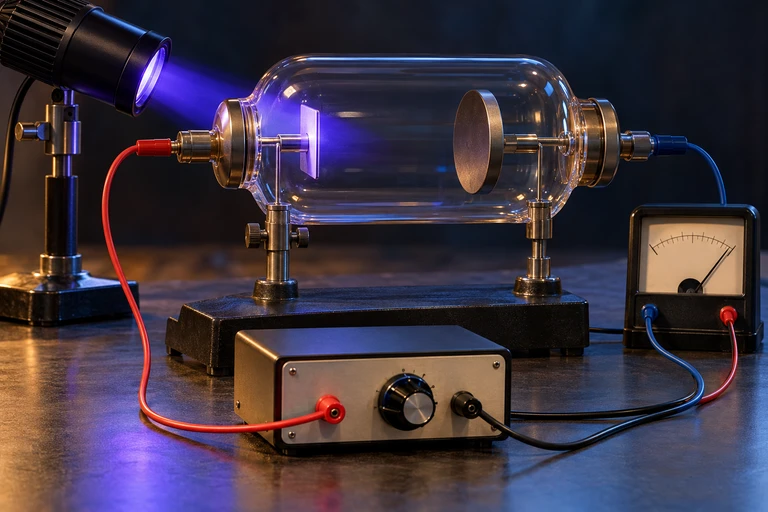 A collector held negative relative to the emitter retards emitted electrons. The stopping-potential magnitude gives the maximum kinetic energy through Kmax = eVstop.
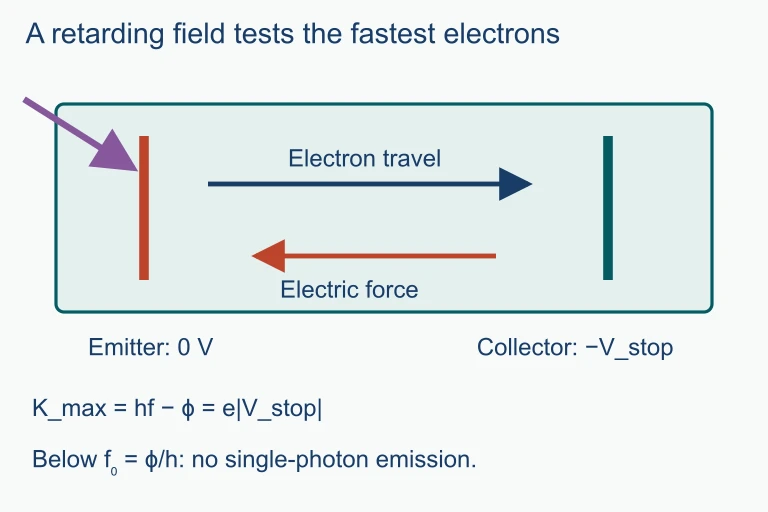 A collector held negative relative to the emitter retards emitted electrons. The stopping-potential magnitude gives the maximum kinetic energy through Kmax = eVstop.
SECTION 4
Mathematical Framework
Einstein's photoelectric equation is an energy conservation statement: the energy of the incoming photon is partitioned into the energy needed to liberate the electron (the work function) and the kinetic energy the electron carries away. This simple equation encapsulates all observed photoelectric behavior and is featured prominently on the AP Physics 2 equation sheet.
PHOTON ENERGY
E = energy of a single photon (J or eV); h = Planck's constant = 6.63 × 10⁻³⁴ J·s = 4.14 × 10⁻¹⁵ eV·s; f = frequency (Hz); c = 3.00 × 10⁸ m/s; λ = wavelength (m).
EINSTEIN'S PHOTOELECTRIC EQUATION
Kmax = maximum kinetic energy of the emitted photoelectron; hf = photon energy; ϕ = work function of the metal surface. If hf < ϕ, no emission occurs.
THRESHOLD FREQUENCY
f₀ = minimum frequency of incident light required to eject electrons. Equivalently, the threshold wavelength is λ₀ = hc / ϕ. For photon frequencies below f₀, the photocurrent is exactly zero.
STOPPING POTENTIAL RELATION
V₀ = stopping potential (V); e = elementary charge = 1.60 × 10⁻¹⁹ C. Measuring V₀ for multiple frequencies and plotting V₀ vs. f yields a straight line with slope h/e and y-intercept −ϕ/e.
Unit Tip for AP Physics 2
SECTION 5
Graphical Analysis — Stopping Potential vs. Frequency
One of the most powerful ways to probe the photoelectric equation is by graphing stopping potential V₀ as a function of incident light frequency f. From eV₀ = hf − ϕ, rearranging gives V₀ = (h/e)f − ϕ/e. This is a linear equation in the form y = mx + b, where the slope is h/e and the y-intercept is −ϕ/e. The x-intercept—where V₀ equals zero—corresponds to the threshold frequency f₀. This type of linearized graph is a staple of AP Physics 2 free-response questions involving experimental data analysis.
Several features of this graph deserve emphasis for the AP exam. The slope h/e is the same for every metal, because it depends only on fundamental constants. Different metals have different work functions, so their lines are vertically shifted—metals with larger ϕ have higher threshold frequencies and more negative y-intercepts. If an exam question provides a V₀ vs. f graph with data points from two metals, the lines should be parallel with different x-intercepts. This is a common feature of AP free-response experimental design questions.
| Metal | Work Function ϕ (eV) | Threshold Frequency f₀ (× 10¹⁴ Hz) | Threshold Wavelength λ₀ (nm) |
|---|---|---|---|
| Cesium (Cs) | 2.1 | 5.07 | 590 |
| Sodium (Na) | 2.3 | 5.56 | 540 |
| Zinc (Zn) | 4.3 | 10.4 | 288 |
| Platinum (Pt) | 6.4 | 15.5 | 194 |
Common metals and their photoelectric properties. Metals with lower work functions require lower-frequency (longer-wavelength) light to eject electrons.
SECTION 6
Worked Example
Calculating Maximum Kinetic Energy and Stopping Potential
- 1
Step 1 — Identify Given Values
Ultraviolet light of wavelength λ = 250 nm illuminates a sodium surface with work function ϕ = 2.3 eV. We need to find (a) the photon energy, (b) the maximum kinetic energy of the photoelectrons, and (c) the stopping potential. - 2
Step 2 — Calculate Photon Energy
Using E = hc / λ with h = 4.14 × 10⁻¹⁵ eV·s and c = 3.00 × 10⁸ m/s: E = (4.14 × 10⁻¹⁵ eV·s)(3.00 × 10⁸ m/s) / (250 × 10⁻⁹ m). It is often convenient to use the combined constant hc = 1240 eV·nm, so E = 1240 eV·nm / 250 nm.E = 4.96 eV - 3
Step 3 — Apply Einstein's Photoelectric Equation
K_max = hf − ϕ = E − ϕ = 4.96 eV − 2.3 eV.K_max = 2.66 eV ≈ 2.7 eV - 4
Step 4 — Determine the Stopping Potential
Since K_max = eV₀, we solve for V₀: V₀ = K_max / e. When K_max is already in electron-volts, V₀ numerically equals K_max because dividing eV by e gives volts.V₀ = 2.66 V ≈ 2.7 V - 5
Step 5 — Verify and Interpret
The photon energy (4.96 eV) exceeds the work function (2.3 eV), confirming that electron emission occurs. The remaining energy appears as kinetic energy of the fastest photoelectrons. To stop these electrons, a reverse potential of 2.7 V must be applied. Note that if we doubled the intensity of this UV light, the photocurrent would double but V₀ and K_max would remain unchanged—only frequency affects K_max.
The hc = 1240 eV·nm Shortcut
SECTION 7
Classical Predictions vs. Experimental Observations
The photoelectric effect's historical significance rests on the dramatic failure of classical electromagnetic wave theory to account for the experimental data. Understanding precisely where the classical picture breaks down—and why the quantum model succeeds—is critical both for conceptual AP exam questions and for developing deeper physical intuition about the nature of light.
| Observation | Classical Wave Prediction | Quantum Photon Prediction |
|---|---|---|
| Threshold frequency | No threshold should exist; any frequency should eject electrons if intensity is sufficient | Threshold f₀ = ϕ/h exists; below it, no electrons are emitted regardless of intensity ✓ |
| Effect of intensity on K_max | Greater intensity should increase electron kinetic energy | K_max depends only on frequency, not intensity; intensity controls number of electrons ✓ |
| Time delay | At low intensity, minutes to hours should be needed for an electron to accumulate enough energy | Emission is essentially instantaneous (< 10⁻⁹ s) because a single photon delivers all energy at once ✓ |
| K_max vs. frequency dependence | No specific frequency dependence predicted for kinetic energy | K_max increases linearly with frequency above threshold: K_max = hf − ϕ ✓ |
Classical wave theory fails on every key prediction, while Einstein's photon model matches all observations.
KEY TAKEAWAY
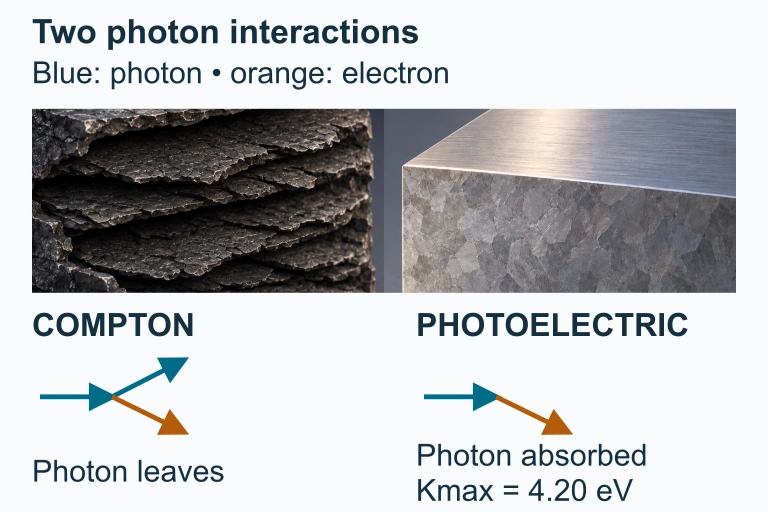 In Compton scattering a photon leaves after transferring momentum to an electron. In the selected photoelectric example, a 6.20 eV photon is absorbed and a 2.00 eV work function leaves a maximum electron kinetic energy of 4.20 eV.
SECTION 8
Connections to Advanced Theory
The photoelectric effect sits at the foundation of modern quantum physics, but its principles extend far beyond the simple metal-surface experiments described here. Understanding how this baseline concept connects to more advanced topics—some of which appear on the AP Physics 2 exam and some in college-level quantum mechanics—strengthens your overall physical reasoning.
| Concept | Photoelectric Effect (AP Physics 2) | Advanced Extension |
|---|---|---|
| Compton Scattering | Photon transfers all its energy to an electron bound in a metal | Photon transfers partial energy to a free electron; both photon and electron scatter, confirming photon momentum p = h/λ |
| de Broglie Wavelength | Electrons are ejected with kinetic energy from photon absorption | Ejected electrons have an associated matter wave: λ = h/p = h/√(2mK_max), bridging particle and wave descriptions of matter |
| Bohr Model & Atomic Spectra | Energy quantization explains threshold frequency | Energy quantization in atoms produces discrete spectral lines; photon absorption and emission follow the same E = hf relation |
| Photovoltaics & Technology | Light ejects electrons from a metal surface | Solar cells use semiconductor band gaps (analogous to ϕ) to convert photon energy into electrical current at industrial scale |
The photoelectric effect connects to many topics in modern physics, from fundamental quantum concepts to practical technology.
For the AP Physics 2 exam specifically, keep in mind that the photoelectric effect often appears alongside questions on wave-particle duality and atomic energy levels. The unifying thread is E = hf: the same equation governs photon emission and absorption in atomic transitions, the threshold condition in the photoelectric effect, and the energy of photons scattered in Compton experiments. Master this equation and its physical meaning, and you command a large fraction of the Modern Physics content on the exam.
SECTION 9
Practice Problems
Question 1: CONCEPTUAL
- A. The maximum kinetic energy of the photoelectrons doubles.
- B. The stopping potential doubles.
- C. The number of photoelectrons emitted per second approximately doubles.
- D. The threshold frequency of the metal decreases.
Show answer (C)
Question 2: BASIC CALCULATION
- A. 1.0 eV
- B. 1.5 eV
- C. 2.5 eV
- D. 4.0 eV
Show answer (B)
Question 3: INTERMEDIATE
- A. 1.1 eV
- B. 1.8 eV
- C. 2.9 eV
- D. 4.1 eV
Show answer (B)
Question 4: APPLIED
5 ptsShow answer
Question 5: CRITICAL THINKING
4 ptsShow answer
SUMMARY
Summary & Review
Summary
The photoelectric effect demonstrates that light delivers energy in discrete photons, each carrying energy E = hf. Electrons are ejected from a metal surface only when the photon frequency meets or exceeds the threshold frequency f₀ = ϕ/h, where ϕ (the work function) is the minimum energy required to free an electron from the metal. The maximum kinetic energy of the photoelectrons is given by Einstein's equation K_max = hf − ϕ and depends only on frequency, not intensity.
Experimentally, the stopping potential V₀ measures K_max via eV₀ = K_max, and plotting V₀ vs. f yields a line with universal slope h/e. Increasing light intensity increases the photocurrent (more electrons per second) but does not change K_max or V₀. The photoelectric effect provided decisive evidence for energy quantization and earned Einstein the 1921 Nobel Prize in Physics, marking a foundational moment in the development of quantum mechanics.