
SECTION 1
Historical Context & Motivation
The behavior of gases captivated natural philosophers for centuries, driven by practical questions about steam engines, weather, and the very nature of matter. Before the ideal gas law emerged as a single unifying equation, a series of empirical gas laws were discovered independently, each isolating the relationship between two state variables while holding others constant. The synthesis of these separate laws into one elegant expression represents a triumph of scientific reasoning—combining observation, mathematical generalization, and the emerging kinetic theory of matter into a tool of remarkable predictive power.
1662 • Boyle's Law
1787 • Charles's Law
1811 • Avogadro's Hypothesis
1834 • Clapeyron's Synthesis
1857 • Kinetic Theory Foundation
The central question these scientists addressed was deceptively simple: how do the macroscopic properties of a gas—pressure, volume, and temperature—relate to each other and to the amount of gas present? The ideal gas law provides the answer under conditions where intermolecular forces and molecular volumes are negligible, which serves as the starting point for all gas-phase thermodynamics in AP Physics 2.
SECTION 2
Core Principles & Definitions
An ideal gas is a theoretical model in which gas molecules are treated as point particles that undergo perfectly elastic collisions and exert no long-range forces on one another. While no real gas behaves ideally under all conditions, the model provides an excellent approximation at low pressures and high temperatures—precisely the regime explored in most AP Physics 2 problems. Understanding the assumptions and variables of this model is essential before applying the equation.
Point-Particle Assumption
No Intermolecular Forces
Thermal Equilibrium
State Variables
SECTION 3
Visualizing Gas Behavior
The diagram below illustrates how the three classic gas laws—Boyle's, Charles's, and Gay-Lussac's—are each special cases of the ideal gas law. Each panel shows a piston-cylinder system with the constrained variable indicated, demonstrating how fixing one quantity produces a predictable relationship between the other two.
Notice that in every case, one variable is held constant while the other two change. The ideal gas law, PV = nRT, encodes all three relationships simultaneously—fixing any one variable and the amount of gas recovers the corresponding historical law. This is why a single equation replaces three separate ones, and why recognizing which variables are held constant in a given AP problem is the essential first step in selecting the right approach.
SECTION 4
Mathematical Framework
The ideal gas law can be written in two equivalent forms depending on whether you count gas in moles or in individual molecules. Both forms appear on the AP Physics 2 exam, and you must be comfortable converting between them.
MOLAR FORM
P = absolute pressure (Pa) • V = volume (m³) • n = number of moles (mol) • R = universal gas constant = 8.314 J/(mol·K) • T = absolute temperature (K)
MOLECULAR FORM
N = number of molecules • kB = Boltzmann constant = 1.381 × 10⁻²³ J/K • Since N = nNA and R = NAkB, the two forms are algebraically equivalent.
COMBINED GAS LAW (FIXED n)
When the amount of gas is unchanged between two states, dividing PV = nRT for each state yields this ratio form. This is extremely useful for AP problems where a sealed gas undergoes a change in conditions.
The ideal gas law also connects to the microscopic picture through the average translational kinetic energy of a molecule. From kinetic theory, Kavg = (3/2)kBT. This means temperature is not merely a thermometer reading; it is a direct measure of the average kinetic energy per molecule. Doubling the absolute temperature doubles Kavg and increases the root-mean-square speed by a factor of √2.
KINETIC ENERGY – TEMPERATURE LINK
This equation holds for any ideal gas regardless of molecular mass. Heavier molecules move more slowly but carry the same average KE at the same temperature.
 For a fixed amount of ideal gas, compare equilibrium states using P₁V₁/T₁ = P₂V₂/T₂, with absolute pressure and temperature in kelvin. Endpoint states alone do not determine work.
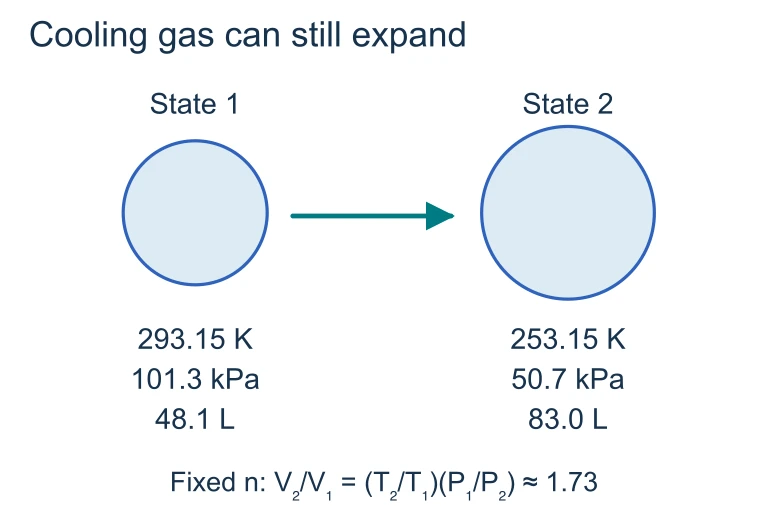 For the same amount of gas, temperature falls from 293.15 K to 253.15 K while pressure falls from 101.3 to 50.7 kPa. Volume rises from about 48.1 to 83.0 L because the pressure decrease outweighs the temperature decrease.
SECTION 5
PV Diagrams & Processes
A PV diagram (pressure vs. volume) is the standard graphical tool for analyzing gas processes in thermodynamics. Each point on a PV diagram represents a unique equilibrium state of the gas, and a curve connecting two states represents the path of a quasi-static process. For an ideal gas, the equation PV = nRT defines a family of isotherms—hyperbolic curves along which temperature remains constant. Different thermodynamic processes trace distinct paths on this diagram, and the area under any path equals the work done by the gas.
| Process | Held Constant | Ideal Gas Consequence | Work Done by Gas |
|---|---|---|---|
| Isobaric | Pressure (P) | V/T = constant | W = PΔV |
| Isochoric | Volume (V) | P/T = constant | W = 0 |
| Isothermal | Temperature (T) | PV = constant | W = nRT ln(V₂/V₁) |
| Adiabatic | Q = 0 (no heat) | PVγ = constant | W = −ΔU |
Summary of common ideal gas processes
SECTION 6
Worked Example
Worked example
- 1
Step 1 — Read and Identify
A sealed weather balloon contains 2.00 mol of helium at sea level where the temperature is 20.0 °C and the pressure is 1.013 × 10⁵ Pa. The balloon rises to an altitude where the pressure is 5.07 × 10⁴ Pa and the temperature is −20.0 °C. Find the volume of the balloon at altitude. - 2
Step 2 — List Known Quantities
n = 2.00 mol (sealed, so constant). State 1: P₁ = 1.013 × 10⁵ Pa, T₁ = 20.0 + 273.15 = 293.15 K. State 2: P₂ = 5.07 × 10⁴ Pa, T₂ = −20.0 + 273.15 = 253.15 K. Unknown: V₂. We also need V₁ to use the combined gas law, or we can compute V₂ directly from PV = nRT.T₁ = 293.15 K, T₂ = 253.15 K - 3
Step 3 — Choose Equation
Since we know n, R, P₂, and T₂, we can find V₂ directly from PV = nRT without needing V₁. Rearranging: V₂ = nRT₂ / P₂. - 4
Step 4 — Substitute and Calculate
V₂ = (2.00 mol)(8.314 J/(mol·K))(253.15 K) / (5.07 × 10⁴ Pa). Numerator: 2.00 × 8.314 × 253.15 = 4209.7 J. Denominator: 5.07 × 10⁴ Pa. Since 1 J = 1 Pa·m³, we get V₂ = 4209.7 / 50700 = 0.08303 m³.V₂ ≈ 0.0830 m³ ≈ 83.0 L - 5
Step 5 — Verify with Combined Gas Law
As a check, find V₁ = nRT₁/P₁ = (2.00)(8.314)(293.15)/(1.013 × 10⁵) = 0.04808 m³. Now apply P₁V₁/T₁ = P₂V₂/T₂, solving for V₂: V₂ = V₁ × (P₁/P₂) × (T₂/T₁) = 0.04808 × (1.013 × 10⁵ / 5.07 × 10⁴) × (253.15/293.15) = 0.04808 × 1.998 × 0.8636 = 0.0830 m³. ✓ Consistent result.Both methods confirm V₂ ≈ 0.0830 m³ - 6
Step 6 — Physical Interpretation
The balloon's volume at altitude is roughly 1.73 times its sea-level volume. The decrease in pressure tends to expand the balloon (Boyle's law effect), while the decrease in temperature tends to contract it (Charles's law effect). The net result is expansion because the pressure drops by about half, which dominates over the relatively modest temperature decrease of about 14%.
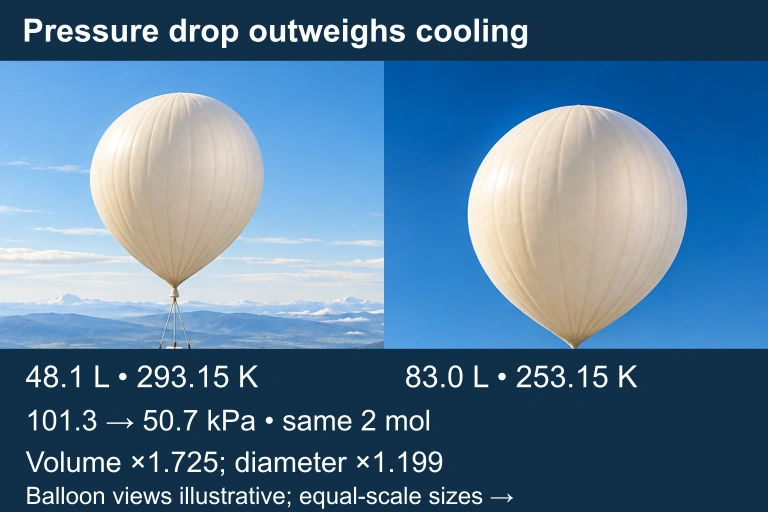 With fixed gas amount, the pressure decrease outweighs cooling, increasing volume by about 1.725 and equivalent-sphere diameter by about 1.199.
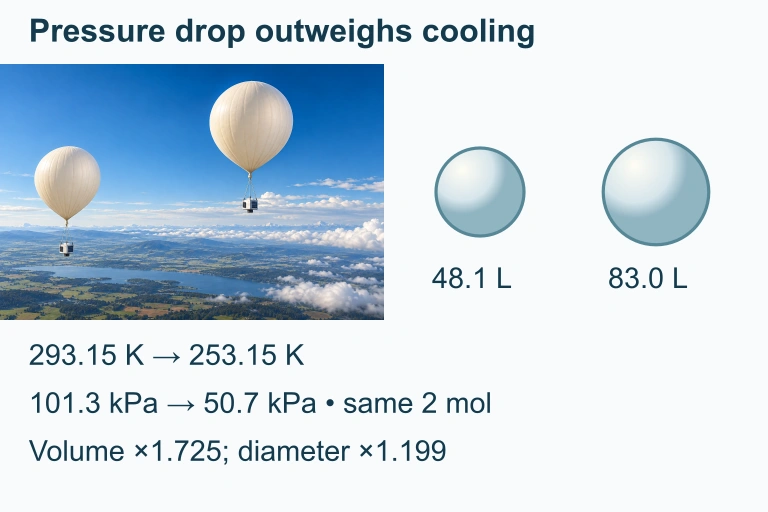 Computed equivalent-sphere size comparison; balloon scene is illustrative.
SECTION 7
Strengths & Limitations
The ideal gas law is remarkably powerful within its domain of validity, but it is a model with clear boundaries. Understanding when the approximation breaks down is just as important as knowing how to apply it—the AP exam frequently tests this conceptual understanding.
| Strengths | Limitations |
|---|---|
| Accurate for most gases at atmospheric pressure and moderate-to-high temperatures. | Fails at very high pressures where molecular volume becomes significant compared to container volume. |
| Simple algebra—no calculus required for most applications. | Fails near the boiling point of a substance, where intermolecular attractions cause condensation. |
| Unifies Boyle's, Charles's, Gay-Lussac's, and Avogadro's laws into one equation. | Cannot account for phase transitions (liquid ↔ gas ↔ solid). |
| Connects macroscopic variables (P, V, T) to microscopic energy via kinetic theory. | Does not describe polar or highly interactive gases (e.g., H₂O, NH₃) well at moderate pressures. |
When the ideal gas law works—and when it doesn't
Key takeaway
SECTION 8
Connection to Real Gases & Advanced Theory
While AP Physics 2 focuses on the ideal gas law, it is instructive to see how the model extends to real gases. The most famous correction is the van der Waals equation, which modifies PV = nRT by adding two parameters: one that accounts for intermolecular attraction (reducing effective pressure) and one that accounts for finite molecular volume (reducing effective volume). This equation smoothly reduces to the ideal gas law when the corrections are small, confirming that PV = nRT is the correct low-density limit.
| Feature | Ideal Gas (PV = nRT) | van der Waals Gas |
|---|---|---|
| Molecular volume | Zero (point particles) | Finite (correction parameter b) |
| Intermolecular forces | None | Attractive (correction parameter a) |
| Phase transitions | Not predicted | Predicted (liquid–gas coexistence) |
| Equation | PV = nRT | (P + an²/V²)(V − nb) = nRT |
| AP Physics 2 relevance | Core equation—used in most problems | Conceptual awareness only—not calculated on exam |
Ideal vs. van der Waals gas models
The ideal gas law also connects forward to statistical mechanics, where PV = nRT is derived from first principles by computing the ensemble average of molecular momenta colliding with container walls. In AP Physics 2, you should be prepared to explain qualitatively why increasing temperature increases pressure (faster molecules strike walls harder and more frequently) and why decreasing volume increases pressure (same molecules hit walls more often in a smaller space). These microscopic explanations reinforce the macroscopic equation and are commonly assessed in free-response questions.
SECTION 9
Practice Problems
Question 1: CONCEPTUAL
- A. The pressure doubles and the average molecular kinetic energy doubles.
- B. The pressure doubles and the average molecular speed doubles.
- C. The pressure quadruples and the average molecular kinetic energy doubles.
- D. The pressure doubles and the number of moles doubles.
Show answer (A)
Question 2: BASIC CALCULATION
- A. 20 mol
- B. 40 mol
- C. 80 mol
- D. 120 mol
Show answer (B)
Question 3: INTERMEDIATE
- A. 2P₁/3
- B. P₁/3
- C. 6P₁
- D. 2P₁
Show answer (A)
Question 4: APPLIED
Show answer
Question 5: CRITICAL THINKING