
SECTION 1
Historical Context & Motivation
The systematic study of heat began long before physicists understood atoms or molecular motion. Early experimenters noticed that different substances required vastly different amounts of heating to achieve the same temperature change—a pound of water took far more fire than a pound of iron. This observation, seemingly simple, demanded a quantitative framework that would take over a century to mature. The concepts of specific heat and thermal conductivity emerged from painstaking calorimetry and heat-flow experiments, ultimately becoming cornerstones of thermodynamics and materials science.
1760 • Black's Calorimetry
1822 • Fourier's Analytical Theory of Heat
1842 • Mayer & Joule: Mechanical Equivalent of Heat
1871 • Boltzmann's Kinetic Theory
1907 • Einstein's Quantum Model of Solids
From Black's calorimeter to modern thermal management in electronics, two fundamental questions persist: How much energy does a material need to change temperature? and How quickly does heat flow through it? The answers define specific heat and thermal conductivity, respectively, and together they determine how thermal energy is stored and redistributed in any physical system.
SECTION 2
Core Principles & Definitions
Understanding thermal behavior requires separating two distinct but complementary ideas: the capacity of a substance to absorb or release thermal energy without changing phase, and the rate at which thermal energy moves through a material when a temperature difference exists. These ideas map onto specific heat capacity and thermal conductivity, respectively. Both are intrinsic material properties—they depend on what the substance is, not on its size or shape—and both arise from the microscopic structure of matter: the masses of constituent particles, the strength of intermolecular bonds, and the available modes of molecular motion.
Specific Heat Capacity (c)
Thermal Conductivity (k)
Thermal Energy (Q)
Thermal Equilibrium
Conduction vs. Convection vs. Radiation
KEY TAKEAWAY
SECTION 3
Visual Explanation — Energy Storage vs. Energy Flow
The diagram illustrates the fundamental distinction between how much energy a material can absorb and how rapidly it transmits that energy. In the upper panel, the filled rectangles represent the thermal energy Q required to raise 1 kg of each material by 1 K. Water's rectangle dwarfs iron's, visually reinforcing water's role as Earth's primary heat reservoir—its vast specific heat moderates coastal climates and stabilizes biological systems. In the lower panel, the gradient bars represent material slabs with the same temperature difference across them, while the amber arrows indicate relative heat-flow rates. Copper's arrow extends far beyond wood's, illustrating why metals are used in heat sinks while wood functions as a natural insulator. Together, these two properties—specific heat (energy storage) and thermal conductivity (energy transport)—determine the complete thermal character of any material.
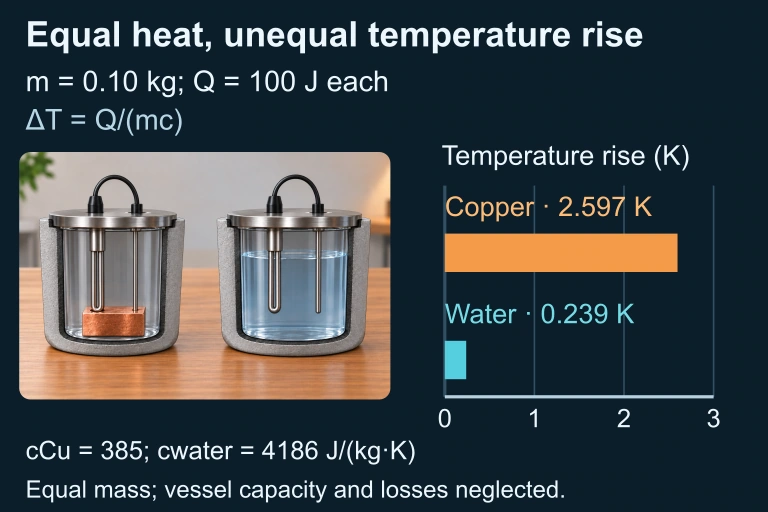 A synthetic no-loss comparison adds 100 J to 0.10 kg of each material. Copper rises by 2.597 K and water by 0.239 K on the same zero-based scale. Container and heater heat capacities are neglected; equal masses do not imply equal volumes. This compares specific heat, not thermal conductivity.
SECTION 4
Mathematical Framework
Heat Transfer and Specific Heat
When a substance absorbs or releases thermal energy without changing phase, the relationship among energy transferred, mass, specific heat, and temperature change is captured by the calorimetry equation. This equation is the workhorse of thermal-energy accounting in AP Physics 2, appearing in every calorimetry problem and many equilibrium analyses.
CALORIMETRY EQUATION
Q = thermal energy transferred (J), m = mass (kg), c = specific heat capacity (J/(kg·K)), ΔT = Tfinal − Tinitial (K or °C). When ΔT is positive the object absorbs energy; when negative it releases energy.
Note that ΔT can be expressed in kelvins or degrees Celsius interchangeably because the two scales differ only by a constant offset; a change of 1 K equals a change of 1 °C. In an isolated system (no heat lost to surroundings), conservation of energy requires that the sum of all Q values is zero: ΣQ = 0. This is the basis of every calorimetry equilibrium calculation.
THERMAL EQUILIBRIUM (ISOLATED SYSTEM)
Tf is the common final temperature. The hot object's Q is negative (energy out), and the cold object's Q is positive (energy in).
Fourier's Law of Heat Conduction
Thermal conductivity enters through Fourier's law, which describes the steady-state rate of heat flow through a slab of material. The law states that the rate of energy transfer is proportional to the cross-sectional area, the thermal conductivity of the material, and the temperature difference across it, and inversely proportional to the thickness of the slab.
FOURIER'S LAW (STEADY STATE)
P = power (rate of heat flow, W), k = thermal conductivity (W/(m·K)), A = cross-sectional area (m²), TH − TC = temperature difference across the slab (K), L = thickness of slab (m).
THERMAL RESISTANCE (R-VALUE)
R = thermal resistance per unit area (m²·K/W). Higher R means better insulation. Fourier's law rewrites as P = AΔT / R, analogous to Ohm's law: I = V / R.
Ohm's Law Analogy
 Thermal resistances add in series across the two glass panes and the air gap. Under steady conduction, every layer carries the same heat-transfer rate and the largest resistance has the largest temperature drop.
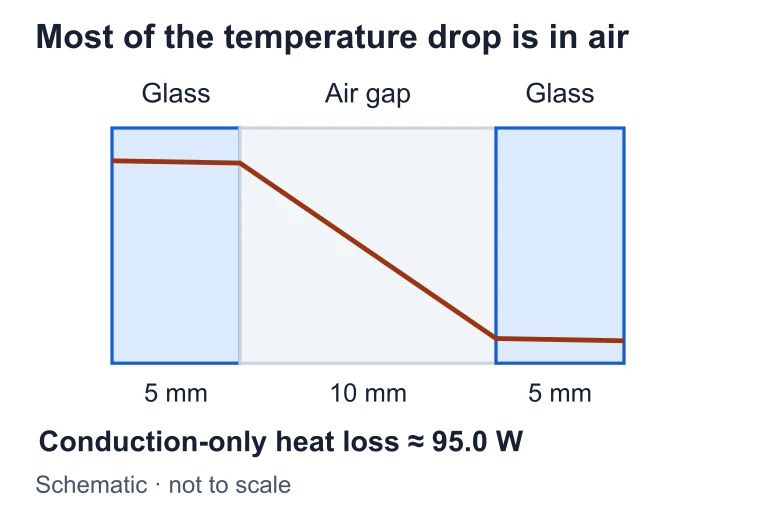 Thermal resistances add in series across the two glass panes and the air gap. Under steady conduction, every layer carries the same heat-transfer rate and the largest resistance has the largest temperature drop.
SECTION 5
Material Properties & Classification
Materials span an enormous range in both specific heat and thermal conductivity. Understanding where common materials fall on these scales is essential for predicting thermal behavior in engineering and natural systems. The table below catalogues representative values encountered on the AP Physics 2 exam and in laboratory settings. Notice that metals generally combine relatively low specific heats with high thermal conductivities, while nonmetals and liquids often display the reverse trend.
| Material | c [J/(kg·K)] | k [W/(m·K)] | Category |
|---|---|---|---|
| Copper | 385 | 401 | Metal (conductor) |
| Aluminum | 897 | 237 | Metal (conductor) |
| Iron | 449 | 80 | Metal (conductor) |
| Water | 4 186 | 0.606 | Liquid (insulator) |
| Glass | 840 | 1.0 | Amorphous solid |
| Wood (oak) | 2 380 | 0.15 | Organic solid (insulator) |
| Styrofoam | 1 210 | 0.033 | Polymer foam (insulator) |
| Air | 1 005 | 0.026 | Gas (insulator) |
Representative specific heat and thermal conductivity values at approximately 25 °C and 1 atm.
The scatter plot reveals an important physical pattern. In metals, free electrons dominate both electrical and thermal transport, yielding high k values, while the tightly packed lattice stores relatively little vibrational energy per degree, giving low c values. Water's exceptionally high specific heat stems from its extensive hydrogen-bonding network, which absorbs substantial energy as bonds stretch and rotate before the translational kinetic energy—and hence temperature—rises significantly. Insulating materials like Styrofoam trap air in small pockets, dramatically reducing k because air itself is a poor conductor and the foam suppresses convection.
SECTION 6
Worked Examples
Calorimetry: Finding Equilibrium Temperature
- 1
Step 1 — Identify Given Values
A 0.250 kg block of aluminum at 120 °C is dropped into 0.600 kg of water initially at 20.0 °C in an insulated container. Find the final equilibrium temperature Tf. Given: cAl = 897 J/(kg·K), cwater = 4 186 J/(kg·K). - 2
Step 2 — Apply Conservation of Energy
In an insulated system, ΣQ = 0. The aluminum loses energy and the water gains it: mAlcAl(Tf − 120) + mwcw(Tf − 20.0) = 0. - 3
Step 3 — Substitute Known Values
(0.250)(897)(Tf − 120) + (0.600)(4 186)(Tf − 20.0) = 0. This simplifies to 224.25(Tf − 120) + 2 511.6(Tf − 20.0) = 0. - 4
Step 4 — Solve for
224.25 Tf − 26 910 + 2 511.6 Tf − 50 232 = 0 → 2 735.85 Tf = 77 142 → Tf ≈ 28.2 °C.≈ 28.2 °C - 5
Step 5 — Reasonableness Check
The final temperature is much closer to the initial water temperature than to the aluminum's initial temperature. This makes sense because water's mass × specific heat product (2 511.6 J/K) is more than 11 times that of the aluminum (224.25 J/K). The water's enormous thermal inertia dominates the equilibrium.
Fourier's Law: Heat Loss Through a Window
- 1
Step 1 — Identify Given Values
A single-pane glass window is 1.2 m wide, 1.0 m tall, and 5.0 × 10⁻³ m thick. The inside surface temperature is 20 °C and the outside surface temperature is −5.0 °C. The thermal conductivity of glass is k = 1.0 W/(m·K). Find the rate of heat loss through the window. - 2
Step 2 — Apply Fourier's Law
P = kA(TH − TC) / L. Area A = 1.2 × 1.0 = 1.2 m². Temperature difference = 20 − (−5.0) = 25 K. - 3
Step 3 — Calculate
P = (1.0)(1.2)(25) / (5.0 × 10⁻³) = 30.0 / 0.005 = 6 000 W.P = 6 000 W = 6.0 kW - 4
Step 4 — Interpret
A single pane loses 6 kW—equivalent to running six space heaters just to compensate for one window. This dramatic result explains why double-pane windows with trapped air gaps (kair ≈ 0.026 W/(m·K)) are standard in cold climates; the air layer adds enormous thermal resistance.
SECTION 7
Strengths, Limitations & Common Misconceptions
| Feature | Specific Heat Model (Q = mcΔT) | Fourier's Law (P = kAΔT/L) |
|---|---|---|
| What it predicts | Total energy exchanged during a temperature change | Rate of heat flow through a material at steady state |
| Key assumption | No phase change; c is constant over ΔT | Steady-state conditions; k is constant; geometry is uniform slab |
| Works well for | Calorimetry, mixing problems, small ΔT ranges | Wall insulation, heat sinks, cylindrical pipes |
| Breaks down when | Phase transitions occur (latent heat needed) or c varies significantly with T | Temperature changes with time (transient regime), convection/radiation dominate |
| Common exam pitfall | Forgetting that ΔT is signed; mixing up mass units | Confusing L (thickness along heat flow) with surface dimensions |
Side-by-side comparison of the two central equations in this topic.
Common Misconception
KEY TAKEAWAY
SECTION 8
Connection to Advanced Theory & the AP Exam
The algebra-based treatment of specific heat and thermal conductivity in AP Physics 2 provides a gateway to deeper ideas encountered in university-level thermodynamics and materials science. The table below maps each concept to its more general or advanced counterpart, helping you anticipate how these foundational ideas evolve.
| AP Physics 2 Concept | Advanced Extension | Where It Appears |
|---|---|---|
| Q = mcΔT (constant c) | Q = ∫m c(T) dT — temperature-dependent specific heat | University physical chemistry, materials science |
| Specific heat at constant pressure (cₚ) | cₚ vs. cᵥ distinction; γ = cₚ/cᵥ for ideal gases | AP Physics 2 (gas law applications), engineering thermodynamics |
| Fourier's law (1-D slab) | Heat equation: ∂T/∂t = α∇²T (transient, 3-D conduction) | Partial differential equations, thermal engineering |
| Thermal resistance R = L/k | Composite wall analysis; series and parallel thermal circuits | Building science, HVAC design |
| Conduction only | Combined convection + radiation + conduction (Newton's law of cooling, Stefan-Boltzmann law) | Heat transfer courses, AP Physics 2 (radiation topic) |
On the AP Physics 2 exam, expect specific heat and thermal conductivity to appear in several contexts. Free-response questions frequently combine calorimetry with phase changes (requiring latent heat alongside Q = mcΔT), ask you to design experiments to measure c or k, or prompt qualitative reasoning about why different materials reach different equilibrium temperatures. The thermal resistance analogy to Ohm's law is a favorite target for qualitative–quantitative translation questions, where you might be asked to predict how replacing one insulating layer with another changes the overall heat loss rate. Mastery of these two equations, combined with careful energy-conservation reasoning, will equip you for a substantial portion of the thermodynamics section.
SECTION 9
Practice Problems
Question 1: CONCEPTUAL
- A. The copper reaches a higher final temperature because it has a lower specific heat.
- B. The water reaches a higher final temperature because it has a higher thermal conductivity.
- C. Both reach the same final temperature because they absorb the same amount of energy.
- D. The copper reaches a lower final temperature because metals are better conductors of heat.
Show answer (A)
Question 2: BASIC CALCULATION
- A. 2.9 × 10⁵ J
- B. 5.9 × 10⁵ J
- C. 7.1 × 10⁵ J
- D. 3.5 × 10⁵ J
Show answer (B)
Question 3: INTERMEDIATE
- A. 1.5 W
- B. 3.75 W
- C. 7.5 W
- D. 15 W
Show answer (B)
Question 4: APPLIED
5 ptsShow answer
Question 5: CRITICAL THINKING
4 ptsShow answer
SUMMARY
Lesson Summary
Summary
Specific heat capacity (c) quantifies the thermal energy needed to change a material's temperature: Q = mcΔT. Materials with high c, such as water (4 186 J/(kg·K)), act as powerful thermal reservoirs, resisting temperature swings. In an isolated calorimetry system, conservation of energy (ΣQ = 0) allows you to solve for unknown temperatures, masses, or specific heats by setting the energy lost by hot objects equal to the energy gained by cold ones.
Thermal conductivity (k) describes how fast heat flows through a material under a temperature gradient: P = kAΔT / L (Fourier's law). High-k materials like copper (401 W/(m·K)) are thermal conductors; low-k materials like Styrofoam (0.033 W/(m·K)) are insulators. The thermal resistance R = L/k parallels electrical resistance in Ohm's law, enabling series-resistance analysis of composite walls. Together, specific heat and thermal conductivity form the quantitative backbone of thermodynamic energy transfer in AP Physics 2.