AP Physics 2 • Waves, Sound, and Physical Optics

Properties of Wave Pulses and Waves

How energy propagates through media without transporting matter, governed by superposition and medium properties.

An atom with wave and electric energy symbols.
Inside this lesson 10 sections 5 questions 8 figures

SECTION 1

Historical Context & Motivation

The study of wave phenomena stretches back millennia, but a rigorous, mathematical understanding of waves only crystallized over the last four centuries. Ancient Greek philosophers recognized that sound traveled through air, and Pythagoras observed relationships between the lengths of vibrating strings and musical pitch, yet these observations remained largely qualitative. The pivotal shift came when natural philosophers began treating waves not merely as curiosities of sound and water but as a universal mechanism for energy transfer — a concept that ultimately reshaped our understanding of light, electricity, and the fundamental structure of matter.

1678 • Huygens' Wave Theory of Light

Christiaan Huygens proposed that light propagates as a wavefront, with every point on a wavefront acting as a source of secondary wavelets. This principle remains foundational in optics today.

1747 • d'Alembert's Wave Equation

Jean le Rond d'Alembert derived the one-dimensional wave equation, providing a mathematical framework that describes how disturbances propagate through continuous media at a well-defined speed.

1801 • Young's Double-Slit Experiment

Thomas Young demonstrated interference of light through two closely spaced slits, providing compelling evidence that light behaves as a wave and establishing the principle of superposition experimentally.

1864 • Maxwell's Electromagnetic Theory

James Clerk Maxwell unified electricity and magnetism, predicting electromagnetic waves that travel at the speed of light — revealing light itself as a transverse electromagnetic wave.

These breakthroughs collectively established a central question in physics: what universal properties do all waves share, whether they are ripples on a pond, pulses on a string, sound vibrations in air, or electromagnetic radiation in a vacuum? In AP Physics 2, understanding these foundational properties — including how wave pulses differ from continuous waves, how medium characteristics determine wave speed, and how the superposition principle governs interactions — provides the conceptual scaffolding for everything from sound and optics to modern quantum mechanics.

SECTION 2

Core Principles & Definitions

Before diving into equations, it is essential to establish a precise vocabulary for wave phenomena. A wave is a disturbance that transfers energy from one location to another without the net transport of matter. Individual particles of the medium oscillate about their equilibrium positions, but it is the pattern of the disturbance — the wave — that propagates. A wave pulse is a single, non-repeating disturbance that moves through a medium, whereas a periodic wave consists of repeating cycles characterized by a well-defined frequency and wavelength.

1

Transverse vs. Longitudinal

In a transverse wave, particle displacement is perpendicular to wave propagation (e.g., light, waves on a string). In a longitudinal wave, displacement is parallel to propagation (e.g., sound in air).
2

Wavelength, Frequency & Period

Wavelength (λ) is the spatial distance of one complete cycle. Frequency (f) is the number of cycles per second (Hz). Period (T) is the time for one complete cycle, where T = 1/f.
3

Amplitude & Energy

Amplitude (A) is the maximum displacement from equilibrium. The energy carried by a wave is proportional to the square of its amplitude (E ∝ A²), making amplitude the primary determinant of wave intensity.
4

Superposition Principle

When two or more waves overlap in the same region of space, the resultant displacement at any point is the algebraic sum of the individual displacements. This leads to constructive and destructive interference.
5

Wave Speed & Medium Dependence

Wave speed (v) depends on the properties of the medium — its restoring force and inertia — not on frequency or amplitude. When a wave passes from one medium to another, its speed and wavelength change, but its frequency remains constant.
✦

KEY TAKEAWAY

Think of a wave on a string as analogous to the "wave" that fans do in a stadium: each person (particle) simply stands up and sits back down in place, yet the visible disturbance (the wave pattern) sweeps around the entire arena. Energy is transported by the wave, but matter is not. This distinction between the motion of the medium and the propagation of the disturbance is the single most important concept in wave physics.

SECTION 3

Visual Explanation — Transverse & Longitudinal Waves

Transverse Wave on a StringequilibriumAλ (wavelength)v (wave speed)troughcrestLongitudinal Wave (Sound in Air)compressionrarefactionλ (wavelength)v (wave speed)Particle displacement ⊥ propagation (transverse)Particle displacement ∥ propagation (longitudinal)
Top: a transverse wave on a string showing crests, troughs, amplitude (A), and wavelength (λ). Bottom: a longitudinal wave in air represented by dots of varying density — tightly packed regions are compressions and spread-out regions are rarefactions. In both cases, wave speed v is determined by the medium, and wavelength λ spans one full cycle.

The upper panel of the diagram illustrates a transverse wave propagating along a taut string. Each point on the string oscillates vertically — perpendicular to the horizontal direction of wave travel. The highest point above the equilibrium line is called the crest, and the lowest point below it is the trough. The amplitude A measures the maximum displacement from equilibrium, while the wavelength λ is the distance between any two successive points in phase — for instance, from crest to crest.

The lower panel depicts a longitudinal wave — a pattern you encounter every time you hear a sound. Here, air molecules oscillate parallel to the direction of wave propagation, producing alternating regions of high pressure (compressions) and low pressure (rarefactions). The wavelength in a longitudinal wave is measured as the distance between the centers of two successive compressions (or two successive rarefactions). Despite these structural differences, both wave types obey the same fundamental relationship v = fλ and exhibit superposition, reflection, and refraction.

SECTION 4

Mathematical Framework

The quantitative description of waves rests on a small set of interrelated equations. These relationships connect the observable properties of waves — speed, wavelength, frequency, and period — to the physical characteristics of the medium through which they travel. In AP Physics 2, you are expected to apply these relationships algebraically without calculus-based derivations, but you should understand the physical reasoning behind each equation.

WAVE SPEED EQUATION

v=fλ=λ/Tv = fλ = λ / T

v = wave speed (m/s), f = frequency (Hz), λ = wavelength (m), T = period (s). This is the most fundamental wave equation: the speed at which a wave crest advances equals the number of cycles per second multiplied by the spatial length of each cycle.

SPEED ON A STRING

v=√(FT/μ)v = √(F_T / μ)

FT = tension in the string (N), μ = linear mass density (kg/m). Greater tension increases the restoring force, raising wave speed; greater mass density increases inertia, lowering wave speed.

FREQUENCY-PERIOD RELATION

f=1/Tf = 1 / T

Frequency and period are reciprocals. A wave with a period of 0.002 s has a frequency of 500 Hz. This relationship is universal and applies to all periodic phenomena.

SUPERPOSITION PRINCIPLE

ytotal(x,t)=y1(x,t)+y2(x,t)+⋯y_total(x, t) = y₁(x, t) + y₂(x, t) + ⋯

When multiple waves coexist in the same medium, the net displacement at any point equals the algebraic sum of all individual wave displacements at that point and instant. This principle underlies interference, beats, and standing wave formation.

💡

Medium Transition Rule

When a wave crosses the boundary between two media, its frequency stays the same because the source has not changed. Since v = fλ and f is fixed, a change in wave speed necessarily causes a proportional change in wavelength: λ₂ = (v₂/v₁)λ₁. This is the physical basis of refraction.

SECTION 5

Superposition & Pulse Interactions

One of the most powerful and testable properties of waves is the principle of superposition. When two wave pulses travel toward each other on a string, they pass through one another without being permanently altered. At the instant they overlap, the resulting displacement is the point-by-point algebraic sum of the individual pulse shapes. After the overlap region, each pulse continues unchanged — waves do not interact like colliding billiard balls.

Superposition of Two Pulses on a StringBEFORE overlapPulse A →← Pulse BCONSTRUCTIVE (same side)A + B = 2A2ADESTRUCTIVE (opposite sides)Pulse A (up) →← Pulse B (down)AT OVERLAP (complete cancellation)y_total = 0 (momentary flat line — energy stored as kinetic energy)
Two pulse scenarios on a string. Constructive interference occurs when both pulses displace the string in the same direction, producing a resultant amplitude equal to the sum of individual amplitudes. Destructive interference occurs when pulses displace in opposite directions; if they have equal amplitudes, the string is momentarily flat — but the energy has not vanished; it exists as kinetic energy of the string particles.

A common misconception is that destructive interference "destroys" energy. In reality, at the moment of complete cancellation, the displacement is zero but the transverse velocity of the string particles is at a maximum — all of the wave's potential energy has temporarily converted to kinetic energy. After the pulses pass through each other, they re-emerge with their original shapes and continue in their original directions. This behavior is a hallmark of wave phenomena and distinguishes waves from particle collisions, where permanent deformation or scattering can occur.

ℹ

Reflection at Boundaries

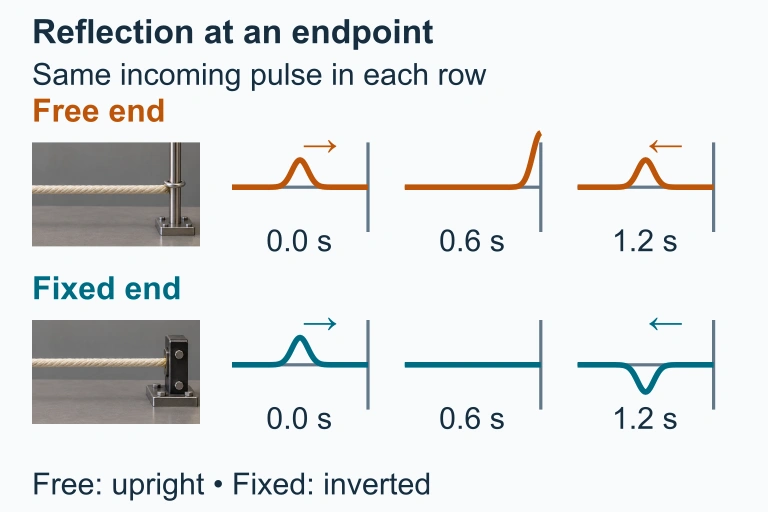
When a pulse reaches a fixed (rigid) boundary, it reflects inverted (180° phase change). When it reaches a free (open) boundary, the pulse reflects upright (no phase change). This boundary behavior is essential for understanding standing waves and resonance.

Fixed-end inversion and zero endpoint; free-end non-inversion and doubled endpoint at overlap; successive pulse snapshots.The same ideal pulse reflects upright at a free end and inverted at a fixed end. At complete overlap, the free-end displacement doubles and the fixed end remains stationary.

SECTION 6

Worked Example — Wave Properties on a String

A string of length 2.0 m and total mass 0.010 kg is stretched with a tension of 90 N. A vibrator at one end sends a continuous wave along the string at a frequency of 120 Hz. Determine (a) the speed of the wave on the string, (b) the wavelength, and (c) the period of the wave.

Wave on a Stretched String

  1. 1

    Step 1 — Identify Given Values

    Length L = 2.0 m, total mass m = 0.010 kg, tension FT = 90 N, frequency f = 120 Hz. We first need the linear mass density: μ = m / L = 0.010 kg / 2.0 m = 0.0050 kg/m.
    μ = 0.0050 kg/m
  2. 2

    Step 2 — Calculate Wave Speed

    Using v = √(FT / μ) = √(90 N / 0.0050 kg/m) = √(18 000 m²/s²) = 134.2 m/s.
    v ≈ 134 m/s
  3. 3

    Step 3 — Calculate Wavelength

    From v = fλ, we solve for wavelength: λ = v / f = 134.2 m/s / 120 Hz = 1.118 m.
    λ ≈ 1.12 m
  4. 4

    Step 4 — Calculate Period

    T = 1/f = 1 / 120 Hz = 0.00833 s ≈ 8.33 × 10⁻³ s. The period can also be verified as T = λ / v = 1.118 m / 134.2 m/s ≈ 8.33 × 10⁻³ s, confirming consistency.
    T ≈ 8.33 × 10⁻³ s
  5. 5

    Step 5 — Physical Interpretation

    This wave travels fast because the string has a relatively high tension-to-mass ratio. Each point on the string completes one full oscillation in about 8.3 milliseconds, and in that time the wave pattern advances by approximately 1.12 m. Notice that doubling the tension would increase the speed by a factor of √2 ≈ 1.41, not by a factor of 2 — the square-root dependence is a critical feature of the wave speed equation.
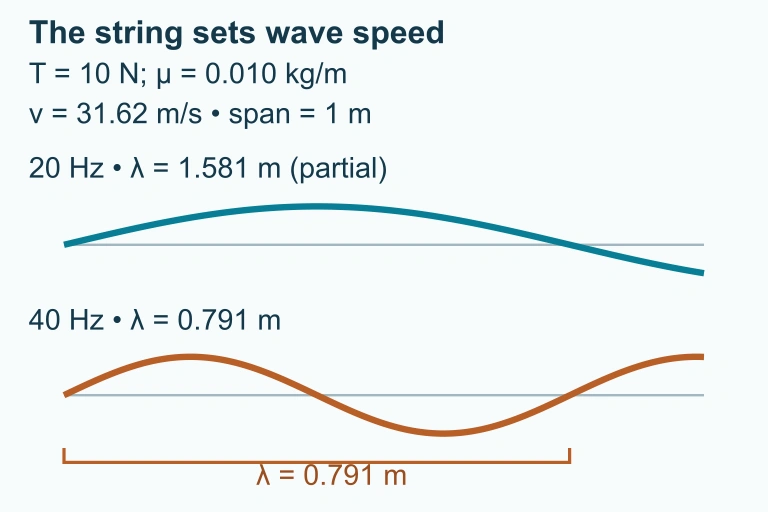
T 10 N,μ0.010 kg/m givesv 31.62 m/s;20/40 Hz givesλ1.581/0.791 m.At fixed tension and linear density, the wave speed stays constant while a higher drive frequency shortens wavelength.

SECTION 7

Comparing Wave Types & Properties

A clear understanding of the similarities and differences between wave types is essential for AP Physics 2, where questions frequently test whether students can distinguish properties that are universal to all waves from those specific to particular categories. The table below provides a systematic comparison across several wave types you will encounter.

PropertyTransverse (Mechanical)Longitudinal (Mechanical)Electromagnetic
Requires a medium?YesYesNo — travels through vacuum
Particle motionPerpendicular to propagationParallel to propagationE and B fields oscillate ⊥ to propagation
Can be polarized?YesNo — oscillation in 1D onlyYes
Speed determined byTension and density of mediumBulk modulus and densityPermittivity and permeability (c in vacuum)
Obeys v = fλ?YesYesYes
Exhibits superposition?YesYesYes
ExampleVibrating guitar string, rope waveSound in air, ultrasoundLight, radio waves, X-rays

Comparison of transverse mechanical, longitudinal mechanical, and electromagnetic waves

✦

KEY TAKEAWAY

Despite vast differences in their physical nature — from water ripples to radio signals — all waves share a common mathematical DNA: they satisfy v = fλ, obey superposition, and transport energy without net matter transport. This universality is why wave physics is so powerful — techniques learned with a slinky or string directly transfer to understanding light and sound in sophisticated engineering and medical contexts.

SECTION 8

Connection to Advanced Wave Phenomena

The foundational wave properties covered in this lesson serve as the gateway to every other wave topic in AP Physics 2 and beyond. Standing waves, resonance, diffraction, and the Doppler effect all build directly on the ideas of superposition, wavelength, frequency, and medium dependence. Additionally, the concept of wave-particle duality in quantum mechanics hinges on the recognition that particles such as electrons exhibit wave-like behavior — described by a de Broglie wavelength λ = h/p — making the language and mathematics of classical waves indispensable at the frontier of modern physics.

Concept (This Lesson)Advanced Extension (Later in AP Physics 2)
Superposition of pulsesStanding waves on strings and in pipes; resonance conditions
v = fλ with constant frequency at boundariesSnell's law and refraction of light; index of refraction n = c/v
Constructive/destructive interferenceDouble-slit and single-slit diffraction; thin-film interference
Wave speed depends on mediumSpeed of sound vs. temperature; electromagnetic wave speed in materials
Energy ∝ A²Intensity (I = P/A); inverse-square law for point sources

How foundational wave properties connect to advanced AP Physics 2 topics

As you proceed through the course, recognize that nearly every new wave topic is an application of the principles explored here. Mastering v = fλ, the superposition principle, and the energy-amplitude relationship now will pay dividends across every subsequent unit. In particular, the AP exam frequently presents scenarios that combine these foundational ideas — for example, a question about standing waves requires understanding both superposition and boundary conditions simultaneously.

SECTION 9

Practice Problems

Question 1: CONCEPTUAL

A wave pulse travels along a string and reaches a boundary where the string is firmly attached to a rigid wall. Which of the following correctly describes the reflected pulse?
  • A. The reflected pulse is inverted relative to the incident pulse and has the same speed.
  • B. The reflected pulse is upright (not inverted) and has a higher speed due to the rigid boundary.
  • C. The reflected pulse is inverted and has a lower speed because energy is lost at the wall.
  • D. The pulse is completely absorbed by the rigid wall and no reflection occurs.
Show answer (A)
A is correct. At a fixed (rigid) boundary, the reflected pulse is inverted (180° phase change) because the wall exerts a reaction force opposite to the pulse's displacement. The speed of the reflected pulse remains the same because it travels in the same medium (the same string with the same tension and linear mass density). B is incorrect because reflection at a fixed boundary produces inversion, not an upright pulse, and the boundary does not change wave speed. C is incorrect because while the pulse is inverted, its speed does not decrease — wave speed depends on medium properties, not boundary interactions (some energy may transmit into the wall, but the reflected pulse's speed is unchanged). D is incorrect because a rigid boundary reflects virtually all of the pulse energy; complete absorption does not occur for an idealized fixed end.

Question 2: BASIC CALCULATION

A sound wave in air has a frequency of 440 Hz and a wavelength of 0.773 m. If this wave enters water where its speed is 1480 m/s, what is the wavelength of the sound wave in water?
  • A. 0.773 m
  • B. 1.48 m
  • C. 3.36 m
  • D. 0.297 m
Show answer (C)
C is correct. When a wave crosses from one medium to another, its frequency remains constant (440 Hz). Using v = fλ, the wavelength in water is λ = v/f = 1480 m/s ÷ 440 Hz = 3.36 m. A is incorrect because wavelength does not remain unchanged when wave speed changes. B is incorrect — this value does not correspond to the correct calculation. D is incorrect and appears to result from dividing frequency by speed instead of speed by frequency.

Question 3: INTERMEDIATE

A string has tension FTF_T and linear mass density μ. If the tension is quadrupled and the linear mass density is doubled, by what factor does the wave speed change?
  • A. √2
  • B. 2
  • C. 4
  • D. √8
Show answer (A)
A is correct. The wave speed on a string is v = √(FTF_T / μ). If tension becomes 4F_T and density becomes 2μ, the new speed is v' = √(4F_T / 2μ) = √(2F_T / μ) = √2 × √(FTF_T / μ) = √2 × v. Therefore the speed increases by a factor of √2 ≈ 1.41. B is incorrect because it ignores the square-root relationship — simply dividing 4 by 2 neglects that v depends on the square root of the ratio. C is incorrect and would result from quadrupling the speed, which is not supported by the equation. D is incorrect — √8 would result if the tension were increased 8-fold without changing density.

Question 4: APPLIED

5 pts
A student wants to experimentally determine how the speed of a transverse wave on a string depends on the tension in the string. The student has access to a long string, a mechanical vibrator of adjustable frequency, a pulley, a set of hanging masses, a ruler, and a stopwatch. (a) Describe an experimental procedure the student could follow to collect the necessary data. Include enough detail that another student could replicate the experiment. (b) Identify the independent variable, dependent variable, and at least two variables that should be controlled. (c) Describe how the student should analyze the data to determine the relationship between wave speed and tension. Indicate what quantities should be plotted and what the shape of the graph would indicate. (d) If the student plots v² versus FTF_T and obtains a straight line through the origin, explain what the slope of this line physically represents. (e) Describe one source of systematic error in this experiment and how it could be minimized.
Show answer
Rubric (5 points): Point 1 — Procedure (a): The student should fix one end of the string to the vibrator and thread the other end over the pulley with a hanging mass to create tension FTF_T = mg. The student adjusts the vibrator frequency until a clear standing wave pattern (known number of antinodes) is established, then measures the distance between nodes to determine wavelength λ. Wave speed is calculated as v = fλ. The process is repeated for multiple hanging masses (different tensions) while keeping the same string (constant μ). Point 2 — Variables (b): Independent variable: tension (FTF_T), controlled by changing hanging mass. Dependent variable: wave speed (v). Controlled variables: the same string (same linear mass density μ), the same string length, and consistent frequency-reading method. Point 3 — Data Analysis (c): Plot wave speed v versus tension FTF_T. If v ∝ √(FTF_T), the graph of v vs. FTF_T will be a curve (square-root shape). Alternatively, to linearize the data, plot v² versus FTF_T. A straight line on this graph confirms that v² ∝ FTF_T. Point 4 — Slope Interpretation (d): From v = √(FTF_T / μ), we get v² = FTF_T / μ, so v² = (1/μ)FTF_T. A plot of v² vs. FTF_T yields a straight line with slope = 1/μ, where μ is the linear mass density of the string. The slope is the reciprocal of the linear mass density. Point 5 — Systematic Error (e): One source of systematic error is the string sagging under its own weight, which means the actual tension varies along the string's length and is not exactly equal to mg. This can be minimized by keeping the string taut with sufficiently large masses and by using a lightweight string so that its weight is negligible compared to the hanging mass.

Question 5: CRITICAL THINKING

4 pts
Two pulses of the same shape and equal amplitude magnitude A travel toward each other from opposite ends of an ideal taut string. Pulse 1 is upward (+A) and Pulse 2 is downward (−A). (a) Describe what happens at the instant the two pulses completely overlap. Is the energy of the system zero at that instant? Justify your answer. (b) A student claims, "Since destructive interference can make the displacement zero everywhere on the string, energy is not conserved during wave interference." Critique this claim using the concepts of potential and kinetic energy of the string. (c) Now suppose Pulse 1 has upward peak displacement +A and Pulse 2 has downward peak displacement −2A, using upward as positive for both pulses. Determine the maximum displacement at the point of overlap and state whether it is above or below the equilibrium position.
Show answer
Rubric (4 points): Point 1 — Part (a): At the instant of complete overlap, the displacement of the string is zero everywhere (assuming equal amplitudes on opposite sides). However, the energy is NOT zero. The energy of a wave exists in two forms: elastic potential energy (associated with string deformation/displacement) and kinetic energy (associated with the transverse velocity of string elements). At the moment of zero displacement, all the wave energy has been converted to kinetic energy — the string particles are moving at maximum transverse velocity. Point 2 — Part (b): The student's claim is incorrect. Energy is conserved during destructive interference. When displacement is zero, the elastic potential energy of the string is indeed zero, but the kinetic energy of the string segments is at its maximum. The total mechanical energy (KE + PE) remains constant throughout the overlap process. Energy conservation applies at every instant, not just when displacement is nonzero. Point 3 — Part (c): Using the superposition principle, the net displacement at overlap is y_total = A + (−2A) = −A (taking upward as positive for both pulses). The maximum displacement at the overlap point is A below the equilibrium position. Point 4 — Justification/Reasoning: The superposition principle dictates algebraic addition of displacements. Since Pulse 1 contributes +A and Pulse 2 contributes −2A at the overlap point, the resultant is −A. This demonstrates that complete cancellation only occurs when the two overlapping pulses have equal amplitudes. When amplitudes differ, partial destructive interference occurs, and the resultant has the direction and magnitude determined by the difference.

SUMMARY

Summary — Properties of Wave Pulses and Waves

Summary

Waves are disturbances that transfer energy without net matter transport. A single disturbance is a wave pulse, while a repeating disturbance is a periodic wave characterized by wavelength (λ), frequency (f), period (T), and amplitude (A). In transverse waves, particle displacement is perpendicular to propagation; in longitudinal waves, it is parallel. All waves obey the universal relation v = fλ, and wave speed depends on medium properties (such as tension and density for a string), not on frequency or amplitude.

The superposition principle states that overlapping waves produce a resultant displacement equal to the algebraic sum of individual displacements, leading to constructive interference (same-direction displacements add) and destructive interference (opposite displacements cancel). Energy is always conserved — during destructive interference, energy shifts from potential to kinetic form. When waves cross boundaries, frequency remains constant while speed and wavelength change. Reflection at a fixed boundary inverts the pulse; reflection at a free boundary does not. These foundational properties underpin all subsequent wave topics — standing waves, diffraction, refraction, and interference — throughout AP Physics 2.

Varsity Tutors • AP Physics 2: Algebra-Based • Properties of Wave Pulses and Waves