
SECTION 1
Historical Context & Motivation
The study of periodic waves has deep roots in humanity's effort to understand how energy propagates through space without the bulk motion of matter. Ancient Greek thinkers, including Pythagoras, recognized that musical pitch was tied to the vibration of strings, but a rigorous mathematical framework would take centuries to develop. The transition from qualitative descriptions of sound and water waves to the precise, quantitative wave equations we use today represents one of the great triumphs of classical physics, and its consequences extend far beyond acoustics—into optics, electromagnetism, and even quantum mechanics.
~500 BCE • Pythagorean Harmonics
1678 • Huygens' Wave Theory
1746 • d'Alembert's Wave Equation
1864 • Maxwell's Electromagnetic Waves
1887 • Hertz Confirms EM Waves
These developments converged around a central question that remains at the heart of AP Physics 2: How do we describe, predict, and manipulate the behavior of disturbances that repeat in both time and space? Answering this question requires a precise mathematical vocabulary—wavelength, frequency, amplitude, period, and wave speed—and an understanding of how these quantities interrelate. The concepts you learn here underpin everything from understanding sound in a concert hall to analyzing the electromagnetic radiation that carries information through fiber optic cables.
SECTION 2
Core Principles & Definitions
A periodic wave is a disturbance that repeats itself at regular intervals in both time and space. Unlike a single pulse, which passes through a medium once, a periodic wave is generated by a source that oscillates continuously, producing a pattern that can be described by a fixed set of parameters. The medium through which the wave travels—air, water, a stretched string—oscillates locally, but the medium itself does not travel with the wave; instead, energy and momentum are transported while the medium particles return to their equilibrium positions. Understanding the following foundational concepts is essential before we develop the mathematical framework.
Wavelength (λ)
Frequency (f)
Period (T)
Amplitude (A)
Wave Speed (v)
KEY TAKEAWAY
SECTION 3
Anatomy of a Periodic Wave
The diagram above captures a spatial snapshot of a transverse periodic wave—a graph of displacement versus position at one instant of time. Notice that the wave pattern is perfectly repetitive: each wavelength contains one complete crest-to-trough cycle. The crest is the point of maximum positive displacement, the trough is the point of maximum negative displacement, and the nodes are the equilibrium-crossing points. In a transverse wave, the oscillation of the medium is perpendicular to the direction of wave propagation, as indicated by the orange arrows. For a longitudinal wave (such as sound in air), the oscillation would instead be parallel to the direction of travel—we will compare these two types in Section 5.
AP Exam Tip
SECTION 4
Mathematical Framework
The behavior of periodic waves is governed by a small set of interconnected equations. Mastering these relationships—and understanding which variables are set by the source and which are determined by the medium—is essential for solving AP Physics 2 problems efficiently.
WAVE SPEED EQUATION
v = wave speed (m/s), λ = wavelength (m), f = frequency (Hz). This is the most fundamental relationship: wave speed equals wavelength times frequency. Because v depends on the medium and f depends on the source, wavelength adjusts when a wave enters a new medium.
PERIOD–FREQUENCY RELATION
T = period (s), f = frequency (Hz). Period and frequency are reciprocals—a wave with a high frequency completes cycles quickly and therefore has a short period.
WAVE SPEED FROM PERIOD
An equivalent form obtained by substituting f = 1/T into v = λf. Useful when the period (rather than frequency) is the given quantity.
SINUSOIDAL WAVE FUNCTION
A = amplitude, λ = wavelength, T = period. This function gives the displacement y of the medium at position x and time t for a wave traveling in the +x direction. The argument of the sine function is the phase of the wave. While AP Physics 2 is algebra-based and rarely requires you to evaluate this function numerically, understanding its structure clarifies why crests, troughs, and nodes appear where they do.
A critical conceptual point: frequency is set by the source, and wave speed is set by the medium. When a periodic wave crosses a boundary between two media (for example, light entering glass from air), the frequency remains constant, the speed changes, and the wavelength must adjust accordingly. This principle is the foundation of refraction. Furthermore, the energy carried by a mechanical wave is proportional to the square of the amplitude and the square of the frequency: E ∝ A²f². Doubling the amplitude quadruples the energy transport rate, which is why high-amplitude waves—such as tsunamis—carry enormous destructive energy.
KEY TAKEAWAY
SECTION 5
Transverse vs. Longitudinal Waves
Periodic waves are classified by the relationship between the direction of the medium's oscillation and the direction of wave propagation. In a transverse wave, the medium oscillates perpendicular to the wave's direction of travel—examples include waves on a string, surface water waves (approximately), and electromagnetic waves. In a longitudinal wave, the medium oscillates parallel to the direction of propagation. Sound waves in air, where air molecules oscillate back and forth along the direction the sound travels, are the classic example. Some waves, such as surface waves on deep water, exhibit both transverse and longitudinal components simultaneously.
| Property | Transverse Wave | Longitudinal Wave |
|---|---|---|
| Oscillation direction | Perpendicular to propagation | Parallel to propagation |
| Key features | Crests and troughs | Compressions and rarefactions |
| Can travel in | Solids, surfaces, vacuum (EM waves) | Solids, liquids, gases |
| Polarizable? | Yes—oscillation can be restricted to one plane | No—oscillation is along a single axis |
| Common examples | Light, waves on a string, S-waves | Sound in air, P-waves, ultrasound |
Comparison of transverse and longitudinal periodic waves
An important point for AP Physics 2: electromagnetic waves are transverse and can propagate through a vacuum, unlike mechanical waves which require a material medium. Sound, by contrast, is longitudinal and cannot travel through empty space. The fact that transverse waves can be polarized while longitudinal waves cannot is a direct consequence of the geometry of oscillation, and this distinction plays a central role when you study polarization in the optics portion of the course.
SECTION 6
Worked Example
Let's work through a multi-part problem that integrates the core equations and conceptual reasoning needed for the AP exam.
Sound Wave Crossing Media Boundaries
- 1
Step 1 — Read the Problem
A tuning fork vibrating at 440 Hz produces a sound wave in air where the speed of sound is 343 m/s. The sound then enters water, where the speed of sound is 1480 m/s. Determine (a) the wavelength in air, (b) the wavelength in water, and (c) explain why the frequency does not change when the wave crosses the boundary. - 2
Step 2 — Identify Given Values
f = 440 Hz (set by the source, constant across both media). vair = 343 m/s. vwater = 1480 m/s. - 3
Step 3 — Solve for Wavelength in Air
Using v = λf → λair = vair / f = 343 m/s ÷ 440 Hzλ_air = 0.780 m - 4
Step 4 — Solve for Wavelength in Water
The frequency remains 440 Hz. λwater = vwater / f = 1480 m/s ÷ 440 Hzλ_water = 3.36 m - 5
Step 5 — Explain Constant Frequency
At the air-water boundary, the wave arriving from air drives oscillations in the water at the same rate it arrives—every crest in air produces a crest in water. If the frequency changed at the boundary, wave crests would either pile up or disappear at the interface, violating conservation of energy and creating a physical discontinuity. Therefore, frequency is preserved across boundaries, and the wavelength adjusts to accommodate the new wave speed in the second medium. - 6
Step 6 — Check Reasonableness
The wave speed in water is about 4.3 times that in air (1480/343 ≈ 4.31), and the ratio of wavelengths is also 3.36/0.780 ≈ 4.31. This consistent ratio confirms our calculation and reinforces that λ ∝ v when f is constant.
SECTION 7
Source vs. Medium: What Controls What
One of the most common sources of confusion on the AP exam is determining which wave properties are intrinsic to the source and which are determined by the medium. The table below clarifies these relationships and their implications.
| Wave Property | Determined By | Changes at a Boundary? | Physical Reason |
|---|---|---|---|
| Frequency (f) | Source | No | Boundary continuity: crests arrive and depart at the same rate |
| Wave speed (v) | Medium | Yes | Speed depends on density, elasticity, temperature, etc. |
| Wavelength (λ) | Both (v/f) | Yes | Adjusts so that v = λf remains satisfied with constant f |
| Amplitude (A) | Source + medium | Yes | Energy partition at boundary; absorption and damping in medium |
| Period (T) | Source | No | T = 1/f; since f is preserved, T is also preserved |
Summary of which wave properties change when a periodic wave crosses into a new medium
KEY TAKEAWAY
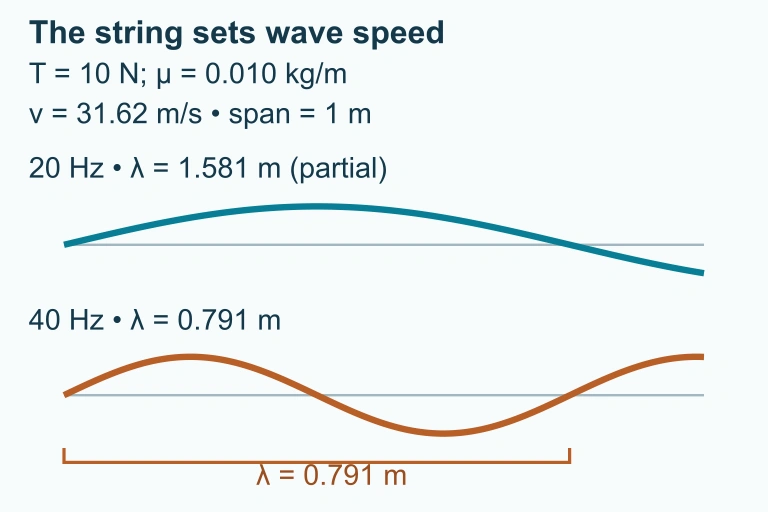 At fixed tension and linear density, the wave speed stays constant while a higher drive frequency shortens wavelength.
SECTION 8
Connections to Superposition and Beyond
Periodic waves are the building blocks for nearly every phenomenon you will encounter in the rest of AP Physics 2's wave unit. When two or more periodic waves overlap in the same region of space, they obey the superposition principle: the resultant displacement at any point is the algebraic sum of the individual displacements. This principle leads directly to interference, standing waves, beats, and diffraction—all of which are tested on the AP exam. Fourier's theorem, while beyond the algebra-based syllabus, tells us that any complex periodic waveform can be decomposed into a sum of simple sinusoidal waves, further underscoring the centrality of the sinusoidal model developed in this lesson.
| Concept | This Lesson (Periodic Waves) | Advanced Extensions |
|---|---|---|
| Single wave description | v = λf; sinusoidal shape; amplitude, period | Full wave equation ∂²y/∂t² = v²∂²y/∂x² |
| Two waves overlapping | Superposition principle; constructive/destructive interference | Standing wave patterns; beats; Fourier synthesis |
| Wave at a boundary | Frequency preserved; λ adjusts; partial reflection | Snell's law; impedance matching; transmission coefficients |
| Energy transport | Energy ∝ A²; waves carry energy without net mass transport | Intensity (power/area); inverse-square law; Poynting vector |
| Wave type | Transverse vs. longitudinal classification | Polarization; electromagnetic wave structure (E ⊥ B ⊥ v) |
How periodic wave concepts extend to advanced topics in the AP Physics 2 curriculum
As you proceed through the waves unit, remember that every interference pattern, every standing wave resonance, and every diffraction effect builds directly on the properties of the periodic waves you have studied here. The mathematical simplicity of v = λf belies the extraordinary range of physical phenomena it governs—from the harmonics of a guitar string to the colors in a thin film of soap.
SECTION 9
Practice Problems
Question 1: CONCEPTUAL
- A. Frequency increases; wavelength stays the same
- B. Frequency stays the same; wavelength increases
- C. Frequency decreases; wavelength increases
- D. Frequency stays the same; wavelength decreases
Show answer (B)
Question 2: BASIC CALCULATION
- A. 24 m/s
- B. 60 m/s
- C. 240 m/s
- D. 0.0042 m/s
Show answer (B)
Question 3: INTERMEDIATE
- A. 0.30 m/s
- B. 1.5 m/s
- C. 4.5 m/s
- D. 2.25 m/s
Show answer (B)
Question 4: APPLIED
4 ptsShow answer
Question 5: CRITICAL THINKING
4 ptsShow answer
SUMMARY
Periodic Waves — Summary
Summary
A periodic wave is a repeating disturbance characterized by five essential parameters: wavelength (λ), frequency (f), period (T = 1/f), amplitude (A), and wave speed (v). These are linked by the universal wave equation v = λf. Waves transport energy and momentum without net displacement of the medium. Transverse waves oscillate perpendicular to propagation (light, string waves), while longitudinal waves oscillate parallel to it (sound in air).
At a boundary between media, frequency is preserved (set by the source), wave speed changes (set by the medium), and wavelength adjusts to satisfy v = λf. Energy carried by a wave scales with the square of both amplitude and frequency. These foundational principles underpin every subsequent topic in the AP Physics 2 waves unit: superposition, interference, standing waves, diffraction, and refraction all depend on the behavior of periodic waves.