
SECTION 1
Historical Context & Motivation
The relationship between electricity and magnetism eluded natural philosophers for centuries. Ancient Greeks observed that lodestones attracted iron, while separately noting that rubbed amber could attract lightweight objects, yet these two phenomena appeared entirely distinct. The breakthrough came in the early nineteenth century when a series of remarkable experiments demonstrated that electric currents produce magnetic effects and, conversely, that magnetic fields influence moving charges. This unification of electricity and magnetism into a single coherent framework ranks among the greatest achievements in the history of physics, ultimately leading to Maxwell's equations and the prediction of electromagnetic waves.
1820 • Ørsted's Discovery
1821 • Ampère's Force Law
1831 • Faraday's Induction
1895 • Lorentz Force Formulation
The central question this lesson addresses is deceptively simple: how does a magnetic field exert a force on a moving charged particle, and what determines the magnitude and direction of that force? Understanding this interaction is essential for explaining everything from the operation of electric motors and mass spectrometers to the confinement of charged particles in Earth's magnetosphere and in fusion reactors.
SECTION 2
Core Principles & Definitions
Before diving into calculations, it is important to establish the foundational principles governing the interaction between magnetic fields and moving charges. Unlike gravitational or electrostatic forces, the magnetic force on a charged particle depends not only on the charge and the field strength but also on the particle's velocity and its direction relative to the field. A stationary charge in a magnetic field experiences zero magnetic force — a fact that distinguishes magnetic interactions from electric ones in a fundamental way.
Magnetic Field (B⃗)
Magnetic Force Requires Motion
Right-Hand Rule
No Work Done by Magnetic Force
Superposition of Fields
KEY TAKEAWAY
SECTION 3
Visualizing the Magnetic Force
The geometric relationship among the velocity, magnetic field, and resulting force is inherently three-dimensional, which makes clear diagrams essential. The following diagram illustrates a positive charge moving through a uniform magnetic field directed into the page. The right-hand rule determines the force direction: point your right-hand fingers along v⃗ (to the right), curl them toward B⃗ (into the page), and your thumb points upward — confirming the force direction shown.
Notice the crucial geometric constraint: the three vectors — v⃗, B⃗, and F⃗ — are mutually perpendicular when the velocity is perpendicular to the field. If the charge were negative instead of positive, the force would point downward (into the bottom of the page), exactly opposite the direction shown. This perpendicularity is not coincidental; it is an intrinsic property of the cross product that defines the magnetic force. Because the force is always perpendicular to the velocity, a charged particle moving in a uniform magnetic field traces out a circular arc, with the magnetic force serving as the centripetal force.
SECTION 4
Mathematical Framework
The quantitative description of the magnetic force on a moving charge is given by the Lorentz force law. For a single charged particle, the magnetic component of this force is expressed as a cross product, which naturally encodes both the magnitude and the perpendicular direction of the force.
MAGNETIC FORCE ON A MOVING CHARGE
where q is the charge (C), v is the speed (m/s), B is the magnetic field strength (T), and θ is the angle between v⃗ and B⃗. The force is maximum when θ = 90° and zero when θ = 0° or 180°.
The sin θ factor is critical: a charge moving parallel to the magnetic field (θ = 0°) experiences no magnetic force at all, while a charge moving perpendicular to the field (θ = 90°) experiences the maximum force. For intermediate angles, the component of velocity perpendicular to B⃗ determines the force magnitude, while the parallel component carries the charge along the field lines unimpeded, producing a helical trajectory.
CIRCULAR MOTION RADIUS
When a charge moves perpendicular to a uniform B⃗, the magnetic force provides centripetal acceleration. Setting |q|vB = mv²/r and solving for r gives the radius of the circular orbit. Here m is the particle mass (kg). Larger mass or higher speed means a larger radius; stronger fields or greater charge produce tighter circles.
FORCE ON A CURRENT-CARRYING WIRE
For a straight wire of length L carrying current I in a uniform field B, the force magnitude depends on the angle θ between the current direction and B⃗. This equation derives directly from F = qv⃗ × B⃗ applied to the drift charges in the conductor.
Connecting Charge Force to Wire Force
SECTION 5
Charged Particles in Circular & Helical Paths
When a charged particle enters a uniform magnetic field with its velocity entirely perpendicular to B⃗, the magnetic force acts as a centripetal force, deflecting the particle into a uniform circular orbit. This behavior is the operating principle behind devices such as cyclotrons and mass spectrometers. If the velocity has a component parallel to B⃗ as well, that parallel component is unaffected, and the particle traces a helix — spiraling around the field lines while drifting forward. This helical motion explains how charged particles from the solar wind become trapped in Earth's magnetosphere, spiraling along field lines between the poles and producing the aurora.
The diagram above illustrates a key experimental signature: positive and negative charges curve in opposite directions within the same magnetic field. This principle is exploited in mass spectrometers, where ions of different charge-to-mass ratios follow circular arcs of different radii, allowing separation and identification. Since r = mv/(|q|B), particles with greater mass (at the same speed and charge) follow larger circles, while those in stronger fields follow tighter circles.
| Quantity Changed | Effect on Orbital Radius r | Physical Reasoning |
|---|---|---|
| Increase mass (m) | r increases | Greater inertia resists deflection — particle is harder to bend |
| Increase speed (v) | r increases | Higher momentum requires a larger arc for the same centripetal force |
| Increase |q| | r decreases | Greater charge means a stronger force for the same v and B |
| Increase B | r decreases | Stronger field provides more centripetal force, tightening the orbit |
How each variable in r = mv/(|q|B) affects the circular orbit radius
SECTION 6
Worked Example — Proton in a Magnetic Field
A proton (q = 1.60 × 10⁻¹⁹ C, m = 1.67 × 10⁻²⁷ kg) enters a region of uniform magnetic field B = 0.50 T with a velocity of 3.0 × 10⁶ m/s perpendicular to the field. Determine (a) the magnitude of the magnetic force on the proton, (b) the radius of its circular orbit, and (c) the period of its orbital motion.
Proton in a Uniform Magnetic Field
- 1
Step 1 — Identify Given Values
q = 1.60 × 10⁻¹⁹ C, m = 1.67 × 10⁻²⁷ kg, v = 3.0 × 10⁶ m/s, B = 0.50 T, θ = 90° (velocity perpendicular to B⃗). - 2
Step 2 — Calculate the Magnetic Force (Part a)
Using F = |q|vB sin θ with sin 90° = 1: F = (1.60 × 10⁻¹⁹)(3.0 × 10⁶)(0.50)(1).F = 2.4 × 10⁻¹³ N - 3
Step 3 — Calculate the Orbital Radius (Part b)
Using r = mv/(|q|B): r = (1.67 × 10⁻²⁷)(3.0 × 10⁶) / [(1.60 × 10⁻¹⁹)(0.50)] = (5.01 × 10⁻²¹) / (8.00 × 10⁻²⁰).r ≈ 0.063 m = 6.3 cm - 4
Step 4 — Calculate the Orbital Period (Part c)
The circumference of the orbit is 2πr, and the speed is constant, so T = 2πr/v. Alternatively, T = 2πm/(|q|B) = 2π(1.67 × 10⁻²⁷) / [(1.60 × 10⁻¹⁹)(0.50)] = (1.049 × 10⁻²⁶) / (8.00 × 10⁻²⁰).T ≈ 1.3 × 10⁻⁷ s = 130 ns - 5
Step 5 — Physical Interpretation
Notice that the period T = 2πm/(|q|B) is independent of the proton's speed. This remarkable fact — called the cyclotron frequency property — means all protons at a given B complete orbits in the same time regardless of their energy. Faster protons simply travel in larger circles. This is the principle that makes classical cyclotrons practical particle accelerators.
SECTION 7
Magnetic vs. Electric Forces — Key Differences
Students often confuse magnetic and electric forces because both act on charged particles. While they share some superficial similarities — both are electromagnetic in nature and both can deflect charges — their behaviors differ in fundamental ways that carry important physical consequences. A careful comparison clarifies when and how each force operates.
| Property | Electric Force (F⃗ = qE⃗) | Magnetic Force (F⃗ = qv⃗ × B⃗) |
|---|---|---|
| Acts on stationary charges? | Yes | No — charge must be moving |
| Direction relative to field | Parallel (or antiparallel) to E⃗ | Perpendicular to both v⃗ and B⃗ |
| Does work on the charge? | Yes — changes KE | No — changes direction only |
| Can change particle speed? | Yes | No (speed is constant) |
| Depends on velocity? | No | Yes — proportional to v sin θ |
| Field lines | Start/end on charges; can be open | Always form closed loops |
Comparison of electric and magnetic forces on charged particles
KEY TAKEAWAY
SECTION 8
Connections to Advanced Electromagnetism
The AP Physics 2 treatment of magnetism and moving charges provides a solid algebraic foundation, but the full picture extends into vector calculus and relativistic physics. The magnetic force on a moving charge is, at its deepest level, a relativistic effect — what appears as a purely magnetic force in one reference frame can appear partly electric in another. This profound connection was recognized by Einstein in his 1905 special relativity paper and is a major reason why electricity and magnetism are unified under the umbrella of electromagnetism.
| Topic | AP Physics 2 Treatment | University / Advanced Treatment |
|---|---|---|
| Magnetic force equation | F = |q|vB sin θ with right-hand rule | F⃗ = qv⃗ × B⃗ using full cross product with determinant formalism |
| Sources of B⃗ | Qualitative: currents and magnets produce fields | Biot-Savart law and Ampère's law (integral form) for quantitative field computation |
| Charged particle motion | Circular orbits when v⃗ ⊥ B⃗; qualitative helical motion | Full 3D trajectory analysis, magnetic mirrors, plasma confinement |
| Relation to electric force | Treated as separate forces that superpose | Unified via electromagnetic field tensor in special relativity |
AP Physics 2 vs. advanced treatment of magnetism and moving charges
For students planning to continue in physics or engineering, mastering the algebraic relationships and physical intuition in this lesson is excellent preparation. The concepts of the Lorentz force, the right-hand rule, and circular motion of charges recur throughout classical electrodynamics, plasma physics, accelerator design, and astrophysics. The key insight to carry forward is that the magnetic force is fundamentally a velocity-dependent, direction-changing force that does no work — a constraint force in the truest sense.
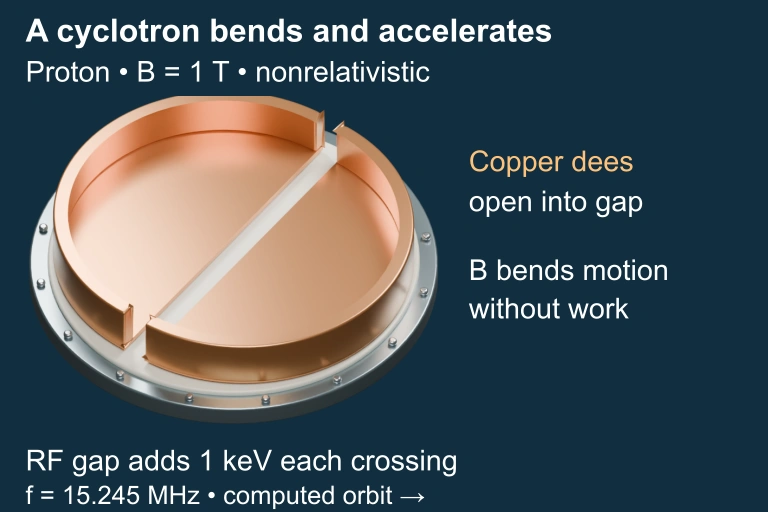 A proton follows alternating semicircles in the magnetic field and gains energy at each electric-field gap crossing.
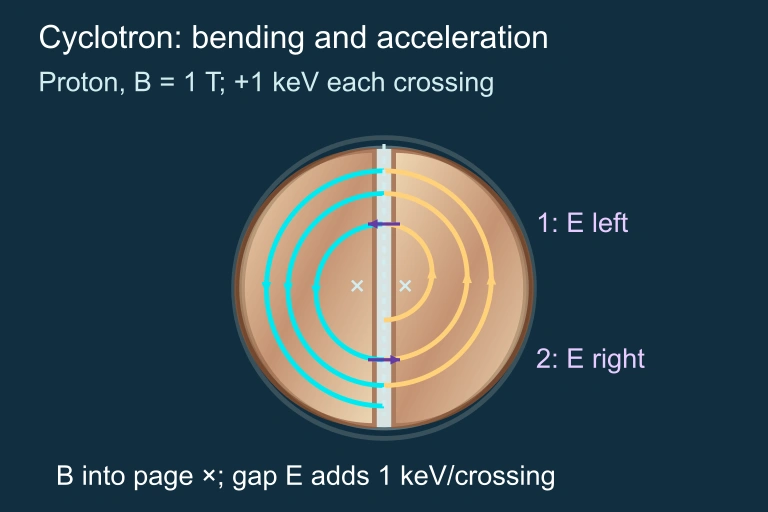 Computed ideal nonrelativistic proton arcs with alternating gap fields.
SECTION 9
Practice Problems
Question 1: CONCEPTUAL
- A. Upward (out of the ground)
- B. Downward (into the ground)
- C. Due west
- D. Due south
Show answer (A)
Question 2: BASIC CALCULATION
- A. 1.28 × 10⁻¹³ N
- B. 6.4 × 10⁻¹⁴ N
- C. 3.2 × 10⁻¹³ N
- D. 8.0 × 10⁻²⁶ N
Show answer (A)
Question 3: INTERMEDIATE
- A. 3.2 × 10⁻²⁰ C
- B. 1.6 × 10⁻¹⁹ C
- C. 8.0 × 10⁻²⁰ C
- D. 3.2 × 10⁻¹⁹ C
Show answer (B)
Question 4: APPLIED
5 ptsShow answer
Question 5: CRITICAL THINKING
4 ptsShow answer
SUMMARY
Lesson Summary
Summary
A magnetic field exerts a force on a moving charged particle given by F = |q|vB sin θ, where θ is the angle between the velocity and the field. The direction of this force is determined by the right-hand rule for positive charges (reverse for negative). The force is always perpendicular to both v⃗ and B⃗, which means it changes the particle's direction but does zero work — the particle's speed and kinetic energy remain constant.
When a charge moves perpendicular to a uniform field, it follows a circular path with radius r = mv/(|q|B). This relationship is the basis for devices like mass spectrometers and cyclotrons. For a current-carrying wire, the force is F = BIL sin θ, connecting the microscopic Lorentz force on individual charges to macroscopic forces on conductors. Remember: a stationary charge experiences no magnetic force, and the orbital period T = 2πm/(|q|B) is independent of speed.