
SECTION 1
Historical Context & Motivation
The study of magnetism stretches back millennia, beginning with the ancient observation that certain stones—lodestones—could attract iron. For centuries, magnetism remained a curiosity with limited practical application beyond primitive compasses. It was not until the early nineteenth century that a profound connection between electricity and magnetism was uncovered, launching the field of electromagnetism and ultimately unifying two seemingly distinct phenomena into a single theoretical framework.
1820 • Ørsted's Discovery
1831 • Faraday's Induction
1865 • Maxwell's Equations
1895 • Lorentz Force Law
The central question this lesson addresses is: how do we quantitatively describe the magnetic field created by currents and magnets, and how does that field exert forces on moving charges and current-carrying wires? Answering this question is essential for understanding everything from MRI machines to electric motors.
SECTION 2
Core Principles & Definitions
A magnetic field (symbol B⃗) is a vector field that permeates the space around magnets, current-carrying conductors, and moving charges. Unlike gravitational or electrostatic fields, the magnetic field exerts a force only on charges that are in motion; a stationary charge sitting in a magnetic field experiences no magnetic force. The SI unit of magnetic field strength is the tesla (T), where 1 T = 1 kg·s−2·A−1.
Sources of B⃗
Vector Nature
No Magnetic Monopoles
Superposition
SECTION 3
Visualizing Magnetic Fields
The concept of magnetic field lines, pioneered by Faraday, provides a powerful visual tool. Field lines are drawn so that their tangent at any point gives the direction of B⃗, and the density of lines (number per unit area) is proportional to the field's magnitude. The diagram below shows the field around a bar magnet, where lines emerge from the north pole, arc through the surrounding space, and return to the south pole—forming the characteristic closed-loop pattern required by Gauss's law for magnetism.
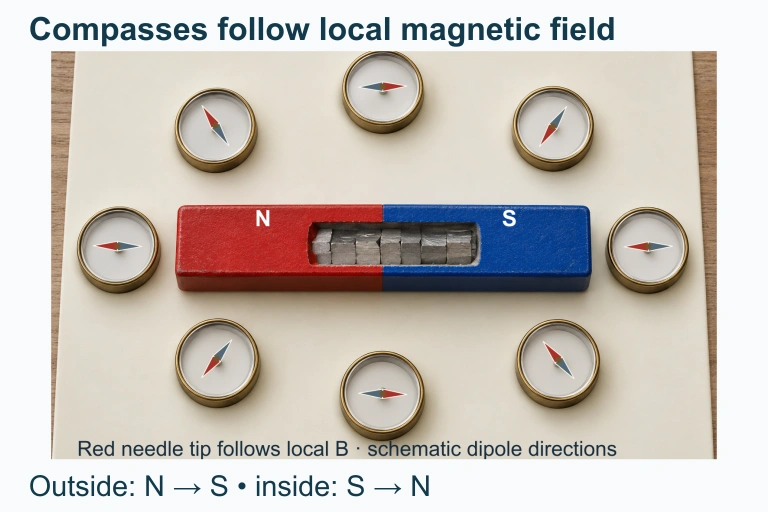 Compass north-seeking ends align with the local field. Outside the bar magnet, the field points from north toward south.
SECTION 4
Mathematical Framework
Two foundational equations govern how magnetic fields interact with moving charges and current-carrying conductors. The first describes the force on a single moving charge; the second extends that idea to a straight segment of wire carrying current in a uniform external field.
MAGNETIC FORCE ON A MOVING CHARGE
F = magnitude of the magnetic force (N), q = charge (C), v = speed of the charge (m/s), B = magnetic field strength (T), θ = angle between v⃗ and B⃗. The force direction is given by the right-hand rule and is always perpendicular to both v⃗ and B⃗.
MAGNETIC FORCE ON A CURRENT-CARRYING WIRE
F = force on the wire (N), B = external magnetic field (T), I = current (A), L = length of the wire segment in the field (m), θ = angle between the current direction and B⃗.
FIELD FROM A LONG STRAIGHT WIRE
B = magnetic field magnitude (T), μ₀ = permeability of free space = 4π × 10−7 T·m/A, I = current (A), r = perpendicular distance from the wire (m). The field forms concentric circles around the wire.
FIELD INSIDE A SOLENOID
n = number of turns per unit length (turns/m), I = current (A). The field inside a long solenoid is approximately uniform and directed along its axis.
A critically important consequence of F = qvB sin θ is that the magnetic force does zero work on a charged particle. Because the force is always perpendicular to the velocity, it changes the direction of the particle's motion but not its speed—hence the kinetic energy remains constant. This is why a charged particle in a uniform magnetic field follows a circular path (when v⃗ ⊥ B⃗), with the magnetic force supplying the centripetal acceleration.
SECTION 5
Motion of Charged Particles in B⃗
When a charged particle enters a region of uniform magnetic field with its velocity perpendicular to B⃗, the resulting magnetic force acts as a centripetal force and the particle traces out a circle. Setting qvB = mv²/r yields the radius of circular motion: r = mv / (qB). Larger mass or faster speed produces a bigger circle; stronger fields or greater charge produce tighter orbits. This principle underlies the operation of mass spectrometers, cyclotrons, and the confinement of plasma in fusion reactors.
| Quantity | Symbol | Effect on Orbit Radius |
|---|---|---|
| Mass | m | r ∝ m — heavier particles orbit in larger circles |
| Speed | v | r ∝ v — faster particles have larger radii |
| Charge magnitude | |q| | r ∝ 1/|q| — greater charge means tighter orbit |
| Field strength | B | r ∝ 1/B — stronger field means tighter orbit |
Dependence of circular orbit radius on physical quantities
SECTION 6
Worked Example
Worked example
- 1
Step 1 — Identify Given Values
A proton (m = 1.67 × 10⁻²⁷ kg, q = 1.60 × 10⁻¹⁹ C) enters a uniform magnetic field B = 0.50 T with a speed v = 3.0 × 10⁶ m/s perpendicular to B⃗. Find (a) the radius of its circular orbit and (b) the magnetic force on the proton. - 2
Step 2 — Find the Orbit Radius
Use r = mv / (qB). Substitute: r = (1.67 × 10⁻²⁷)(3.0 × 10⁶) / [(1.60 × 10⁻¹⁹)(0.50)].r = 6.3 × 10⁻² m ≈ 6.3 cm - 3
Step 3 — Find the Magnetic Force
Since v⃗ ⊥ B⃗, sin θ = 1. F = qvB = (1.60 × 10⁻¹⁹)(3.0 × 10⁶)(0.50).F = 2.4 × 10⁻¹³ N - 4
Step 4 — Verify Consistency
As a check, confirm that F = mv²/r: (1.67 × 10⁻²⁷)(3.0 × 10⁶)² / (6.3 × 10⁻²) = 2.4 × 10⁻¹³ N. This matches, confirming the magnetic force serves as the centripetal force. Note that the proton's kinetic energy is unchanged because F⃗ ⊥ v⃗.
SECTION 7
Applications & Limitations
The equations developed in previous sections assume ideal conditions—uniform fields, point charges, or infinitely long wires. Real-world applications require awareness of when these models break down and how additional effects (such as relativistic speeds, non-uniform field regions, or magnetic materials) modify the picture.
| Application | How It Uses B⃗ | Key Limitation |
|---|---|---|
| Mass Spectrometer | Different ions have different r = mv/(qB), separating isotopes by mass | Requires high vacuum; assumes uniform B |
| Electric Motor | F = BIL sin θ on current-carrying coil produces torque | Field non-uniformity reduces efficiency |
| MRI Scanner | Strong uniform B aligns nuclear spins; RF pulses probe tissue | Requires superconducting magnets (1.5–3 T); extremely costly |
| Earth's Magnetic Field | Deflects charged solar wind particles, protecting the atmosphere | Field is non-uniform and changes over geological time |
Selected applications of magnetic fields and their practical limitations
SECTION 8
Connection to Advanced Theory
The AP Physics 2 treatment of magnetic fields is grounded in the algebra-based formulation of classical electromagnetism. At higher levels, the same physics is expressed using vector calculus (Ampère's law with the line integral ∮B⃗·dl⃗ = μ₀Ienc), and ultimately through the relativistic unification of E⃗ and B⃗ into the electromagnetic field tensor. The table below contrasts the AP-level and advanced treatments.
| Topic | AP Physics 2 Treatment | Advanced / University Treatment |
|---|---|---|
| Sources of B⃗ | B = μ₀I/(2πr) for long wire; B = μ₀nI for solenoid | Biot-Savart law for arbitrary current geometries; Ampère's law in integral/differential form |
| Force on charges | F = qvB sin θ (scalar magnitude) | F⃗ = qv⃗ × B⃗ (full vector cross product) |
| Magnetic flux | Φ = BA cos θ for uniform fields | Φ = ∫B⃗·dA⃗ for non-uniform fields and curved surfaces |
| E and B unification | Treated as separate fields | E⃗ and B⃗ are components of one electromagnetic field tensor; a pure E field in one frame can appear as a mix of E and B in another |
Understanding the algebra-based framework thoroughly prepares you to transition into vector-calculus-based electromagnetism. The physical intuition—right-hand rules, field-line visualization, and the perpendicularity of magnetic forces—carries directly forward into more advanced courses.
SECTION 9
Practice Problems
Question 1: CONCEPTUAL
- A. The force is directed vertically downward, opposite to B⃗.
- B. The force is directed horizontally to the left, opposite to v⃗.
- C. The force is perpendicular to both v⃗ and B⃗, directed out of the page.
- D. The force is zero because the proton is not accelerating.
Show answer (C)
Question 2: BASIC CALCULATION
- A. 1.6 × 10⁻¹³ N
- B. 8.0 × 10⁻¹⁴ N
- C. 1.0 × 10⁻¹² N
- D. 3.2 × 10⁻¹³ N
Show answer (A)
Question 3: INTERMEDIATE
- A. 0.60 N
- B. 0.30 N
- C. 0.52 N
- D. 0.15 N
Show answer (B)
Question 4: APPLIED
Show answer
Question 5: CRITICAL THINKING