

SECTION 1
Historical Context & Motivation
For centuries, heat was thought to be a material substance—a weightless fluid called caloric—that flowed from hot objects to cold ones. This picture could explain some phenomena, such as the flow of heat through a metal bar, but it failed spectacularly when challenged by experiments on friction and compression. The modern understanding that temperature and pressure are statistical consequences of molecular motion required breakthroughs spanning three centuries.
1738 • Bernoulli's Hydrodynamica
1845 • Waterston & Joule
1860 • Maxwell's Speed Distribution
1877 • Boltzmann's Statistical Mechanics
1905 • Einstein & Brownian Motion
The central question that kinetic theory answers is deceptively simple: What is temperature, really? Thermometers register a number, but that number is not a fundamental property of matter in the way that mass or charge is. Kinetic theory reveals that temperature is a macroscopic proxy for the average translational kinetic energy of the particles in a substance, and pressure arises from the collective force of those particles colliding with confining surfaces.
SECTION 2
Core Principles of Kinetic Theory
Kinetic theory rests on a set of simplifying assumptions about an ideal gas. Although real gases deviate from these assumptions at high pressures or low temperatures, the ideal-gas model is remarkably accurate under ordinary conditions and provides the foundation for all AP-level thermodynamic reasoning.
Large Number of Particles
Random Motion
Negligible Volume
Elastic Collisions
No Intermolecular Forces
SECTION 3
Visualizing Molecular Motion and Pressure
In the diagram above, notice that no two velocity arrows are identical: molecules travel in every direction with a spread of speeds. When a molecule strikes the right wall and bounces back elastically, it transfers momentum to the wall. Billions of such collisions each second produce a nearly constant outward force. Dividing that total force by the wall's area gives the gas pressure P. Increasing the temperature means the molecules move faster on average, hit the walls harder, and therefore generate a higher pressure if the volume is held constant.
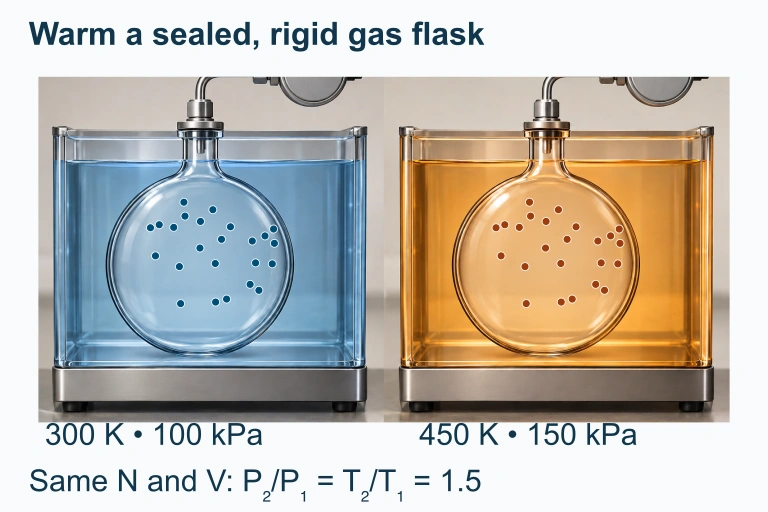 For a rigid fixed-volume ideal gas, increasing temperature from 300 K to 450 K raises pressure from 100 kPa to 150 kPa. Dots are representative, not individual molecule counts.
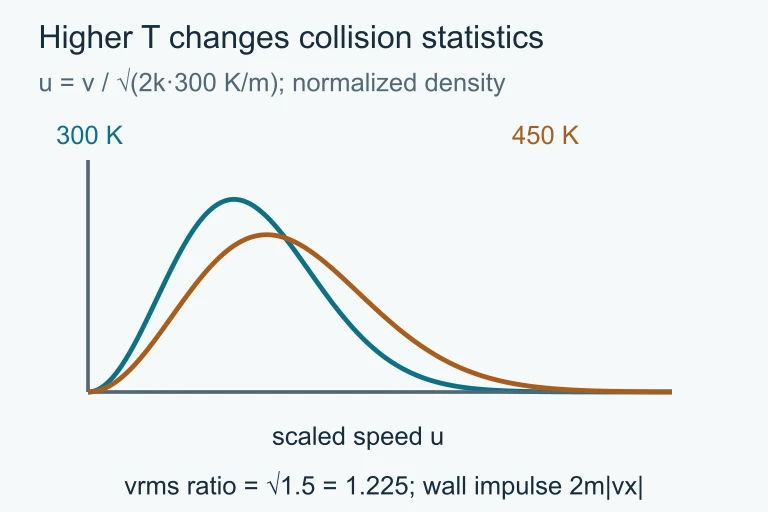 Retained normalized speed distributions and ideal elastic wall impulse.
SECTION 4
Mathematical Framework
The central result of kinetic theory connects microscopic molecular motion to the macroscopic ideal-gas law. We begin with the derivation's key conclusion—the expression for pressure in terms of molecular speeds—and then show how temperature emerges naturally.
From Molecular Collisions to Pressure
Consider N identical molecules of mass m inside a cubic container of side length L. A single molecule moving with x-component of velocity vx rebounds elastically off a wall, changing its momentum by Δp = 2mvx. It returns to the same wall after traversing the box twice (distance 2L), so the time between hits is Δt = 2L/vx. The average force from one molecule is therefore F = Δp/Δt = mvx2/L. Summing over all N molecules and noting that the average of vx2 equals one-third of the mean square speed v2rms (because motion is isotropic in three dimensions), we arrive at the pressure on one wall.
PRESSURE FROM KINETIC THEORY
P = gas pressure (Pa), N = number of molecules, m = mass of one molecule (kg), vrms = root-mean-square speed (m/s), V = volume (m³).
Connecting to Temperature
Comparing the kinetic-theory expression PV = (1/3)Nmv²rms with the ideal-gas law PV = NkBT immediately yields the bridge between microscopic and macroscopic worlds.
AVERAGE TRANSLATIONAL KINETIC ENERGY
Kavg = average translational KE per molecule (J), kB = Boltzmann constant = 1.38 × 10⁻²³ J/K, T = absolute temperature (K).
This is one of the most important results on the AP Physics 2 exam. Temperature is directly proportional to the average translational kinetic energy of gas molecules. Doubling the Kelvin temperature doubles Kavg. Note that temperature depends on translational kinetic energy only; rotational and vibrational modes contribute to internal energy but not to temperature as measured by an ideal-gas thermometer.
ROOT-MEAN-SQUARE SPEED
Equivalently, vrms = √(3RT/M), where R = 8.314 J/(mol·K) and M = molar mass (kg/mol). Lighter molecules move faster at the same temperature.
IDEAL GAS LAW (PER MOLECULE)
Or in molar form: PV = nRT, where n = number of moles and R = NAkB.
SECTION 5
Maxwell–Boltzmann Speed Distribution
Not all molecules in a gas move at the same speed. The Maxwell–Boltzmann distribution describes the fraction of molecules with speeds in any given range. The distribution is asymmetric: it rises steeply from zero, peaks at the most probable speed vp, and then falls off with a long tail toward high speeds. Three characteristic speeds are commonly discussed: vp < vavg < vrms. For AP Physics 2, you need to know vrms and understand the qualitative shape of the distribution.
Several AP-relevant conclusions follow from the graph. First, raising the temperature shifts the distribution to higher speeds—the peak flattens and moves right. Second, at any temperature there are always some molecules moving very slowly and some moving very fast; temperature sets the average, not a uniform speed. Third, because vrms ∝ √T, doubling the Kelvin temperature increases vrms by a factor of √2 ≈ 1.41, not 2. Finally, at a given temperature, lighter molecules (smaller m) have higher vrms than heavier ones, explaining why hydrogen escapes Earth's atmosphere more readily than nitrogen.
| Characteristic Speed | Formula | Relative Value (ratio) |
|---|---|---|
| Most probable (vp) | √(2kBT / m) | 1.00 |
| Mean (vavg) | √(8kBT / πm) | 1.13 |
| Root-mean-square (vrms) | √(3kBT / m) | 1.22 |
Three characteristic molecular speeds and their relationships
SECTION 6
Worked Example
Worked example
- 1
Step 1 — Identify Given Values
A container holds nitrogen gas (N₂) at T = 300 K. The molar mass of N₂ is M = 28.0 g/mol = 0.0280 kg/mol. The mass of one molecule is m = M/NA = 0.0280 / (6.022 × 10²³) = 4.65 × 10⁻²⁶ kg. Boltzmann constant kB = 1.38 × 10⁻²³ J/K. - 2
Step 2 — Calculate v_rms
Apply vrms = √(3kBT / m) = √(3 × 1.38 × 10⁻²³ × 300 / 4.65 × 10⁻²⁶).vrms = √(2.67 × 10⁵) ≈ 517 m/s - 3
Step 3 — Calculate Average Translational KE
Kavg = (3/2) kB T = (3/2)(1.38 × 10⁻²³)(300).Kavg = 6.21 × 10⁻²¹ J - 4
Step 4 — Interpret Results
Nitrogen molecules at room temperature zip around at roughly 517 m/s—faster than the speed of sound in air (≈ 343 m/s). The average kinetic energy is tiny for a single molecule but when multiplied by Avogadro's number gives the molar kinetic energy: (3/2)RT = 3740 J/mol. Notice that Kavg depends only on T, not on the molecular mass—all ideal-gas species at the same temperature share the same average translational KE.
SECTION 7
Strengths and Limitations of the Ideal-Gas Model
| Feature | Strength | Limitation |
|---|---|---|
| Point particles (no volume) | Simplifies math; accurate at low densities. | Fails near condensation where molecular volume matters. |
| No intermolecular forces | Explains Boyle's & Charles's laws elegantly. | Cannot explain liquefaction or deviations at high P. |
| Elastic collisions | Conserves total KE; consistent with constant T at equilibrium. | Inelastic processes (e.g., chemical reactions) are excluded. |
| Classical treatment | Works well above ≈ 50 K for most gases. | Breaks down at very low T where quantum effects dominate (e.g., He-4 superfluid). |
Strengths and limitations of ideal-gas assumptions
SECTION 8
Connection to Advanced Theory
Kinetic theory is the entry point into the vast field of statistical mechanics. Beyond the ideal-gas model, more sophisticated treatments account for intermolecular attractions, molecular volume, and quantum statistics.
| Concept | Ideal-Gas / Kinetic Theory | Advanced Treatment |
|---|---|---|
| Equation of state | PV = NkBT | Van der Waals: (P + a/V²)(V − b) = NkBT |
| Energy per molecule | (3/2)kBT (translation only) | Equipartition: (f/2)kBT for f degrees of freedom |
| Speed distribution | Maxwell–Boltzmann (classical) | Fermi–Dirac (fermions) or Bose–Einstein (bosons) |
| Heat capacity | = (3/2)NkB (monatomic) | Temperature-dependent from quantum freezing of modes |
Ideal-gas kinetic theory vs. advanced models
The equipartition theorem extends the kinetic-theory energy result to molecules with rotational and vibrational degrees of freedom. For a diatomic gas like N₂ at moderate temperatures, five active degrees of freedom (three translational plus two rotational) give an internal energy per molecule of (5/2)kBT. Understanding when this theorem breaks down—because vibrational modes "freeze out" at low T—requires quantum mechanics and sits at the frontier of what AP Physics 2 previews.
SECTION 9
Practice Problems
Question 1: CONCEPTUAL
- A. Helium atoms have a greater average translational kinetic energy than argon atoms.
- B. Argon atoms have a greater root-mean-square speed than helium atoms.
- C. Helium atoms have a greater root-mean-square speed than argon atoms.
- D. Both species have the same root-mean-square speed because they are at the same temperature.
Show answer (C)
Question 2: BASIC CALCULATION
- A. 2.76 × 10⁻²¹ J
- B. 5.52 × 10⁻²¹ J
- C. 8.28 × 10⁻²¹ J
- D. 1.66 × 10⁻²⁰ J
Show answer (C)
Question 3: INTERMEDIATE
- A. Pressure triples; v_rms triples.
- B. Pressure triples; v_rms increases by √3.
- C. Pressure increases by √3; v_rms triples.
- D. Pressure increases by 9; v_rms increases by √3.
Show answer (B)
Question 4: APPLIED
Show answer
Question 5: CRITICAL THINKING