
SECTION 1
Historical Context & Motivation
The study of light emitted and absorbed by matter ranks among the most consequential experimental programs in the history of physics. When Isaac Newton first dispersed sunlight through a prism in the seventeenth century, he revealed a continuous rainbow of colors — but it was the discovery of dark lines interrupting that rainbow, and bright lines emitted by heated elements, that ultimately demanded an entirely new theory of matter. These spectral features could not be explained by classical wave optics, and their resolution required the birth of quantum mechanics.
1814 • Fraunhofer Lines
1859 • Kirchhoff & Bunsen
1885 • Balmer Series
1913 • Bohr Model
1925–1926 • Quantum Mechanics
The central question that spectroscopy posed — why does each element emit and absorb only certain wavelengths of light? — became the gateway to quantum physics. Understanding emission and absorption spectra is therefore essential not only for the AP Physics 2 exam but for grasping the physical basis of modern atomic theory.
SECTION 2
Core Principles & Definitions
Spectral phenomena arise directly from the quantized energy levels of atoms. When an atom transitions between two energy states, it either releases or absorbs a photon whose energy exactly equals the difference between those states. This discrete nature of atomic energy is the origin of the line patterns that distinguish emission spectra and absorption spectra from the continuous spectrum produced by incandescent solids or dense gases.
Continuous Spectrum
Emission (Bright-Line) Spectrum
Absorption (Dark-Line) Spectrum
Quantized Energy Levels
Kirchhoff's Three Laws of Spectroscopy
KEY TAKEAWAY
SECTION 3
Visual Explanation — Energy-Level Transitions
The diagram above illustrates several critical features. First, the energy levels are not evenly spaced — they converge as n increases, bunching together near the ionization limit at 0 eV. This means transitions involving the ground state (n = 1) release or require much more energy than transitions among higher levels. Second, the emission transition from n = 3 to n = 2 (the Hα line at 656.3 nm) falls in the visible red portion of the spectrum, while the n = 3 → 1 transition produces an ultraviolet photon — its larger energy gap yields a shorter wavelength. Third, absorption is the mirror process: the photon energy must match the gap precisely, or the atom will not absorb it. This selectivity is why absorption spectra consist of sharp dark lines at exactly the same wavelengths as the corresponding emission lines.
SECTION 4
Mathematical Framework
The quantitative treatment of emission and absorption spectra rests on two foundational relationships: the Bohr energy-level equation for hydrogen-like atoms and the photon energy equation. Together, they allow us to predict every spectral line wavelength from first principles.
ENERGY OF THE nTH LEVEL (HYDROGEN)
En = energy of the electron in the nth level (eV); n = principal quantum number (1, 2, 3, …); −13.6 eV = the ground-state energy, equal to the ionization energy of hydrogen. The negative sign indicates a bound state.
PHOTON ENERGY FOR A TRANSITION
h = Planck's constant = 6.626 × 10⁻³⁴ J·s = 4.136 × 10⁻¹⁵ eV·s; f = photon frequency (Hz); c = speed of light = 3.00 × 10⁸ m/s; λ = photon wavelength (m). The photon energy equals the magnitude of the energy difference between the two levels involved.
COMBINED WAVELENGTH EQUATION
RH = Rydberg constant for hydrogen = 1.097 × 10⁷ m⁻¹; nf = final (lower) energy level; ni = initial (higher) energy level. This equation is valid for emission when ni > nf. For AP Physics 2, you will most commonly use E = hf or the energy-level formula directly.
AP Exam Tip
A key conceptual point in the mathematical framework is that the photon energy is always positive — it is the absolute value of the energy difference between levels. For emission, the electron moves from a higher (less negative) energy to a lower (more negative) energy, and the difference is carried away by the photon. For absorption, the incoming photon must supply exactly the right energy to promote the electron upward. If the photon energy does not match any available transition, the atom is transparent to that wavelength.
SECTION 5
Spectral Series of Hydrogen
The emission lines of hydrogen are organized into named spectral series, each defined by the lower energy level (nf) to which the electron transitions. Every series converges to a series limit — the shortest wavelength produced when ni → ∞ — and spans a particular region of the electromagnetic spectrum.
| Series Name | Final Level () | Spectral Region | Key Wavelengths |
|---|---|---|---|
| Lyman | 1 | Ultraviolet | 121.6 nm (Ly-α), 102.6 nm (Ly-β), series limit 91.2 nm |
| Balmer | 2 | Visible / near UV | 656.3 nm (Hα, red), 486.1 nm (Hβ, cyan), 434.0 nm (Hγ, violet), limit 364.6 nm |
| Paschen | 3 | Infrared | 1875 nm, 1282 nm, limit 820.4 nm |
| Brackett | 4 | Infrared | 4051 nm, 2625 nm, limit 1458 nm |
Hydrogen spectral series with representative wavelengths
For the AP Physics 2 exam, the Balmer series is the most frequently tested because its lines fall in the visible range. However, you should understand conceptually why the Lyman series involves higher-energy photons (UV) — the transitions terminate at the deeply bound ground state — and why the Paschen and Brackett series involve lower-energy photons (IR), since the upper levels are closely spaced. Each element has its own unique set of energy levels, so each element's spectrum serves as a spectral fingerprint used in chemical analysis and astrophysics.
SECTION 6
Worked Example — Calculating a Spectral Line Wavelength
A hydrogen atom in the n = 4 excited state emits a photon and transitions to the n = 2 state. Determine the energy, wavelength, and color of the emitted photon.
Photon from the n = 4 → n = 2 Transition (Hβ line)
- 1
Step 1 — Find the Energy of Each Level
Using En = −13.6 eV / n²: E₄ = −13.6 / 4² = −13.6 / 16 = −0.850 eV E₂ = −13.6 / 2² = −13.6 / 4 = −3.40 eVE₄ = −0.850 eV, E₂ = −3.40 eV - 2
Step 2 — Calculate the Photon Energy
The photon carries the energy difference between the two levels: Ephoton = |E₂ − E₄| = |−3.40 − (−0.850)| = |−2.55| = 2.55 eV Converting to joules: 2.55 eV × 1.602 × 10⁻¹⁹ J/eV = 4.09 × 10⁻¹⁹ JE_photon = 2.55 eV = 4.09 × 10⁻¹⁹ J - 3
Step 3 — Calculate the Wavelength
Using E = hc / λ, solve for λ: λ = hc / E = (6.626 × 10⁻³⁴ J·s)(3.00 × 10⁸ m/s) / (4.09 × 10⁻¹⁹ J) λ = 1.988 × 10⁻²⁵ / 4.09 × 10⁻¹⁹ = 4.86 × 10⁻⁷ m = 486 nmλ = 486 nm - 4
Step 4 — Identify the Color
A wavelength of 486 nm falls in the blue-cyan portion of the visible spectrum. This is the Hβ (H-beta) line of the Balmer series — one of the four visible hydrogen emission lines. You can verify this matches the second brightest line shown in the Balmer emission diagram from Section 5.The emitted photon is cyan (blue-green) visible light.
SECTION 7
Emission vs. Absorption — Strengths, Limitations, and Applications
| Feature | Emission Spectrum | Absorption Spectrum |
|---|---|---|
| Appearance | Bright colored lines on a dark background | Dark lines superimposed on a continuous spectrum |
| Physical Process | Electron drops from higher to lower energy level; photon emitted | Photon absorbed by electron, promoting it from lower to higher energy level |
| Source Conditions | Hot, low-pressure gas (Kirchhoff's 2nd law) | Cooler gas in front of a continuous source (Kirchhoff's 3rd law) |
| Line Positions | Identical wavelengths for a given element | Identical wavelengths for a given element |
| Astrophysical Use | Identifying composition of nebulae, stellar atmospheres | Identifying elements in stellar atmospheres (Fraunhofer lines); measuring Doppler shifts for radial velocity |
| Laboratory Use | Flame tests, gas discharge tubes, elemental analysis | UV-Vis spectrophotometry, atmospheric gas analysis |
Comparison of emission and absorption spectra
KEY TAKEAWAY
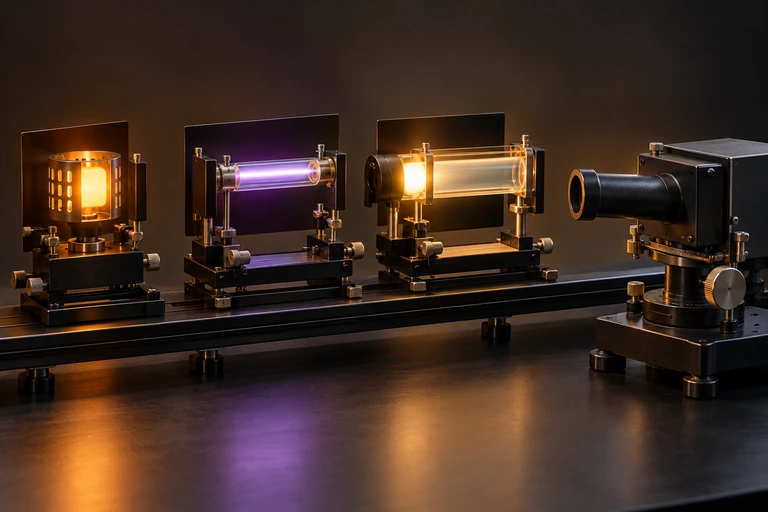 A dense thermal source produces a continuum, an excited dilute gas produces emission lines, and cooler gas in front of a continuum can produce absorption lines. Photon energies match allowed atomic energy differences.
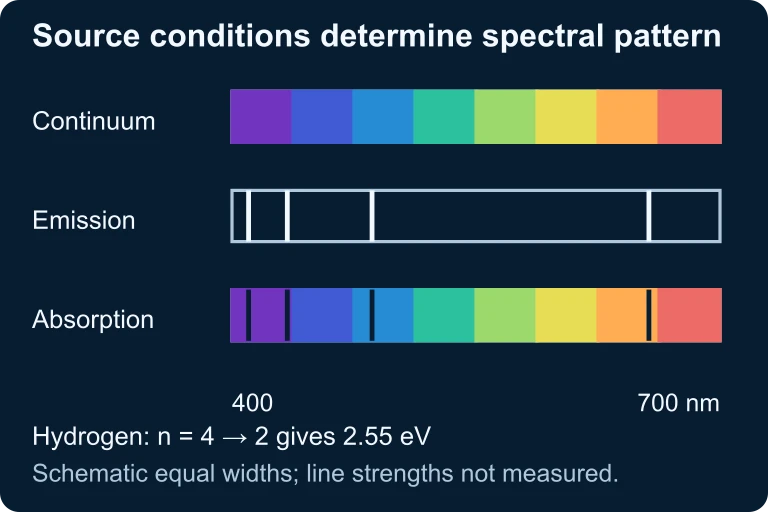 A dense thermal source produces a continuum, an excited dilute gas produces emission lines, and cooler gas in front of a continuum can produce absorption lines. Photon energies match allowed atomic energy differences.
SECTION 8
Connection to Advanced Theory
The Bohr model and its associated energy-level formula work beautifully for hydrogen but fail for multi-electron atoms. Full quantum mechanics — the Schrödinger equation — extends the concept of quantized energy levels to all elements by introducing additional quantum numbers (ℓ, mℓ, ms) that describe orbital shape, orientation, and electron spin. These additional degrees of freedom lead to fine structure — closely spaced doublets and triplets that are invisible in the simple Bohr picture but detectable with high-resolution spectrometers.
| Feature | Bohr Model (AP Physics 2) | Quantum Mechanical Model |
|---|---|---|
| Applicable to | Hydrogen and hydrogen-like ions (He⁺, Li²⁺) | All atoms and molecules |
| Electron description | Circular orbits with definite radius | Probability clouds (orbitals) |
| Energy quantization | Depends only on n | Depends on n, ℓ, and electron-electron interactions |
| Selection rules | Any n → n′ transition allowed | Δℓ = ±1 required for electric dipole transitions |
| Fine structure | Not predicted | Predicted via spin-orbit coupling |
Bohr model vs. full quantum mechanics
For AP Physics 2, you need not solve the Schrödinger equation, but you should be aware that the simple Bohr picture is an approximation. The essential takeaway that survives the transition to quantum mechanics is the concept of quantized energy levels and the rule that photon energy equals the gap between levels. These principles are universal and apply to all atoms, even though the specific level spacings become more complex than the 1/n² pattern of hydrogen. Modern applications like lasers, LEDs, and astronomical spectroscopy all depend on precisely these ideas.
SECTION 9
Practice Problems
Question 1: CONCEPTUAL
- A. The cool gas scatters all wavelengths of light equally, but the bright lines are simply brighter than the rest of the spectrum.
- B. The atoms in the cool gas can only absorb photons whose energies match the differences between the atoms' quantized energy levels, which are the same energy differences that produce the emission lines.
- C. The dark lines are caused by destructive interference between the white light and the light re-emitted by the gas.
- D. The gas absorbs photons of all wavelengths, but the dark lines appear only where the gas re-emits light in a direction away from the observer.
Show answer (B)
Question 2: BASIC CALCULATION
- A. 656 nm
- B. 122 nm
- C. 103 nm
- D. 486 nm
Show answer (C)
Question 3: INTERMEDIATE
- A. The atom absorbs the photon and the electron transitions to the second excited state.
- B. The atom absorbs the photon and the electron transitions to the first excited state, with the remaining 3.0 eV emitted as a second photon.
- C. The atom cannot absorb the photon because 6.0 eV does not match the energy difference to the first excited state.
- D. The atom is ionized because 6.0 eV exceeds the energy of the second excited state.
Show answer (A)
Question 4: APPLIED
4 ptsShow answer
Question 5: CRITICAL THINKING
4 ptsShow answer
SUMMARY
Summary — Emission and Absorption Spectra
Summary
Atoms possess quantized energy levels described by the principal quantum number n. When an electron transitions from a higher to a lower energy state, the atom releases a photon whose energy equals the gap between levels: E = hf = hc/λ. This produces an emission spectrum — bright lines at discrete wavelengths on a dark background. The reverse process, absorption, occurs when a photon of the correct energy is absorbed by the atom, promoting the electron upward and creating dark lines in an otherwise continuous spectrum. For hydrogen, the Bohr model gives energy levels as En = −13.6 eV / n², predicting all observed spectral series.
The three types of spectra — continuous, emission, and absorption — are summarized by Kirchhoff's three laws. Each element's unique set of energy levels gives it a distinct spectral fingerprint, enabling chemical identification in laboratories and across the cosmos. On the AP Physics 2 exam, focus on calculating photon energies and wavelengths from energy-level diagrams, recognizing the complementary relationship between emission and absorption, and applying the Rydberg/Balmer framework to hydrogen.