
SECTION 1
Historical Context & Motivation
The story of electromagnetic waves begins with a centuries-long quest to understand the nature of light and its relationship to electricity and magnetism. By the early 1800s, experiments by Ørsted, Ampère, and Faraday had established that electric and magnetic phenomena were deeply intertwined—changing magnetic fields could produce electric currents, and moving charges could create magnetic fields. Yet no one had articulated a unified framework that linked these observations to the behavior of light, a puzzle that would ultimately transform physics and give rise to modern telecommunications.
1831 • Faraday's Law of Induction
1865 • Maxwell's Equations Published
1887 • Hertz Generates Radio Waves
1895 • Röntgen Discovers X-Rays
1905 • Einstein's Photon Model
Maxwell's crowning insight was recognizing that a time-varying electric field creates a magnetic field and vice versa, forming a self-sustaining wave that requires no material medium. This prediction unified optics with electromagnetism and raised the central question that this lesson addresses: How do electromagnetic waves propagate, what properties do they carry, and how does the electromagnetic spectrum organize all forms of radiant energy?
SECTION 2
Core Principles of Electromagnetic Waves
Electromagnetic (EM) waves arise from the mutual induction of oscillating electric and magnetic fields. Unlike mechanical waves such as sound, EM waves do not require a medium—they propagate through the vacuum of space. The following foundational principles govern their behavior and appear throughout the AP Physics 2 curriculum.
Transverse Wave Structure
Speed in Vacuum
Energy Transport
The Wave Equation
No Medium Required
SECTION 3
Visualizing an Electromagnetic Wave
The diagram above captures the essential geometry of an electromagnetic wave. The electric field vector E oscillates sinusoidally in one plane while the magnetic field vector B oscillates in the plane perpendicular to it. The wave advances along the x-axis at speed c. At every point, E, B, and the propagation direction form a right-handed coordinate system. The peak value E0 is the amplitude of the electric field; the magnetic field amplitude B0 is related by E0 = cB0. This mutual perpendicularity and phase synchronization are fundamental features that distinguish EM waves from all mechanical wave types.
SECTION 4
Mathematical Framework
The quantitative description of electromagnetic waves rests on a handful of key relationships. These equations connect wave speed, frequency, wavelength, energy, and intensity, and they are essential tools for solving AP Physics 2 problems.
WAVE SPEED EQUATION
c = speed of light in vacuum ≈ 3.00 × 10⁸ m/s; λ = wavelength (m); f = frequency (Hz). Since c is constant, λ and f are inversely proportional.
E–B AMPLITUDE RELATIONSHIP
E₀ = peak electric field (V/m); B₀ = peak magnetic field (T). At any instant, the ratio E/B = c. The electric field component carries far more energy per unit volume than the magnetic field in vacuum.
SPEED FROM FUNDAMENTAL CONSTANTS
μ₀ = permeability of free space = 4π × 10⁻⁷ T·m/A; ε₀ = permittivity of free space ≈ 8.85 × 10⁻¹² C²/(N·m²). Maxwell derived this relationship, which showed that c depends only on electromagnetic constants—confirming light is an EM wave.
PHOTON ENERGY
h = Planck's constant ≈ 6.63 × 10⁻³⁴ J·s; f = frequency; λ = wavelength. Higher-frequency EM waves (e.g., gamma rays) carry more energy per photon than lower-frequency waves (e.g., radio).
The intensity of an electromagnetic wave—the power delivered per unit area—is given by I = P/A and is proportional to E₀². For a point source radiating uniformly in all directions, the intensity falls off as I = P/(4πr²), following the familiar inverse-square law. This relationship is crucial for understanding how EM wave energy diminishes with distance, whether from a radio transmitter, a star, or a light bulb.
SECTION 5
The Electromagnetic Spectrum
The electromagnetic spectrum encompasses the entire range of EM wave frequencies, from extremely low-frequency radio waves with wavelengths spanning kilometers to ultra-high-energy gamma rays with wavelengths smaller than atomic nuclei. All regions of the spectrum share the same fundamental physics—they differ only in frequency and wavelength, which determine how the radiation interacts with matter.
| Region | Wavelength Range | Frequency Range (Hz) | Photon Energy |
|---|---|---|---|
| Radio | > 1 mm | < 3 × 10¹¹ | < 1.24 meV |
| Microwave | 1 mm – 1 m | 3 × 10⁸ – 3 × 10¹¹ | 1.24 µeV – 1.24 meV |
| Infrared | 700 nm – 1 mm | 3 × 10¹¹ – 4.3 × 10¹⁴ | 1.24 meV – 1.77 eV |
| Visible | 380 – 700 nm | 4.3 × 10¹⁴ – 7.9 × 10¹⁴ | 1.77 – 3.27 eV |
| Ultraviolet | 10 – 380 nm | 7.9 × 10¹⁴ – 3 × 10¹⁶ | 3.27 – 124 eV |
| X-Rays | 0.01 – 10 nm | 3 × 10¹⁶ – 3 × 10¹⁹ | 124 eV – 124 keV |
| Gamma Rays | < 0.01 nm | > 3 × 10¹⁹ | > 124 keV |
Electromagnetic Spectrum Summary
A critical point for the AP exam: the boundaries between spectrum regions are not sharp—they are conventional and overlap in practice. What distinguishes the regions physically is how the radiation is produced and detected. Radio waves are generated by oscillating charges in antennas; infrared is emitted by warm objects; visible light comes from electronic transitions in atoms; X-rays arise from high-energy electron deceleration or inner-shell transitions; and gamma rays originate from nuclear processes. Despite these different origins, all EM waves obey the same wave equation c = λf.
SECTION 6
Worked Example
Worked example
- 1
Step 1 — Read the Problem
A radio station broadcasts at a frequency of f = 94.5 MHz. Determine (a) the wavelength of the broadcast signal, (b) the energy of a single photon, and (c) the peak magnetic field amplitude if the peak electric field is E₀ = 0.020 V/m. - 2
Step 2 — Find the Wavelength
Use c = λf, solving for λ. First convert frequency: f = 94.5 MHz = 94.5 × 10⁶ Hz = 9.45 × 10⁷ Hz. Then λ = c / f = (3.00 × 10⁸ m/s) / (9.45 × 10⁷ Hz).λ ≈ 3.17 m - 3
Step 3 — Find the Photon Energy
Apply E = hf. E = (6.63 × 10⁻³⁴ J·s)(9.45 × 10⁷ Hz) = 6.27 × 10⁻²⁶ J. To convert to eV, divide by 1.60 × 10⁻¹⁹ J/eV.E ≈ 6.27 × 10⁻²⁶ J ≈ 3.92 × 10⁻⁷ eV - 4
Step 4 — Find the Peak Magnetic Field
Use E₀ = cB₀, so B₀ = E₀ / c = (0.020 V/m) / (3.00 × 10⁸ m/s).B₀ ≈ 6.67 × 10⁻¹¹ T - 5
Step 5 — Interpret the Results
The wavelength of roughly 3 meters is typical for FM radio—comparable to the size of a car, which is why FM antennas are relatively short. The photon energy is extraordinarily small, which is why we don't feel individual radio photons; astronomical numbers of them are required to deliver measurable power. The magnetic field amplitude is extremely small compared to the electric field amplitude, consistent with E₀ = cB₀ (the factor of c ≈ 3 × 10⁸ makes B₀ many orders of magnitude smaller than E₀ in SI units).
SECTION 7
EM Waves vs. Mechanical Waves
Understanding electromagnetic waves becomes clearer when contrasted with the more familiar mechanical waves—sound, water, and seismic waves. While both types transfer energy, their underlying mechanisms and properties differ in fundamental ways.
| Property | Electromagnetic Waves | Mechanical Waves |
|---|---|---|
| Medium required? | No — propagate through vacuum | Yes — require a material medium (air, water, etc.) |
| Wave type | Always transverse | Can be transverse (e.g., string) or longitudinal (e.g., sound) |
| Speed in vacuum | c ≈ 3.00 × 10⁸ m/s (constant) | Cannot propagate in vacuum |
| Speed depends on | Properties of the medium (ε, μ); constant in vacuum | Medium density and elasticity |
| What oscillates? | Electric and magnetic fields | Particles of the medium |
| Polarization | Can be polarized (transverse) | Only transverse waves can be polarized |
Key Differences Between EM and Mechanical Waves
SECTION 8
Connections to Advanced Electromagnetism
AP Physics 2 treats electromagnetic waves at the conceptual and algebraic level, but the full mathematical treatment in university-level electromagnetism reveals deeper structure. Understanding where the AP treatment sits within the broader framework helps solidify your conceptual understanding and prepares you for future coursework.
| Topic | AP Physics 2 Level | Advanced / University Level |
|---|---|---|
| Wave equation | c = λf used to relate speed, frequency, and wavelength | Derived from Maxwell's equations using partial differential equations; full vector wave equation |
| Polarization | EM waves can be polarized; qualitative understanding | Jones vectors, Stokes parameters, circular and elliptical polarization, Malus's law derivation |
| Energy & intensity | I ∝ E₀²; inverse-square law for point sources | Poynting vector S = (1/μ₀)(E × B); energy density u = ½ε₀E² + (1/2μ₀)B² |
| Radiation | Accelerating charges produce EM waves (qualitative) | Larmor formula, antenna theory, radiation patterns, retarded potentials |
| Photon model | E = hf; photon energy related to frequency | Quantum electrodynamics (QED), photon spin, field quantization |
AP Physics 2 vs. Advanced Electromagnetism
For the AP exam, you should be comfortable applying c = λf, E = hf, and E₀ = cB₀, and you should understand qualitatively that accelerating charges produce EM radiation. The Poynting vector and Maxwell's equations in differential form are beyond the scope of AP Physics 2, but knowing they exist provides useful context. One connection worth noting: the fact that c = 1/√(μ₀ε₀) demonstrates that the speed of light is not an independent constant but rather a consequence of the electromagnetic properties of the vacuum—an insight that ultimately led Einstein to develop special relativity.
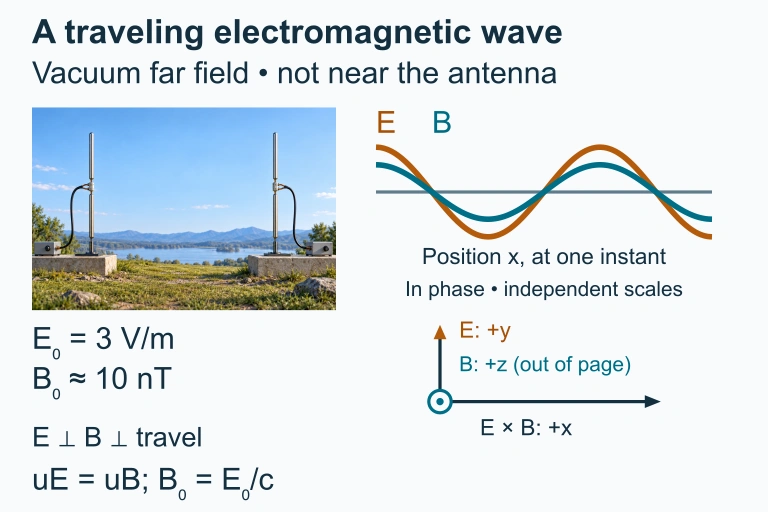 A vacuum far-field plane wave has in-phase E and B on independent plot scales. At the illustrated positive phase E points+y, B points+z out of the page, and E×B gives travel along+x. E 0=3 V/m and B 0≈10 nT.
SECTION 9
Practice Problems
Question 1: CONCEPTUAL
- A. +x direction
- B. −y direction
- C. +z direction
- D. −x direction
Show answer (C)
Question 2: BASIC CALCULATION
- A. 1.77 × 10⁹ Hz
- B. 5.66 × 10¹⁴ Hz
- C. 1.59 × 10² Hz
- D. 5.66 × 10¹¹ Hz
Show answer (B)
Question 3: INTERMEDIATE
- A. λ = 0.025 m, B₀ = 5.0 × 10⁻¹⁰ T
- B. λ = 0.025 m, B₀ = 4.5 × 10⁷ T
- C. λ = 25 m, B₀ = 5.0 × 10⁻¹⁰ T
- D. λ = 2.5 × 10⁻¹¹ m, B₀ = 5.0 × 10⁻¹⁰ T
Show answer (A)
Question 4: APPLIED
Show answer
Question 5: CRITICAL THINKING