AP Physics 2 • Electric Force, Field, and Potential

Electric Potential Energy

Understanding the energy stored in configurations of charges and how it governs electrostatic interactions.

An atom with wave and electric energy symbols.
Inside this lesson 10 sections 5 questions 9 figures

SECTION 1

Historical Context & Motivation

The concept of electric potential energy arose from centuries of investigation into the nature of electric forces and the broader quest to understand how energy is stored and transferred in physical systems. Just as gravitational potential energy revolutionized our understanding of planetary motion and falling bodies, the parallel idea that charged objects store energy by virtue of their positions relative to one another transformed the field of electromagnetism. The development of this concept depended on prior advances in electrostatics, the mathematical description of forces between charges, and the general principle of energy conservation that pervaded nineteenth-century physics.

1785 • Coulomb's Law

Charles-Augustin de Coulomb used a torsion balance to quantify the inverse-square force between point charges, establishing the mathematical foundation upon which potential energy would later be built.

1800 • Volta's Battery

Alessandro Volta's invention of the voltaic pile provided the first steady source of electric current, enabling systematic experiments that linked charge separation to stored energy.

1828 • Green's Potential Function

George Green introduced the concept of a potential function in his essay on electricity and magnetism, formalizing the relationship between force fields and scalar energy landscapes.

1845 • Energy Conservation

The work of James Joule and Hermann von Helmholtz established the conservation of energy as a universal principle, confirming that potential energy in electric systems could be converted to kinetic energy and vice versa.

1873 • Maxwell's Treatise

James Clerk Maxwell unified electricity and magnetism, showing that energy could be stored in electric and magnetic fields themselves — extending the concept of potential energy beyond discrete charges.

The central question these developments addressed is deceptively simple: when you push two like charges closer together against their mutual repulsion, where does the energy you expend go? The answer — that it is stored as electric potential energy in the configuration of charges — provides the foundation for understanding circuits, capacitors, and the behavior of charges in electric fields throughout AP Physics 2.

SECTION 2

Core Principles & Definitions

Electric potential energy is a form of energy that depends on the relative positions of charged objects within an electric field. Unlike kinetic energy, which depends on motion, potential energy is a property of the configuration of the system — it belongs to the system of interacting charges, not to any single charge in isolation. When charges rearrange, this stored energy can be converted into kinetic energy, thermal energy, or other forms, always in accordance with conservation of energy.

1

Configuration-Dependent

Electric potential energy belongs to the entire system of charges. It depends on the distances between charges and their magnitudes — not on the history of how they arrived at their positions.
2

Scalar Quantity

Unlike force and field, potential energy is a scalar — it has no direction. Contributions from multiple pairs of charges are added algebraically, including sign, without vector decomposition.
3

Sign Convention

Like charges (both positive or both negative) yield positive U — energy must be supplied to assemble them. Opposite charges yield negative U — energy is released when they come together.
4

Reference at Infinity

The standard reference is U = 0 when charges are infinitely far apart. All values of U represent energy relative to this separated configuration.
5

Work–Energy Connection

The work done by the electric force equals the negative of the change in potential energy: W = −ΔU. An external agent does positive work to increase U and negative work to decrease it.
✦

KEY TAKEAWAY

Think of electric potential energy like a compressed spring between two magnets on a frictionless track. When you push two repelling magnets closer together, you do work against the repulsive force, and the energy is stored in the system. Release them, and the stored energy converts to kinetic energy as they fly apart. The energy was never 'in' either magnet — it existed in the relationship between them, just as electric potential energy exists in the spatial arrangement of charges.

SECTION 3

Visual Explanation

Energy Landscape of Two Point Charges

Electric Potential Energy vs. Separation DistancerU0Like charges: U > 0(Repulsive — energy stored)++Opposite charges: U < 0(Attractive — energy released)+−U → 0 as r → ∞closer → higher |U|
The red curve shows how potential energy increases (U > 0) as like charges are brought closer — you must do work against the repulsive force. The cyan curve shows how potential energy decreases (U < 0) as opposite charges approach — energy is released as the attractive force pulls them together. Both curves approach U = 0 as r → ∞.

The diagram above captures the essential behavior of the Coulomb potential energy function U(r) = kq₁q₂/r. Notice that the curves are hyperbolic — potential energy varies inversely with separation distance, not inversely with the square of distance (which is how the force behaves). The steepness of the curve at small r indicates that enormous amounts of energy are involved when charges are brought very close together. At large separations, the potential energy is nearly zero, which is consistent with the convention that infinitely separated charges have U = 0. The sign of U encodes the nature of the interaction: positive for repulsion, negative for attraction.

SECTION 4

Mathematical Framework

Potential Energy of Two Point Charges

COULOMB POTENTIAL ENERGY

U=kq1q2/rU = k q₁ q₂ / r

where U is electric potential energy (J), k = 8.99 × 10⁹ N·m²/C² is Coulomb's constant, q₁ and q₂ are the charges (C) including their signs, and r is the center-to-center distance (m).

This expression is derived from the work-energy theorem. The work done by the electric force as charge q₂ is brought from infinity to a distance r from q₁ equals −ΔU. Since U = 0 at infinity, the potential energy at distance r is equal to the negative of the work done by the Coulomb force during that process. The signs of the charges are included algebraically, which automatically produces U > 0 for like charges and U < 0 for opposite charges.

Work–Energy Relationship

WORK BY ELECTRIC FORCE

Welectric=−ΔU=−(Uf−Ui)W_electric = −ΔU = −(U_f − U_i)

The work done by the electric force is the negative of the change in potential energy. If the system loses potential energy (ΔU < 0), the electric force does positive work, converting stored energy into kinetic energy.

POTENTIAL ENERGY FOR MULTIPLE CHARGES

Utotal=Σkqiqj/rij(sumoveralluniquepairsi<j)U_total = Σ k qᵢ qⱼ / rᵢⱼ (sum over all unique pairs i < j)

For a system of N charges, the total potential energy is the algebraic sum of pair-wise terms. For three charges, there are three pairs: (1,2), (1,3), and (2,3). Because U is a scalar, no vector addition is needed.

Charge in a Uniform Electric Field

UNIFORM FIELD POTENTIAL ENERGY CHANGE

ΔU=qEdΔU = qEd

When a charge q moves a distance d against a uniform electric field E (i.e., in the direction of increasing potential), its potential energy increases by qEd. This expression parallels ΔU = mgh for gravity. Here d is the displacement component parallel to E.

SECTION 5

Energy Diagrams & Classification

Comparing Gravitational and Electric Potential Energy

Gravitational vs. Electric Potential Energy AnalogyGRAVITATIONALGround (U = 0 reference)mhF = mg ↓ΔU = mghAlways attractive, U ≥ 0 (near surface)ELECTRICq₁q₂rAttractive if q₁q₂ < 0Repulsive if q₁q₂ > 0U = kq₁q₂/rU can be + or −; ref at r → ∞↔
Side-by-side comparison of gravitational and electric potential energy. Both involve a force that depends on distance, but gravitational PE (near Earth's surface) is always positive and increases linearly with height, while electric PE can be positive or negative and varies as 1/r. The reference point for gravity is typically the ground; for electricity, it is infinite separation.
FeatureGravitational PEElectric PE
Formula (point masses/charges)U = −Gm₁m₂/rU = kq₁q₂/r
Sign of UAlways negative (only attraction)Positive (repulsion) or negative (attraction)
Dependence on distance∝ 1/r∝ 1/r
Reference pointU = 0 at r → ∞U = 0 at r → ∞
SuperpositionSum over all mass pairsSum over all charge pairs (algebraic)

Comparison of gravitational and electric potential energy for point objects

The critical distinction for AP Physics 2 is that electric potential energy can be positive or negative because charge comes in two signs. A system of two protons has U > 0 because external work was required to push them together against repulsion. A proton-electron system has U < 0 because the attractive force did work bringing them together from infinity. This sign is physical, not a choice of convention — it tells you whether the system is bound (U < 0, energy must be added to separate the charges) or unbound (U > 0, the system will fly apart if released).

SECTION 6

Worked Example

Three-Charge System

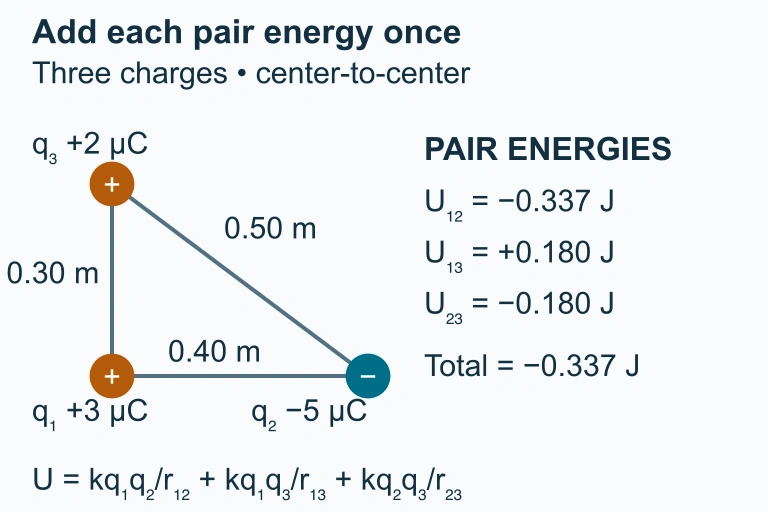
Three point charges are arranged at the vertices of a right triangle. Charge q₁ = +3.0 μC is at the origin, q₂ = −5.0 μC is 0.40 m to the right, and q₃ = +2.0 μC is 0.30 m directly above q₁. Find the total electric potential energy of the system.

Total PE of a Three-Charge Configuration

  1. 1

    Step 1 — Identify the Pairs

    For three charges, there are three unique pairs: (q₁, q₂), (q₁, q₃), and (q₂, q₃). The total potential energy is U_total = U₁₂ + U₁₃ + U₂₃.
  2. 2

    Step 2 — Determine Distances

    r₁₂ = 0.40 m (horizontal separation). r₁₃ = 0.30 m (vertical separation). r₂₃ = √(0.40² + 0.30²) = √(0.16 + 0.09) = √0.25 = 0.50 m (hypotenuse of the right triangle).
    r₁₂ = 0.40 m, r₁₃ = 0.30 m, r₂₃ = 0.50 m
  3. 3

    Step 3 — Calculate U₁₂

    U₁₂ = k q₁ q₂ / r₁₂ = (8.99 × 10⁹)(+3.0 × 10⁻⁶)(−5.0 × 10⁻⁶) / 0.40 = (8.99 × 10⁹)(−1.5 × 10⁻¹¹) / 0.40 = −0.1349 / 0.40
    U₁₂ = −0.337 J
  4. 4

    Step 4 — Calculate U₁₃

    U₁₃ = k q₁ q₃ / r₁₃ = (8.99 × 10⁹)(+3.0 × 10⁻⁶)(+2.0 × 10⁻⁶) / 0.30 = (8.99 × 10⁹)(6.0 × 10⁻¹²) / 0.30 = 0.05394 / 0.30
    U₁₃ = +0.180 J
  5. 5

    Step 5 — Calculate U₂₃

    U₂₃ = k q₂ q₃ / r₂₃ = (8.99 × 10⁹)(−5.0 × 10⁻⁶)(+2.0 × 10⁻⁶) / 0.50 = (8.99 × 10⁹)(−1.0 × 10⁻¹¹) / 0.50 = −0.0899 / 0.50
    U₂₃ = −0.180 J
  6. 6

    Step 6 — Sum All Pairs

    U_total = U₁₂ + U₁₃ + U₂₃ = (−0.337) + (+0.180) + (−0.180) = −0.337 J. The total potential energy is negative, indicating that this configuration is bound — external energy would need to be supplied to completely separate all three charges to infinity.
    U_total ≈ −0.34 J

3–4–5 geometry, q 1=+3 µC q 2=−5 µC q 3=+2 µC; pair energies −0.337, +0.180, −0.180 J; total −0.337 J.The assembly energy is the sum of the three unique signed pair energies for the chosen right-triangle configuration.

SECTION 7

Strengths, Limitations & Common Pitfalls

StrengthsLimitations
Scalar quantity — no vector decomposition needed when summing pair-wise contributions.Only valid for electrostatic situations; moving charges create magnetic fields that alter the energy landscape.
Directly connects to conservation of energy, enabling prediction of speeds and trajectories.The point-charge formula breaks down for extended charge distributions unless integration is used.
Sign of U conveys physical meaning: binding vs. repulsion.Students often confuse electric potential energy (U) with electric potential (V). U is energy (joules); V is energy per unit charge (volts).
Closely analogous to gravitational PE, leveraging prior conceptual understanding.The analogy breaks down because gravity is always attractive, while electric PE can be repulsive.

Strengths and limitations of the point-charge potential energy model

⚠

COMMON AP EXAM PITFALL

Do not forget to include the signs of the charges when computing U = kq₁q₂/r. Treating all charges as positive magnitudes is the single most common error on free-response questions involving potential energy. The sign of U is determined by the product q₁q₂, not by a separate rule you must memorize.
✦

KEY TAKEAWAY

In engineering, understanding electric potential energy is essential for designing capacitors, particle accelerators, and semiconductor devices. Just as a civil engineer must account for gravitational PE when designing a dam, an electrical engineer must track how energy is stored and released in charge configurations. The scalar nature of U is a computational gift — while force problems in two dimensions require component analysis, energy calculations reduce to simple addition of signed terms.

SECTION 8

Connection to Advanced Topics

The electric potential energy concepts you master in AP Physics 2 form the foundation for more advanced treatments in upper-division physics and engineering. In electricity and magnetism courses at the university level, you will encounter the idea that energy is stored not merely in the configuration of charges but in the electric field itself. The energy density of an electric field is given by u = ½ε₀E², where ε₀ is the permittivity of free space and E is the field magnitude. This perspective shifts from discrete particles to continuous fields and is essential for understanding electromagnetic waves, which carry energy through space.

AP Physics 2 TreatmentAdvanced / University Treatment
U = kq₁q₂/r for point chargesU = ∫ρV dτ for continuous distributions (volume integral over charge density)
ΔU = qEd for uniform fieldsU = ½ε₀∫E² dτ (energy stored in the field itself)
Conservation of energy: K + U = constantPoynting vector S = (1/μ₀)E × B describes energy flow in electromagnetic fields
Capacitor energy: U = ½CV²Energy stored in dielectrics, self-energy of charge distributions, renormalization in quantum electrodynamics

How electric potential energy concepts evolve beyond AP Physics 2

For now, the key skill is mastering the algebra-based treatment: computing U for point-charge systems, applying conservation of energy, and distinguishing between U (energy of the system) and V (energy per unit charge at a point). These conceptual distinctions will serve as anchors when the mathematics becomes more sophisticated in later coursework.

SECTION 9

Practice Problems

Question 1: CONCEPTUAL

A positive charge and a negative charge are held at rest, separated by distance d. When released, both charges accelerate toward each other. Which statement best describes the energy transformation? A. Electric potential energy increases while kinetic energy decreases. B. Electric potential energy decreases while kinetic energy increases. C. Electric potential energy remains constant while kinetic energy increases. D. Both electric potential energy and kinetic energy increase.
  • A. Electric potential energy increases while kinetic energy decreases.
  • B. Electric potential energy decreases while kinetic energy increases.
  • C. Electric potential energy remains constant while kinetic energy increases.
  • D. Both electric potential energy and kinetic energy increase.
Show answer (B)
B is correct. The system of opposite charges has negative potential energy that becomes more negative (decreases) as the charges approach each other, because U = kq₁q₂/r becomes more negative as r decreases when q₁q₂ < 0. By conservation of energy, the decrease in potential energy equals the increase in kinetic energy. A is wrong because attractive charges accelerating toward each other gain KE, not lose it. C is wrong because energy conservation requires ΔU + ΔK = 0, so U cannot remain constant if K changes. D is wrong because total energy is conserved — both cannot increase simultaneously without an external energy source.

Question 2: BASIC CALCULATION

Two protons (each q = +1.6 × 10⁻¹⁹ C) are separated by 5.0 × 10⁻¹⁰ m. What is the electric potential energy of this system? (k = 8.99 × 10⁹ N·m²/C²) A. −4.6 × 10⁻¹⁹ J B. +4.6 × 10⁻¹⁹ J C. +2.3 × 10⁻¹⁹ J D. +4.6 × 10⁻¹⁰ J
  • A. −4.6 × 10⁻¹⁹ J
  • B. +4.6 × 10⁻¹⁹ J
  • C. +2.3 × 10⁻¹⁹ J
  • D. +4.6 × 10⁻¹⁰ J
Show answer (B)
B is correct. U = kq₁q₂/r = (8.99 × 10⁹)(1.6 × 10⁻¹⁹)² / (5.0 × 10⁻¹⁰) = (8.99 × 10⁹)(2.56 × 10⁻³⁸) / (5.0 × 10⁻¹⁰) = (2.30 × 10⁻²⁸) / (5.0 × 10⁻¹⁰) = 4.6 × 10⁻¹⁹ J. The result is positive because both charges are positive (q₁q₂ > 0), indicating repulsion. A is wrong because like charges produce positive, not negative, potential energy. C is wrong — it represents a computational error (dividing by 10 instead of 5). D is wrong by nine orders of magnitude, likely from an exponent error in the denominator.

Question 3: INTERMEDIATE

Three identical charges of +4.0 μC are placed at the corners of an equilateral triangle with side length 0.20 m. What is the total electric potential energy of the system? A. 0.72 J B. 1.08 J C. 2.16 J D. 0.36 J
  • A. 0.72 J
  • B. 1.08 J
  • C. 2.16 J
  • D. 0.36 J
Show answer (C)
C is correct. There are 3 unique pairs, each with the same separation r = 0.20 m and the same charge product: U_pair = kq²/r = (8.99 × 10⁹)(4.0 × 10⁻⁶)²/(0.20) = (8.99 × 10⁹)(1.6 × 10⁻¹¹)/0.20 = 0.14384/0.20 = 0.719 J. Total U = 3 × 0.719 = 2.16 J. A (0.72 J) corresponds to only one pair — a common error of forgetting to sum all three pairs. B (1.08 J) would result from counting only 1.5 pairs. D (0.36 J) results from using the wrong exponent for the charge (e.g., using 2.0 μC instead of 4.0 μC, halving each pair's contribution).

Question 4: APPLIED

4 pts
A student wants to experimentally verify that the electric potential energy between two charged spheres varies inversely with their separation distance. The student has access to two small conducting spheres on insulating stands, a Van de Graaff generator, an electroscope, a ruler, and a force sensor. (a) Describe a procedure the student could follow to collect data relating electric potential energy to separation distance. (b) State what quantities should be measured and how they would be recorded. (c) Describe how the collected data should be analyzed to test the 1/r relationship. (d) Identify one significant source of experimental error and explain how it would affect the results.
Show answer
Rubric (4 points): Point 1 — Procedure (a): Charge both spheres identically using the Van de Graaff generator (touch each to the generator in sequence). Place them on the insulating stands at a known separation distance. Use the force sensor to measure the electrostatic force at multiple separation distances (e.g., 5, 10, 15, 20, 25 cm). Since direct measurement of U is not feasible, use F(r) data and the relationship U = ∫F·dr (or equivalently, compute W = F·Δr for small increments) to infer how U depends on r. Point 2 — Measured quantities (b): Record center-to-center separation distance r (in meters, using the ruler) and the electric force F (in newtons, from the force sensor) at each separation. Create a data table with columns for r, F, and 1/r. Multiple trials at each distance reduce random error. Point 3 — Data analysis (c): Since F ∝ 1/r² and U ∝ 1/r, plot F versus 1/r². A linear graph through the origin confirms Coulomb's law. Alternatively, compute U at each r by numerically integrating F(r)·dr from infinity (approximated by the largest r) inward, then plot U versus 1/r. A linear fit through the origin would confirm the 1/r dependence of potential energy. Point 4 — Source of error (d): Charge leakage from the conducting spheres into the surrounding air is a significant error source. Over time, the spheres lose charge to the environment, so force measurements taken later will be systematically lower than expected. This would cause the inferred potential energy to appear smaller at larger separations (measured later in time), distorting the 1/r relationship and making the curve fall off faster than predicted.

Question 5: CRITICAL THINKING

4 pts
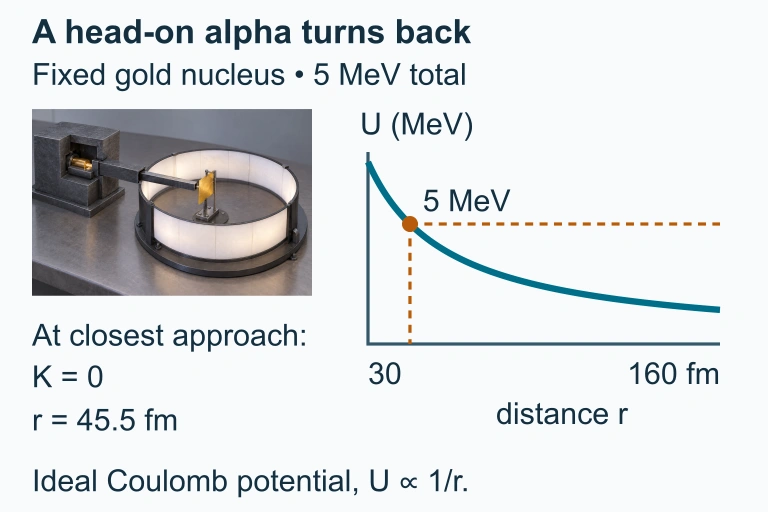
An alpha particle (charge +2e, mass 6.64 × 10⁻²⁷ kg) is launched directly toward a gold nucleus (charge +79e) with an initial kinetic energy of 5.0 MeV from very far away. The gold nucleus is so massive that it can be considered stationary. (a) Determine the distance of closest approach of the alpha particle to the gold nucleus. (b) At the distance of closest approach, what is the electric potential energy of the system? (c) Explain physically why the alpha particle stops momentarily and then reverses direction. (d) If the initial kinetic energy were doubled to 10.0 MeV, would the distance of closest approach be halved? Justify your answer.
Show answer
Rubric (4 points): Point 1 — Distance of closest approach (a): At closest approach, all kinetic energy has been converted to electric potential energy. Using conservation of energy: KiK_i + UiU_i = KfK_f + UfU_f. Since UiU_i ≈ 0 (starts far away) and KfK_f = 0 (momentarily at rest): KiK_i = UfU_f = k(2e)(79e)/r_min. So r_min = k(2)(79)e²/KiK_i = (8.99 × 10⁹)(158)(1.6 × 10⁻¹⁹)² / (5.0 × 10⁶ × 1.6 × 10⁻¹⁹) = (8.99 × 10⁹)(158)(2.56 × 10⁻³⁸) / (8.0 × 10⁻¹³) = (3.637 × 10⁻²⁶) / (8.0 × 10⁻¹³) = 4.55 × 10⁻¹⁴ m ≈ 45.5 fm. Point 2 — Electric PE at closest approach (b): At r_min, U = KiK_i = 5.0 MeV = 8.0 × 10⁻¹³ J. All initial kinetic energy has been stored as electric potential energy. Point 3 — Physical explanation (c): As the positively charged alpha particle approaches the positively charged gold nucleus, it experiences an increasingly strong repulsive Coulomb force that decelerates it. The kinetic energy is continuously converted into electric potential energy. At closest approach, all kinetic energy has been transferred to potential energy and the particle is momentarily at rest. The repulsive force then accelerates the alpha particle back outward, converting potential energy back to kinetic energy. Point 4 — Doubling KE (d): Yes, the distance of closest approach would be exactly halved. Since r_min = k(2)(79)e²/KiK_i, the relationship is r_min ∝ 1/KiK_i. Doubling KiK_i doubles the denominator, so r_min is halved to approximately 22.7 fm. This inverse proportionality is a direct consequence of U ∝ 1/r: to store twice the energy at closest approach, the particle must penetrate to half the distance.Head-on 5 MeV alpha reaches U=5 MeV at r≈45.5 fm; U proportional to 1/r.A head-on 5 MeV alpha particle reaches a closest approach of about 45.5 fm in the ideal fixed-gold Coulomb model, where its kinetic energy becomes zero.

SUMMARY

Summary

Summary

Electric potential energy is the energy stored in a system of charges by virtue of their spatial arrangement. For two point charges, it is given by U = kq₁q₂/r, where the signs of the charges are included algebraically. The sign of U carries physical meaning: positive for like-charge (repulsive) configurations and negative for opposite-charge (attractive, bound) configurations. The standard reference point is U = 0 at infinite separation.

For systems of multiple charges, the total potential energy is the algebraic sum of all unique pair-wise contributions — a significant computational advantage because U is a scalar. The work–energy theorem connects potential energy to dynamics: W_electric = −ΔU, so a decrease in U corresponds to positive work done by the electric force and an increase in kinetic energy. In a uniform electric field, the change in potential energy simplifies to ΔU = qEd, analogous to mgh in gravity. Mastering these relationships is essential for AP Physics 2 topics including capacitors, circuits, and particle dynamics in electric fields.

Varsity Tutors • AP Physics 2: Algebra-Based • Electric Potential Energy