
SECTION 1
Historical Context & Motivation
The study of electricity began long before scientists understood atoms. Ancient Greeks observed that rubbing amber on fur allowed it to attract small objects—a phenomenon they called elektron after the Greek word for amber. For centuries, this curiosity remained unexplained. It was not until systematic experimentation in the 18th century that natural philosophers began to formulate quantitative rules governing electric charge, ultimately revealing one of the most fundamental conservation laws in physics.
1733 • Two Kinds of Charge
1747 • Franklin's Conservation Principle
1785 • Coulomb's Law
1897 • Discovery of the Electron
From Franklin's insight to Thomson's discovery, a central question persisted: if charge can move between objects, what ensures that the total charge of an isolated system never changes? The answer lies in the law of conservation of electric charge, and the three physical mechanisms—friction, conduction, and induction—by which charge is redistributed without ever being created or annihilated.
SECTION 2
Core Principles & Definitions
Before exploring the mechanisms of charging, it is essential to ground yourself in the foundational ideas. Charge is a fundamental property of matter, quantized at the level of the elementary charge e = 1.6 × 10⁻¹⁹ C. In every physical process—from rubbing a balloon on your hair to pair production in particle physics—the net charge of an isolated system remains constant. The following grid summarizes the core principles you must master for the AP exam.
Conservation of Charge
Quantization of Charge
Conductors vs. Insulators
Three Charging Methods
Grounding
SECTION 3
Visualizing the Three Charging Methods
Notice the conservation check at the bottom of the diagram. Regardless of which mechanism is used, the algebraic sum of all charges in the isolated system remains unchanged. In friction, both objects start neutral (total charge = 0), and end with equal-and-opposite charges (total charge still = 0). In conduction, the total charge of the two objects before contact equals the total charge after. In induction with grounding, the Earth serves as the external charge reservoir—charge is conserved within the larger system that includes the Earth.
SECTION 4
Mathematical Framework
The conservation of charge is expressed mathematically in two ways: a global statement for isolated systems and a local continuity equation used in more advanced treatments. For AP Physics 2, you need the global form and the quantization condition.
CONSERVATION OF CHARGE
The total net charge of an isolated system remains constant. If two objects interact, q1i + q2i = q1f + q2f.
QUANTIZATION OF CHARGE
Here e = 1.6 × 10⁻¹⁹ C is the elementary charge, and n is an integer. The charge on any macroscopic object is always an integer multiple of e.
CONDUCTION BETWEEN IDENTICAL CONDUCTORS
When two identical conducting spheres are brought into contact, charge redistributes equally. Each sphere ends with half the total initial charge. For non-identical conductors the final charges depend on geometry, but the total is still conserved.
SECTION 5
Detailed Breakdown of Charging Processes
Charging by Friction (Triboelectric Effect)
When two different insulating materials are rubbed together, electrons transfer from the material that holds them less tightly to the one that holds them more tightly. The triboelectric series ranks materials by their tendency to gain or lose electrons. For instance, glass tends to lose electrons (becoming positive) when rubbed with silk, while rubber tends to gain electrons (becoming negative) when rubbed with fur. Both objects start electrically neutral, so the total charge of the system remains zero throughout the process—one object gains exactly as many electrons as the other loses.
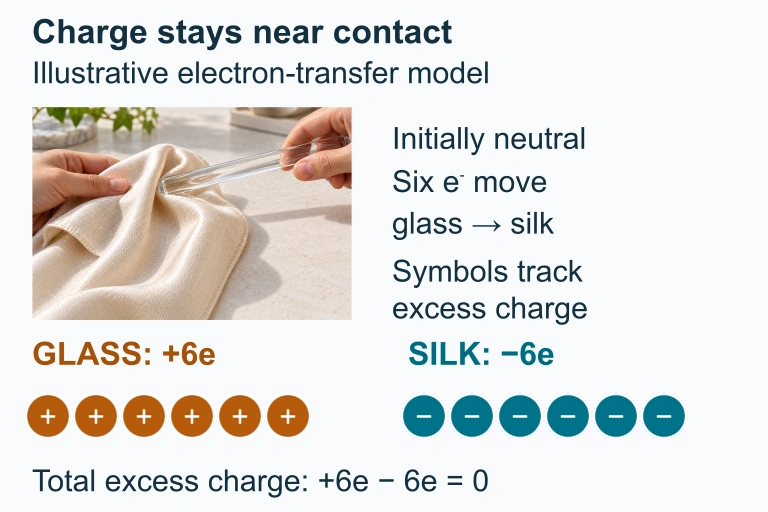 In this illustrative electron-transfer model, six electron units transfer from glass to silk, leaving equal and opposite excess charges; the ionic background is fixed in the model.
Charging by Conduction
Charging by conduction requires direct physical contact between a charged object and a conductor. Upon contact, excess charge flows from the charged object to the neutral conductor until electrostatic equilibrium is reached. Both objects end up with the same sign of charge. If the two conductors are identical in size and shape, the charge divides equally between them. For conductors of different sizes, the larger conductor acquires a greater share of the total charge because it has a larger surface area over which the charge distributes.
Charging by Induction
Induction allows a conductor to be charged without contact. A charged object is brought near (but not touching) a neutral conductor, polarizing it by attracting opposite charges toward the near side and repelling like charges to the far side. While polarized, the conductor is grounded—a conducting path to Earth is established—allowing the repelled charges to escape. When the ground connection is removed and then the inducing charge is taken away, the conductor retains a net charge opposite in sign to the original charged object. The 'lost' charges now reside on Earth, so the total charge of the conductor-plus-Earth system is still conserved.
 Electrons move during charging; protons remain in the material. Contact between identical isolated spheres shares their total charge, while charging by induction depends on the order in which grounding and the nearby rod are removed.
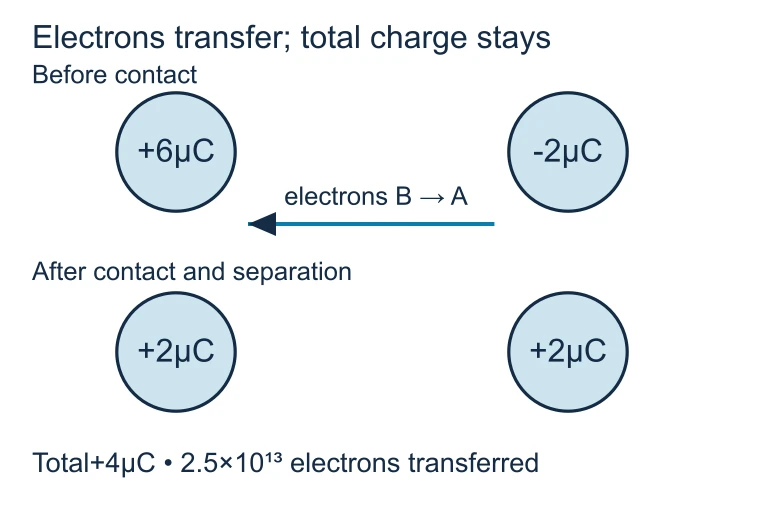 Identical isolated spheres with +6 μC and −2 μC share their total +4 μC equally after contact. Both end at +2 μC; 2.5 × 10¹³ electrons transfer from the initially negative sphere to the positive sphere.
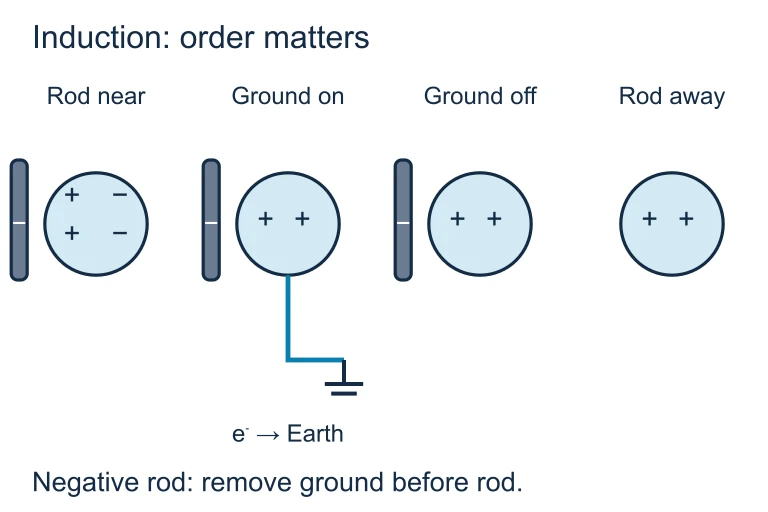 Bring a negative rod near a conductor, then ground the conductor so electrons can leave. Remove the ground while the rod remains nearby, and only then remove the rod; the conductor retains positive charge.
SECTION 6
Worked Example
Worked example
- 1
Step 1 — Identify Given Values
Sphere A has charge qA = +6.0 μC. Sphere B has charge qB = −2.0 μC. Both spheres are identical conducting spheres. - 2
Step 2 — State the Conservation Principle
By the conservation of electric charge, the total charge of the system before contact must equal the total charge after contact. Total initial charge: qtotal = +6.0 μC + (−2.0 μC) = +4.0 μC.qtotal = +4.0 μC - 3
Step 3 — Apply the Equal-Sharing Condition
Because the spheres are identical, charge distributes equally upon contact. Each sphere receives half of the total charge: qf = qtotal / 2 = +4.0 μC / 2 = +2.0 μC.qf = +2.0 μC per sphere - 4
Step 4 — Verify Conservation
After separation: +2.0 μC + +2.0 μC = +4.0 μC. This matches the initial total, confirming charge is conserved. Notice that Sphere B has switched from negative to positive—charge was transferred from A to B during contact. - 5
Step 5 — Find the Number of Electrons Transferred
Sphere B went from −2.0 μC to +2.0 μC, a change of Δq = +4.0 μC = +4.0 × 10⁻⁶ C. This means electrons left Sphere B. The number of electrons transferred is n = |Δq| / e = 4.0 × 10⁻⁶ / 1.6 × 10⁻¹⁹ = 2.5 × 10¹³ electrons.n = 2.5 × 10¹³ electrons transferred from B to A
SECTION 7
Comparing the Charging Methods
| Feature | Friction | Conduction | Induction |
|---|---|---|---|
| Contact required? | Yes (rubbing) | Yes (touching) | No (proximity + grounding) |
| Works on | Insulators (typically) | Conductors | Conductors |
| Sign of acquired charge | Depends on triboelectric ranking | Same as source | Opposite to inducing object |
| Source charge affected? | Yes—both objects change | Yes—source loses charge | No—inducing object unchanged |
| Practical use | Static cling, Van de Graaff belt | Electroscope testing | Electrostatic generators, capacitor charging |
Comparison of Charging Methods
SECTION 8
Connections to Advanced Theory
Charge conservation is not merely a convenient empirical rule—it is a deep consequence of symmetry in nature. In advanced physics, Noether's theorem establishes that every continuous symmetry of the laws of physics implies a conserved quantity. Charge conservation arises from gauge symmetry in electromagnetism—specifically, the invariance of Maxwell's equations under local phase transformations of the electromagnetic potential. This connection will become relevant if you study E&M at the university level.
| Aspect | AP Physics 2 Treatment | University / Advanced Treatment |
|---|---|---|
| Conservation statement | Σq_initial = Σq_final for isolated systems | Continuity equation: ∂ρ/∂t + ∇·J = 0 |
| Charge carriers | Electrons (and protons conceptually) | All leptons, quarks with fractional charge (⅓e, ⅔e) |
| Scope | Electrostatics and circuits | Particle physics, relativistic fields, pair production/annihilation |
| Theoretical basis | Empirical law | Noether's theorem + gauge invariance |
AP vs. Advanced Treatment of Charge Conservation
Even in particle physics processes like pair production (where a photon creates an electron and a positron), charge conservation holds: the photon has zero charge, and the electron (−e) plus positron (+e) sum to zero. The principle you learn now in AP Physics 2 is exactly the same principle that constrains the most exotic particle interactions in the Standard Model.
SECTION 9
Practice Problems
Question 1: CONCEPTUAL
- A. Protons are transferred from the silk to the glass rod.
- B. Electrons are transferred from the glass rod to the silk.
- C. Positive charge is created on the glass rod by the friction.
- D. Neutrons are removed from the glass rod, leaving excess protons.
Show answer (B)
Question 2: BASIC CALCULATION
- A. +4.0 μC and −4.0 μC
- B. +6.0 μC and −2.0 μC
- C. +2.0 μC on each sphere
- D. +8.0 μC and 0 μC
Show answer (C)
Question 3: INTERMEDIATE
- A. The sphere is negatively charged; charging by induction.
- B. The sphere is positively charged; charging by induction.
- C. The sphere is negatively charged; charging by conduction.
- D. The sphere remains neutral because the rod never touched it.
Show answer (A)
Question 4: APPLIED
Show answer
Question 5: CRITICAL THINKING