

SECTION 1
Historical Context & Motivation
By the late nineteenth century, physicists had developed powerful theories of electromagnetism and thermodynamics that appeared to explain virtually every observed phenomenon. Yet one stubborn problem defied all classical treatments: the spectrum of light emitted by a blackbody—an idealized object that absorbs all incident electromagnetic radiation and re-emits energy in a characteristic pattern that depends only on its temperature. Experimental measurements of this emission spectrum revealed a smooth, peaked curve that shifted toward shorter wavelengths as the temperature increased, but the best theoretical models of the era predicted physically absurd results at short wavelengths, a failure so dramatic it earned its own name: the ultraviolet catastrophe. Resolving this crisis required a radical new idea—the quantization of energy—that would ultimately give birth to quantum mechanics.
1859 • Kirchhoff's Challenge
1893 • Wien's Displacement Law
1900 • Rayleigh–Jeans Law & Ultraviolet Catastrophe
1900 • Planck's Quantum Hypothesis
1905 • Einstein Extends Quantization
The central question that drives this lesson is deceptively simple: Why does a hot object glow with a particular color at a particular temperature, and why did classical physics fail to predict the correct spectrum? Understanding the answer connects thermal physics, electromagnetism, and the birth of the quantum theory that underpins nearly every topic in Modern Physics on the AP Physics 2 exam.
SECTION 2
Core Principles & Definitions
Before diving into the mathematics, it is essential to establish the foundational ideas that govern blackbody radiation. These principles connect thermodynamics, electromagnetism, and quantum mechanics in a single physical context, and each one plays a direct role in explaining why Planck's quantum hypothesis succeeded where classical physics failed.
Blackbody as Ideal Absorber–Emitter
Continuous Emission Spectrum
Wien's Displacement Law
Stefan–Boltzmann Law
Energy Quantization
KEY TAKEAWAY
SECTION 3
Blackbody Spectrum — Visual Explanation
The most important visual in blackbody radiation is the spectral radiance curve—a plot of intensity (spectral radiance) versus wavelength at various temperatures. Each curve rises steeply, peaks at a wavelength determined by Wien's law, and falls off gradually toward longer wavelengths. The diagram below shows Planck curves for three temperatures alongside the Rayleigh–Jeans prediction to illustrate the ultraviolet catastrophe.
Several features of the diagram deserve careful attention. First, notice that each curve is asymmetric: the rise on the short-wavelength side is steep, while the falloff on the long-wavelength side is gradual. Second, the total area under each curve—proportional to the total radiated power—grows dramatically with temperature, consistent with the Stefan–Boltzmann law's T⁴ dependence. Third, the dashed Rayleigh–Jeans curve fits the actual Planck curve only in the long-wavelength tail; at shorter wavelengths it climbs without bound, predicting infinite energy output. This visual makes the failure of classical physics immediately apparent: no physical object can radiate infinite energy, so the classical model was clearly missing something fundamental.
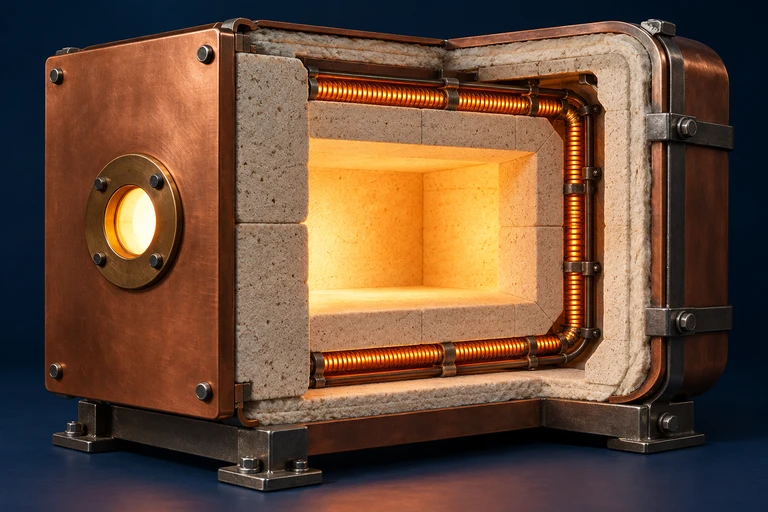 A blackbody emits a broad spectrum. As temperature increases, the peak of Bλ moves to shorter wavelength and total emitted power per area grows as T⁴.
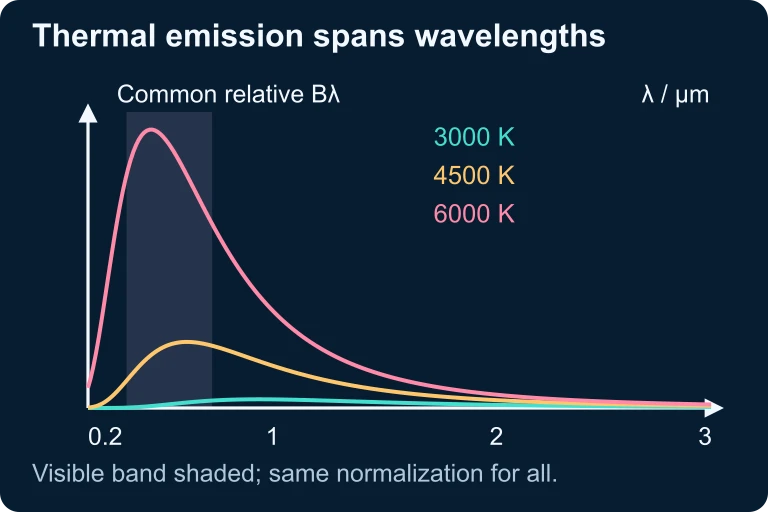 A blackbody emits a broad spectrum. As temperature increases, the peak of Bλ moves to shorter wavelength and total emitted power per area grows as T⁴.
SECTION 4
Mathematical Framework
The AP Physics 2 exam does not require you to derive Planck's full spectral distribution, but you are expected to use three key equations and understand the physical reasoning behind quantization. The equations below form a complete toolkit for analyzing blackbody radiation at the algebra-based level.
WIEN'S DISPLACEMENT LAW
λmax = peak wavelength (m); b = Wien's displacement constant = 2.898 × 10⁻³ m·K; T = absolute temperature (K). This equation gives the wavelength at which a blackbody emits most intensely.
STEFAN–BOLTZMANN LAW
P = total radiated power (W); A = surface area (m²); σ = Stefan–Boltzmann constant = 5.67 × 10⁻⁸ W·m⁻²·K⁻⁴; T = absolute temperature (K). This law governs the total energy output integrated over all wavelengths.
PLANCK'S ENERGY QUANTUM
E = energy of one quantum (J); h = Planck's constant = 6.63 × 10⁻³⁴ J·s; f = frequency (Hz); c = speed of light = 3.00 × 10⁸ m/s; λ = wavelength (m). This is the foundational relationship that resolved the ultraviolet catastrophe: energy is emitted and absorbed in discrete packets of size hf.
Why Quantization Fixes the Problem
POWER RATIO (USEFUL FOR COMPARISONS)
When comparing two blackbodies of the same surface area, this ratio form of the Stefan–Boltzmann law is especially convenient. If one object is twice as hot as another, it radiates 2⁴ = 16 times as much power per unit area.
SECTION 5
The Electromagnetic Spectrum & Blackbody Color
An ideal blackbody's apparent color depends on its full visible spectrum and the observer's color response. Wien's law locates the maximum of a specified spectral distribution; that wavelength alone does not determine appearance. A cooler star can peak in infrared while its visible light appears reddish, and a hot star can peak in ultraviolet while appearing blue-white. Color and spectral measurements help determine stellar temperatures.
Electromagnetic Spectrum and Blackbody Peak Positions
The diagram above illustrates a common misconception worth addressing: the Sun's peak wavelength falls near 500 nm (green), yet we perceive the Sun as white or yellowish-white. This is because the Sun emits significantly across the entire visible range, and our eyes integrate all those wavelengths. The peak wavelength tells us where the most energy is emitted per unit wavelength interval—not the perceived color. On the AP exam, you should always report peak wavelength from Wien's law rather than equating it directly with apparent color.
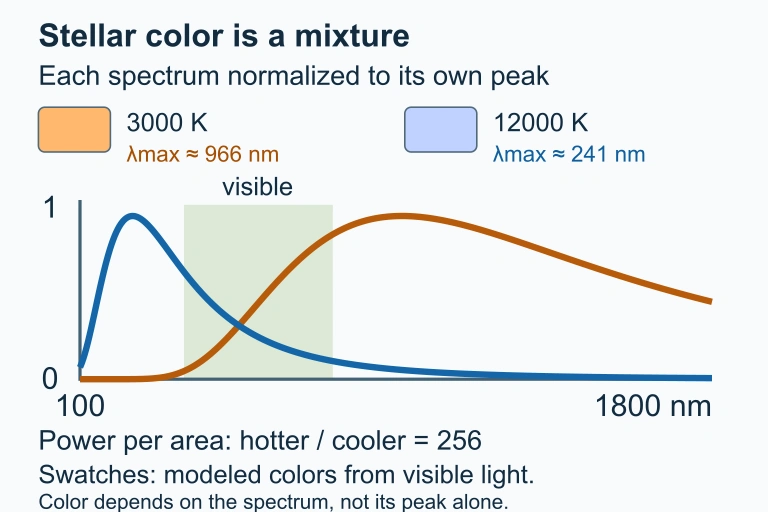 Each Planck spectrum is normalized to its own peak. Integrated visible-spectrum color samples illustrate modeled appearances for 3000 and 12000 K; they are not peak-wavelength hues. Hotter/cooler total power per area is 256. Colors use the preserved CIE 1931 2° observer and sRGB display model.
SECTION 6
Worked Example
The following worked example integrates Wien's displacement law and the Stefan–Boltzmann law in a single problem, mirroring the multi-step reasoning typical of AP Physics 2 free-response questions.
Comparing Two Stars as Blackbodies
- 1
Step 1 — Read the Problem
Star A has a surface temperature of 12 000 K and Star B has a surface temperature of 3 000 K. Both are modeled as ideal blackbodies. (a) Find the peak emission wavelength for each star. (b) Determine the ratio of power radiated per unit surface area by Star A to Star B. - 2
Step 2 — Identify Known Values & Equations
TA = 12 000 K, TB = 3 000 K, Wien's constant b = 2.898 × 10⁻³ m·K, Stefan–Boltzmann constant σ = 5.67 × 10⁻⁸ W·m⁻²·K⁻⁴. We will use Wien's law λmax = b / T for part (a) and the ratio form PA/PB = (TA/TB)⁴ for part (b). - 3
Step 3 — Calculate Peak Wavelengths
For Star A: λmax,A = (2.898 × 10⁻³ m·K) / (12 000 K) = 2.415 × 10⁻⁷ m = 241.5 nm. This falls in the ultraviolet range. For Star B: λmax,B = (2.898 × 10⁻³ m·K) / (3 000 K) = 9.66 × 10⁻⁷ m = 966 nm. This falls in the near infrared, so Star B appears reddish.λ_max,A = 241.5 nm (UV) ; λ_max,B = 966 nm (IR) - 4
Step 4 — Calculate Power Ratio
PA/A ÷ PB/A = (TA / TB)⁴ = (12 000 / 3 000)⁴ = 4⁴ = 256. Star A radiates 256 times more power per unit area than Star B./ = 256 (per unit area) - 5
Step 5 — Interpret Results
Star A, being four times hotter, peaks deep in the ultraviolet and would appear blue-white to the human eye, while Star B peaks in the infrared and appears red. The Stefan–Boltzmann law's T⁴ dependence means that even a modest factor-of-four temperature difference translates into a 256-fold difference in radiated power per unit area—this is why hot O-type stars are so much more luminous than cool M-type stars of comparable size.
SECTION 7
Classical vs. Quantum Predictions
One of the most instructive aspects of blackbody radiation is that it provides a direct, side-by-side comparison of classical and quantum physics applied to the same physical system. The table below highlights the key differences between the Rayleigh–Jeans classical approach and Planck's quantum treatment, along with Wien's empirical approximation, which works at short wavelengths but fails at long ones.
| Feature | Rayleigh–Jeans (Classical) | Planck's Law (Quantum) |
|---|---|---|
| Energy assumption | Continuous — each mode carries average energy kT | Quantized — energy of each mode comes in packets of hf |
| Short-wavelength behavior | Diverges to infinity (ultraviolet catastrophe) | Correctly drops to zero — exponential suppression via e⁻ʰᶠ/ᵏᵀ |
| Long-wavelength behavior | Matches experimental data well | Also matches — reduces to Rayleigh–Jeans in this limit |
| Total radiated power | Infinite (integral diverges) | Finite, yields Stefan–Boltzmann law (σT⁴) |
| Peak prediction | No peak — intensity grows without bound as λ → 0 | Correct peak position consistent with Wien's displacement law |
| Historical significance | Demonstrated a fundamental limit of classical physics | Launched quantum theory; first evidence that energy is quantized |
Comparison of classical and quantum approaches to blackbody radiation
KEY TAKEAWAY
SECTION 8
Connections to Advanced Theory & Applications
Blackbody radiation is not merely a historical curiosity—it remains central to modern physics and technology. Planck's quantum hypothesis was the seed from which quantum mechanics grew, and blackbody concepts appear in contexts ranging from astrophysics to climate science to semiconductor design. The table below connects blackbody radiation to several topics you may encounter in AP Physics 2 and beyond.
| Blackbody Concept | Advanced Connection |
|---|---|
| E = hf (Planck's quantization) | Photoelectric effect (AP Physics 2), Bohr model, quantum electrodynamics |
| Wien's displacement law | Stellar classification, exoplanet detection, thermal imaging technology |
| Stefan–Boltzmann law (σT⁴) | Stellar luminosity, Earth's energy balance / climate models, radiative heat transfer |
| Cavity radiation spectrum | Cosmic Microwave Background radiation (CMB) at T ≈ 2.725 K — the most perfect blackbody ever measured |
| Ultraviolet catastrophe / correspondence | Motivates the transition from classical to quantum statistical mechanics |
How blackbody radiation connects to topics in AP Physics 2 and beyond
AP Exam Tip
Looking beyond AP Physics 2, Planck's constant h appears in virtually every equation of quantum mechanics—from the de Broglie wavelength (λ = h/p) to the Heisenberg uncertainty principle (ΔxΔp ≥ h/4π). The blackbody radiation problem was where this universal constant first emerged, making it one of the most consequential problems in the history of physics.
SECTION 9
Practice Problems
Question 1: CONCEPTUAL
- A. The coal and the arc emit different amounts of total energy, but peak at the same wavelength.
- B. The higher temperature of the arc shifts its peak emission wavelength to shorter (bluer) wavelengths, consistent with Wien's displacement law.
- C. The arc appears blue because it emits only blue photons, while the coal emits only red photons.
- D. The coal emits a line spectrum concentrated in the red, while the arc emits a line spectrum concentrated in the blue.
Show answer (B)
Question 2: BASIC CALCULATION
- A. 290 nm
- B. 500 nm
- C. 1 000 nm
- D. 5 800 nm
Show answer (B)
Question 3: INTERMEDIATE
- A. 2
- B. 4
- C. 8
- D. 16
Show answer (D)
Question 4: APPLIED
5 ptsShow answer
Question 5: CRITICAL THINKING
4 ptsShow answer
SUMMARY
Blackbody Radiation — Summary
Summary
A blackbody is an idealized object that absorbs all incident radiation and emits a continuous spectrum determined entirely by its temperature. Wien's displacement law (λmax = b/T) relates the peak emission wavelength to temperature, while the Stefan–Boltzmann law (P/A = σT⁴) gives the total radiated power per unit area, which scales as the fourth power of temperature. Classical physics predicted that a blackbody should radiate infinite energy at short wavelengths—the ultraviolet catastrophe.
Max Planck resolved this crisis by proposing that electromagnetic oscillators exchange energy only in discrete packets E = hf, introducing Planck's constant h = 6.63 × 10⁻³⁴ J·s. This quantization of energy suppresses high-frequency modes exponentially, producing a finite, peaked spectrum that matches experiment exactly. Blackbody radiation thus stands as the historical gateway to quantum mechanics and remains central to applications in astrophysics, climate science, and thermal engineering. For the AP Physics 2 exam, be fluent in applying Wien's law, the Stefan–Boltzmann law, and E = hf, and be prepared to explain qualitatively how quantization resolves the ultraviolet catastrophe.