01 / 21

Work in
Physics

Understand how forces transfer energy when they act over a distance: the scalar quantity \( W = Fd\cos\theta \).

AP Physics 1

What is Work?

In physics, work measures the energy transferred to or from an object when a force acts on it through a displacement. Unlike everyday language, work has a precise definition: it requires both a force and a displacement in the direction of that force.

Three Ingredients of Work

Force
A push or pull applied to the object, measured in newtons (N).
Displacement
The distance the object actually moves, measured in meters (m).
Angle
The angle \( \theta \) between the force vector and the displacement vector.

Force, Displacement, and Angle

m d (displacement) F (force)
\( \theta \)
\( F \cos \theta \)

The Work Equation

W
Work done by the force, in joules (J).
F
Magnitude of the force applied, in newtons (N).
d
Magnitude of displacement of the object, in meters (m).
θ
Angle between the force and displacement vectors.

Special Cases of \( \theta \)

\( \theta = 0^\circ \)
\( \cos 0^\circ = 1 \)
Force is parallel to displacement.
Maximum positive work: \( W = Fd \)
\( \theta = 90^\circ \)
\( \cos 90^\circ = 0 \)
Force is perpendicular to displacement.
Zero work: \( W = 0 \)
\( \theta = 180^\circ \)
\( \cos 180^\circ = -1 \)
Force opposes displacement.
Negative work: \( W = -Fd \)

Positive vs. Negative Work

Positive Work F d
\( \theta = 0^\circ, W > 0 \)
Negative Work F d
\( \theta = 180^\circ, W < 0 \)

Work as Area Under the \( F \)-\( d \) Curve

d (m) F (N) F d
\( W = F \times d \)
0

Net Work and the Work-Energy Theorem

The net work done on an object equals its change in kinetic energy. This is the Work-Energy Theorem: it links the total work from all forces to how the object speeds up or slows down.

\( W_{\text{net}} > 0 \)
Object speeds up: kinetic energy increases.
\( W_{\text{net}} < 0 \)
Object slows down: kinetic energy decreases.

Additional worked example

The following is a separate example from the long-form lesson. Its values may differ from the example already on this slide.

A child pulls a 15 kg sled across a flat, snowy field with a rope that makes a 30° angle above the horizontal. The child exerts a constant 40 N tension on the rope, and the coefficient of kinetic friction between the sled and snow is μₖ = 0.10. The sled is pulled a horizontal distance of 20 m. Find (a) the work done by the tension, (b) the work done by friction, (c) the work done by gravity, (d) the net work, and (e) the final speed if the sled starts from rest.

Show answer and explanation

Step 1 — Identify Given Values: m = 15 kg, T = 40 N, θ = 30°, d = 20 m, μₖ = 0.10, v_(i) = 0 m/s, g = 9.8 m/s². Step 2 — Work Done by Tension: W_(T) = T d cos θ = (40)(20) cos 30° = (800)(0.866). W_T = 693 J Step 3 — Find Normal Force: In the vertical direction the sled is in equilibrium: N + T sin θ − mg = 0, so N = mg − T sin θ = (15)(9.8) − (40) sin 30° = 147 − 20 = 127 N. N = 127 N Step 4 — Work Done by Friction: fₖ = μₖ N = (0.10)(127) = 12.7 N. Friction opposes displacement, so θ = 180°: W_(f) = fₖ d cos 180° = (12.7)(20)(−1). W_f = −254 J Step 5 — Work Done by Gravity and Normal Force: Both gravity (downward) and the normal force (upward) are perpendicular to the horizontal displacement. Therefore W_(g) = 0 J and W_(N) = 0 J. Step 6 — Net Work and Final Speed: Wₙₑₜ = W_(T) + W_(f) + W_(g) + W_(N) = 693 + (−254) + 0 + 0 = 439 J. By the work-energy theorem, Wₙₑₜ = ½mv² − 0, so v = √(2Wₙₑₜ/m) = √(2 × 439 / 15) = √(58.5) ≈ 7.65 m/s. W_net = 439 J, v_f ≈ 7.65 m/s
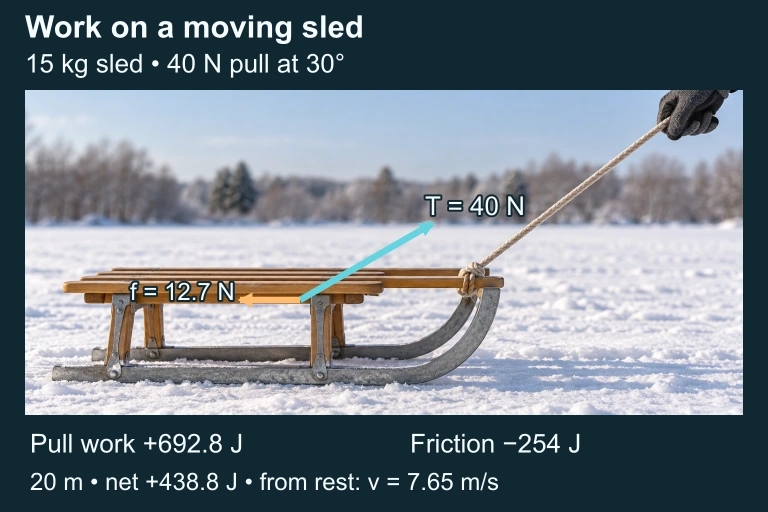
AP Physics 1 sled: m = 15 kg, pull 40 N at 30°, displacement 20 m. Pulling work is 692.8 J, friction work −254 J, net work 438.8 J and final speed 7.65 m/s from rest. Gravity and normal force do zero work on the horizontal path.

Work vs. Energy vs. Power

Work Energy Power
Definition Force acting over a distance Capacity to do work Rate of doing work
Formula \( Fd\cos\theta \) \( \frac{1}{2}mv^2 \), \( mgh \) \( \frac{W}{t} \)
Unit Joule (J) Joule (J) Watt (W)
Scalar/Vector Scalar Scalar Scalar
Can be negative? Yes KE: No Yes

How to Solve Work Problems

1
Identify the force doing the work and its magnitude \( F \).
2
Find the displacement \( d \) over which the force acts.
3
Determine the angle \( \theta \) between the force and displacement vectors.
4
Apply the formula: \( W = Fd\cos\theta \).
5
Check the sign. Positive means energy added, negative means energy removed.

Example 1: Pushing a Crate

20 kg F = 50 N d = 8 m

Example 2: Pulling at an Angle

10 kg F = 100 N
\( 30^\circ \)
d = 6 m

Example 3: Work by Friction

5 kg f = 15 N d = 10 m

Common Mistakes

✕ Forgetting \( \cos\theta \)
Using \( W = Fd \) when the force is not parallel. Always include the angle: \( W = Fd\cos\theta \).
✕ Wrong angle
Using the angle from the vertical instead of from the displacement vector. \( \theta \) is always between \( \vec{F} \) and \( \vec{d} \).
✕ Ignoring sign
Treating work as always positive. Negative work (by friction, gravity going up) is physically meaningful.

Summary of Work Concepts

Scenario \( \theta \) \( \cos\theta \) Work
Push along motion \( 0^\circ \) +1 +Fd
Pull at angle \( 0^\circ < \theta < 90^\circ \) + (fraction) + (reduced)
Carry horizontally (gravity) \( 90^\circ \) 0 0
Push against motion (brake) \( 90^\circ < \theta < 180^\circ \) - (fraction) - (reduced)
Friction / direct opposition \( 180^\circ \) -1 -Fd

Question 1 of 5

A student pushes a box with a force of 40 N over a distance of 5 m along a flat floor. The force is applied parallel to the floor. How much work is done?

Question 2 of 5

A person carries a 10 kg backpack while walking 50 m on a level path. How much work does the gravitational force do on the backpack?

Question 3 of 5

A rope pulls a sled with a force of 80 N at an angle of 60° above the horizontal over a displacement of 12 m. What is the work done by the rope?

Question 4 of 5

A 3 kg object moving at 4 m/s is brought to rest by friction over 2 m. What is the net work done on the object?

Question 5 of 5

Which of the following situations involves zero net work done on the object?