Vectors and Motion
in Two Dimensions
Master the art of breaking motion into components, adding vectors, and solving projectile motion problems with confidence.
What Is a Vector?
A vector is a quantity that has both magnitude (size) and direction. Unlike a scalar (which only has magnitude), a vector tells you not just "how much" but also "which way."
Representing Vectors Graphically
Vector Component Equations
Given a vector \(\vec{A}\) with magnitude \(A\) at angle \(\theta\) from the positive x-axis:
Adding Vectors: Tip-to-Tail Method
Place the tail of \(\vec{B}\) at the tip of \(\vec{A}\). The resultant \(\vec{R}\) goes from the tail of \(\vec{A}\) to the tip of \(\vec{B}\).
Projectile Motion: The Big Idea
A projectile is any object moving through the air under only the influence of gravity. The key insight: horizontal and vertical motions are independent.
The Core Kinematic Equations
Trajectory of a Projectile
Scalars vs Vectors: Key Distinction
| Scalar | Vector | |
|---|---|---|
| Has magnitude? | ✓ Yes | ✓ Yes |
| Has direction? | ✕ No | ✓ Yes |
| Addition rule | Arithmetic | Tip-to-tail / components |
| Example | Speed: \(5\;\text{m/s}\) | Velocity: \(5\;\text{m/s}\) east |
| Can be negative? | Only some (temp) | Components can be |
How to Solve 2D Motion Problems
Example 1: Finding Components
A ball is launched at \(v_0 = 20\;\text{m/s}\) at \(\theta = 30^\circ\) above the horizontal. Find the initial horizontal and vertical velocity components.
Example 2: Time of Flight
Using the same ball (\(v_0 = 20\;\text{m/s}\), \(\theta = 30^\circ\)), find the total time of flight if it lands at the same height it was launched.
Example 3: Range and Max Height
Still using \(v_0 = 20\;\text{m/s}\), \(\theta = 30^\circ\), \(t = 2.04\;\text{s}\). Find the range and maximum height.
\(R = 17.3 \times 2.04\)
\(R = 35.3\;\text{m}\)
\(h = v_{0y}\,t_{peak} - \frac{1}{2}g\,t_{peak}^2\)
\(h = 5.10\;\text{m}\)
Special Case: Horizontal Launch
A relief package meeting a target below a moving helicopter
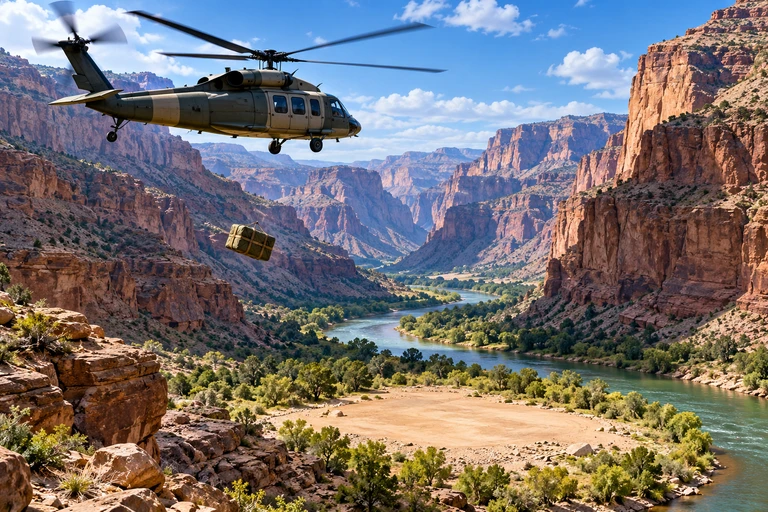 The package inherits the helicopter’s horizontal velocity at release. Gravity changes its vertical velocity while both components evolve over the same elapsed time.
Horizontal release from a helicopter
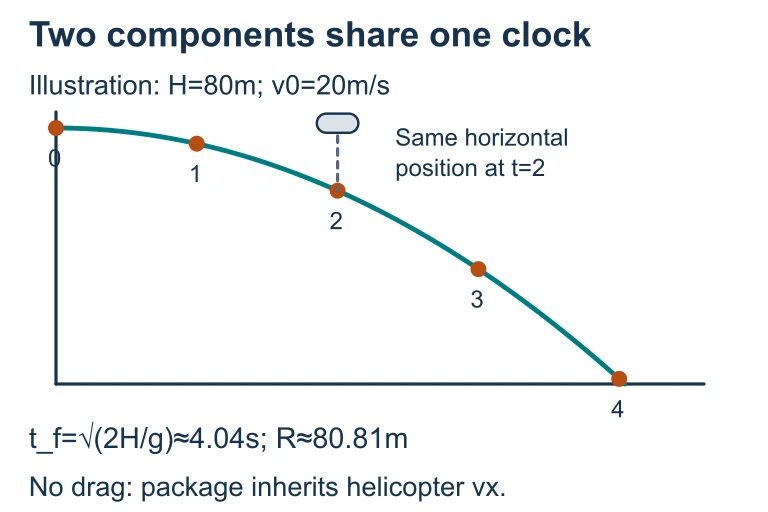 For an 80 m release height, horizontal speed 20 m/s and g = 9.8 m/s², flight time is about 4.04 s and range is about 80.81 m. Without drag, the package and helicopter retain the same horizontal velocity.
Common Mistakes to Avoid
Summary: Key Formulas at a Glance
| Quantity | Horizontal (x) | Vertical (y) |
|---|---|---|
| Acceleration | \(a_x = 0\) | \(a_y = -g\) |
| Initial velocity | \(v_0\cos\theta\) | \(v_0\sin\theta\) |
| Velocity at time \(t\) | \(v_{0x}\) (constant) | \(v_{0y} - g\,t\) |
| Position at time \(t\) | \(x_0 + v_{0x}\,t\) | \(y_0 + v_{0y}\,t - \frac{1}{2}g\,t^2\) |
| Time of flight | \(t = \dfrac{2\,v_0\sin\theta}{g}\) (same-height) | |
| Range | \(R = \dfrac{v_0^2\sin 2\theta}{g}\) (same-height) | |
Question 1 of 5
A vector has magnitude \(10\;\text{m/s}\) and points at \(60^\circ\) above the horizontal. What is its horizontal component?
Question 2 of 5
A projectile is launched at \(45^\circ\) with a speed of \(20\;\text{m/s}\). At the highest point of its trajectory, what is the vertical component of velocity?
Question 3 of 5
Two balls are released simultaneously from the same height: one is dropped straight down, the other is launched horizontally. Which hits the ground first?
Question 4 of 5
A ball is thrown horizontally at \(15\;\text{m/s}\) from a cliff that is \(80\;\text{m}\) tall. How far from the base of the cliff does it land? (Use \(g = 10\;\text{m/s}^2\))
Question 5 of 5
For a projectile launched from flat ground, at which angle is the range maximized?