Translational
Kinetic Energy
Explore the energy of motion in a straight line, master the equation \( K = \frac{1}{2}mv^2 \), and understand how mass and velocity shape the energy of moving objects.
What Is Kinetic Energy?
Every object in motion carries energy because of that motion. This kinetic energy depends on two things: how massive the object is and how fast it is moving. The faster or heavier an object, the more kinetic energy it possesses.
Energy Is a Scalar Quantity
Why Does It Matter?
Kinetic energy is central to physics because it connects force, work, and motion. The work-energy theorem states that the net work done on an object equals its change in kinetic energy. Understanding \( K \) lets you solve problems that would be very difficult with forces alone.
The Core Equation
Deriving \( K \) from Work
Quadratic Dependence on Speed
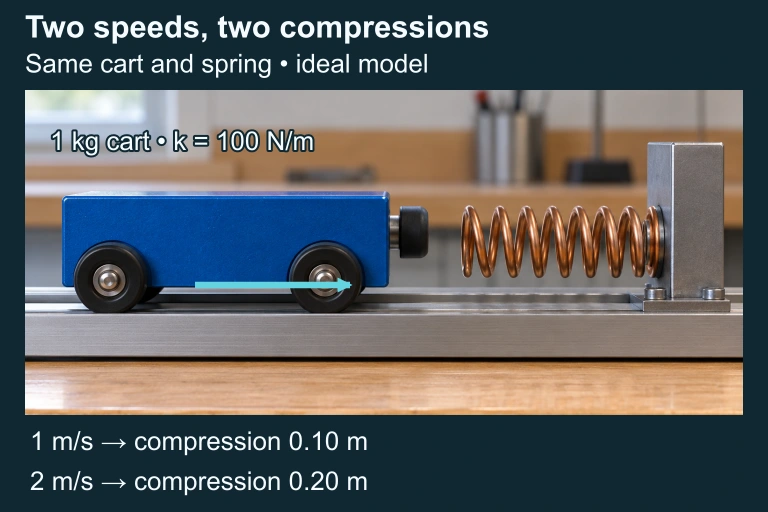
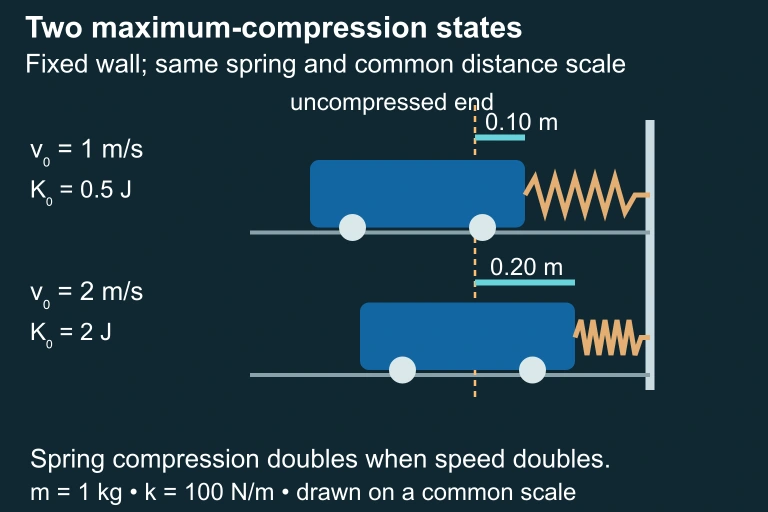
Speed and spring compression
This separate ideal-spring comparison uses the same cart at two speeds. Doubling speed quadruples kinetic energy and doubles maximum compression when all that kinetic energy becomes spring potential energy.
Kinetic vs Potential Energy
| Kinetic Energy | Potential Energy | |
|---|---|---|
| Definition | Energy of motion | Energy of position or configuration |
| Formula | \( \frac{1}{2}mv^2 \) | \( mgh \) (gravitational) |
| Depends on | Mass and speed | Mass, gravity, and height |
| Zero when | Object is at rest | At reference height (\( h = 0 \)) |
| Sign | Always \( \geq 0 \) | Can be negative (below reference) |
Translational vs Rotational
Object's center of mass moves through space. Uses mass and linear speed.
Object spins about an axis. Uses moment of inertia and angular speed.
How to Apply the Equation
Example 1: Running Athlete
A sprinter of mass \( m = 70\;\text{kg} \) runs at \( v = 10\;\text{m/s} \). Find the translational kinetic energy.
Example 2: Comparing Two Cars
Car A has mass \( 1000\;\text{kg} \) at \( 20\;\text{m/s} \). Car B has mass \( 2000\;\text{kg} \) at \( 10\;\text{m/s} \). Which has more kinetic energy?
\( = \frac{1}{2}(1000)(400) \)
= 200,000 J
\( = \frac{1}{2}(2000)(100) \)
= 100,000 J
Example 3: Work-Energy Theorem
A \( 5\;\text{kg} \) box starts at rest and is pushed with a net force until its speed reaches \( 6\;\text{m/s} \). How much net work was done on the box?
Visualizing with Energy Bar Charts
Common Mistakes to Avoid
Summary Table
| Property | Detail |
|---|---|
| Formula | \( K = \frac{1}{2}mv^2 \) |
| Type | Scalar (no direction) |
| SI Unit | Joule (J) |
| Depends on | Mass (linearly), speed (quadratically) |
| Work-Energy Theorem | \( W_{\text{net}} = \Delta K = K_f - K_i \) |
| Always | \( \geq 0 \) (zero only when at rest) |
Question 1 of 5
A 4 kg object moves at 3 m/s. What is its translational kinetic energy?
Question 2 of 5
If you triple the speed of an object while keeping its mass constant, its kinetic energy becomes:
Question 3 of 5
A 1500 kg car accelerates from rest to 20 m/s. How much net work was done on the car?
Question 4 of 5
Two objects have the same kinetic energy. Object X has twice the mass of Object Y. What is the ratio of their speeds, \( v_X / v_Y \)?
Question 5 of 5
Which statement about translational kinetic energy is false?